


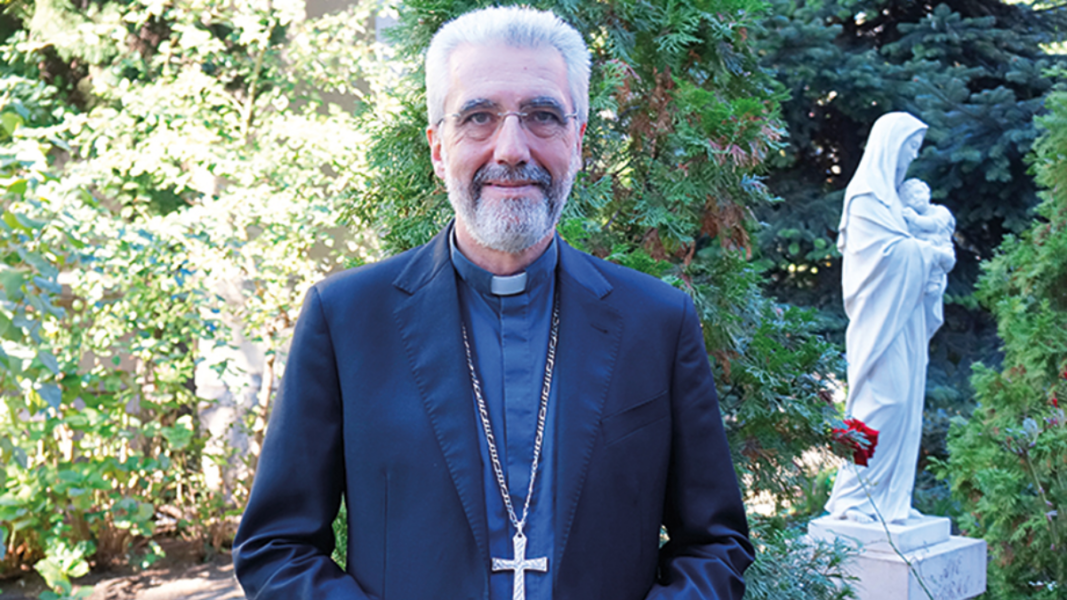
The dioceses of Huesca and Jaca celebrated a diocesan meeting last Saturday, January 17, with Monsignor Luis Marín de San Martín, undersecretary of the Synod of Bishops, to address the implementation phase of the synodal process, which, as was recalled, will culminate in the Ecclesial Assembly of October 2028 in Rome. The prelate insisted on listening, discernment, and greater participation of the laity, in addition to proposing concrete measures such as pastoral councils in all parishes, transparency, and accountability.
More than a hundred priests, religious, and laity participated in the meeting held at the Colegio Santa Rosa in Huesca, with the presence of the synodal teams from both dioceses. The day began with a prayer and a reflection by Bishop Pedro Aguado Cuesta, who emphasized that Christ must be the center of the synodal journey.
Communion, responsibility, and mission
In his intervention, Marín de San Martín presented synodality as an expression of the way the Holy Spirit shapes the Church, recalling that “God is never solitude; He is Trinity.” From that key, he insisted on communion: “no one is saved alone,” but in Christ and in the Church. He linked this to the baptismal responsibility of priests, religious, and laity, and emphasized that it is an active responsibility, oriented toward evangelization and not toward “self-contemplation.”
Listening and discernment: “The Lord speaks in the gathered community”
Another highlighted axis was listening. The undersecretary maintained that it is necessary to listen to everyone and discern in community, affirming that “the Lord speaks in the gathered community.” In that line, he spoke of integrating differences “as in a family” and of expanding participation, with special emphasis on the co-responsibility of the laity.
Up to this point, the official approach. However, the way synodality is presented today requires a prudent reading. Synodal discourses usually come wrapped in an irrefutable-sounding vocabulary—“listening,” “walking together,” “participation,” “discernment”—and it is evident that the Church must accompany. The problem arises when those terms stop describing a Christian attitude and begin to function as a total methodology that seeks to reconfigure ecclesial life.
In Huesca, typical ideas from that framework were repeated: the centrality of “together,” the integration of differences, the need to involve the laity more, and the insistence that there are no universal recipes. All of this can be understood in a legitimate key. But it is also the threshold of a drift: turning the Church into a laboratory where everything is discussed, everything is reviewed, and everything is “implemented.”
“There are no universal recipes”: local application and “open doors”
In explaining the current moment, Marín de San Martín framed the process as an implementation phase in each diocese. As he indicated, “universal recipes” are not imposed, and the Final Document approved by Pope Francis must be read as a key of general principles that each local Church will concretize according to its reality.
This point, presented as pastoral flexibility, poses an evident challenge: that the local application of the process does not become an ambiguous terrain where the prudential ends up displacing the doctrinal, or where the language of “open doors” feeds contradictory interpretations between dioceses. If each local Church “concretizes” in its own way what should remain intact—doctrine, morals, sacraments, essential discipline—the catholicity erodes. And where “open doors” is spoken of without criteria, some enter to relativize moral teachings, dilute Catholic identity, and present as “evolution” what is rupture, as shown by drifts already visible in Germany.
Eucharist as axis and call to “rethink” the parish
On communion, Marín de San Martín emphasized that the Eucharist must be “the center and axis of Christian life,” avoiding routine and recovering the sense of community. He also pointed out that the parish is the privileged place of mission and encouraged “rethinking it together” to respond to a world in rapid change.
Ten points of action: structures, mission, and accountability
As a conclusion, the undersecretary presented ten lines of action, among them: strengthening communion by integrating differences; continuing processes of listening and discernment; expanding participation and co-responsibility; caring for structures of participation; strengthening collaboration with other dioceses; posing the mission; promoting transparency, accountability, and evaluation; exploring new modes of communication; reviewing formative itineraries; and considering the possibility of holding a diocesan synod.
All that, in the abstract, may have administrative utility. But in what is decisive, the Church is not renewed by procedures. If the center of ecclesial life shifts from the sacraments to management, from prayer to meetings, from preaching to “synthesis,” synodality becomes a spiritual bureaucracy.
After the presentation, the attendees worked in groups to synthesize what was addressed. At the close, Bishop Aguado Cuesta noted that he perceives “many challenges” and pointed to the challenge of bringing a Church rooted in the territory closer to the Gospel.
A background note: mission and communion, but without confusions
The meeting leaves a noteworthy message on the insistence on evangelization and the centrality of Christ and the Eucharist. However, the growing weight of expressions like “plurality,” “processes,” or “open doors” demands clarity to avoid synodality becoming an interpretive framework where participation ends up confused with a criterion of truth or where structural reform gains prominence at the expense of sacramental life and integral catechesis in Spain. If it is accepted that everything is modulable according to the context, the first victim is usually the sense of the sacred. And when the sacred falls, the rest collapses quickly. If synodality is implemented without clear limits, the deterioration of sacrality, which is already advancing rapidly, will accelerate.