


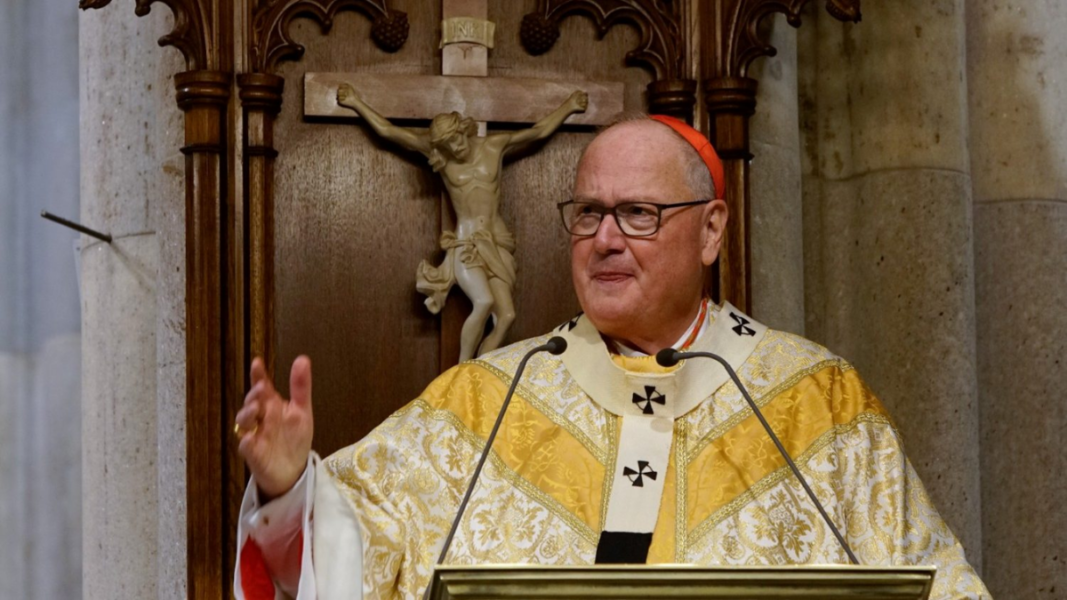
Cardinal Timothy Dolan, emeritus archbishop of New York, has published a series of short videos on X in which he encourages the faithful to resume traditional Catholic practices that—he laments—are being lost: from placing a crucifix in the home to returning to Friday penance, praying at the start and end of the day, and caring for recollection before Holy Mass.
Among the recommendations, Dolan emphasizes the importance of having a visible crucifix in the home. He states that “the Cross is the center of our life, the center of Salvation” and maintains that placing a crucifix in the home is equivalent to publicly recognizing that it is a Christian family that looks to Jesus Christ as guide and Savior.
In that same line of domestic devotion, the cardinal encourages consecrating the home to the Sacred Heart of Jesus, a Catholic custom that, as he explains, is rooted in the spiritual tradition and in the call to honor the Heart of Christ in Christian homes. He invites to pray in the morning, offering the day to the Lord and asking for his help, and to pray at night, before sleeping, with gratitude and, when appropriate, with examination of conscience and contrition: a way of “framing” the day with prayer at the beginning and end.
In the public sphere, he encourages praying before meals, highlighting the witness that making the Sign of the Cross and giving thanks provides, even in a restaurant.
Another central point is the Sunday Mass. Dolan presents it as an essential pillar of Catholic life, not as a mere “devotional habit,” but as a requirement consistent with obedience to Jesus Christ. Along with this, he proposes recovering the Friday penance, recalling the ancient practice of offering sacrifices on that day—including abstinence from meat—because it is the day Christ died on the Cross.
Finally, Dolan makes a call to improve the liturgical atmosphere inside the temples: he laments that sometimes churches are “as noisy as a parking lot” and suggests recovering an atmosphere of reverence and silence before Mass, in preparation for “the greatest of all prayers” and the Eucharistic sacrifice.
The crisis of Catholic identity does not begin with great apostasies; it usually starts with small renunciations. Prayer is abandoned “because there is no time,” noise in church is normalized “because it is habitual,” penance is forsaken “because it is no longer done,” and in the end faith becomes sentimental, private, and comfortable.
Recovering the crucifix in the home, morning and night prayer, silence before Mass, or Friday penance is not a return to the past: they are humble but decisive gestures that transmit faith to children without endless speeches and that restore to the liturgy the reverence it deserves. The Church is not rebuilt with slogans, but with families and parishes that return to taking God seriously.
In times of confusion and half-lived faith, it is good to be grateful when a shepherd reminds us of the obvious: Christian life is not sustained only with ideas, but with concrete, visible, and persevering habits. What Cardinal Dolan proposes is not “nostalgia” or religious folklore, but an elementary pedagogy: if Christ is the center, it must be noticeable at home, at the table, in the rhythm of the day, and in the way of entering the temple.