


By Msgr. Robert J. Batule
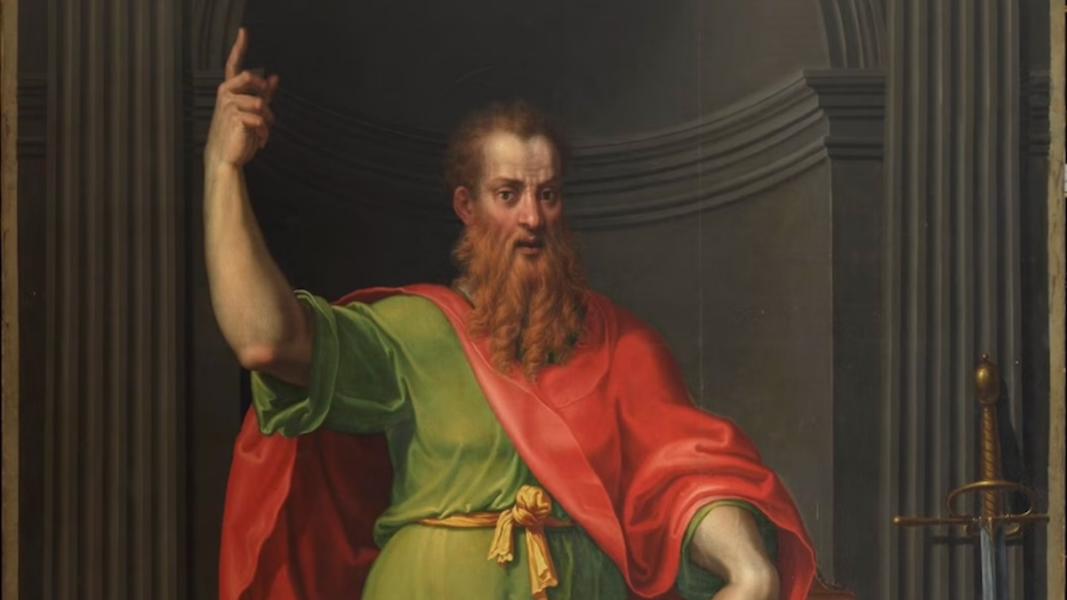
Pope St. John Paul II begins his encyclical on missions (Redemptoris missio, 1990) by quoting St. Paul in his First Letter to the Corinthians. The Apostle to the Gentiles writes there: “Woe to me if I do not preach the [Gospel]!” (1 Corinthians 9:16)
This is exactly what we expect St. Paul to say. After all, he was the greatest evangelizer of the Church in the ancient world, and he remains the par excellence example of what we ourselves are called to do in the light of Baptism and our desire for Heaven. But there might be some reluctance to accept the Gospel if we understand the word “woe” from only one point of view. And by this I mean considering that the “woe” refers solely to calamities.
Indeed, calamities were not lacking in Paul’s ministry. He was beaten with rods and imprisoned in Philippi. (Acts 16:22-23) Later, at sea, he suffered a shipwreck. (Acts 27:41-44) When he arrived in Rome, he was placed under house arrest. (Acts 28:16) And even this reduction in immediate danger could not prevent his beheading and martyrdom around the year 68 A.D.
“Woe” has another meaning that we must recognize. Its second sense is found in St. Luke’s presentation of the Beatitudes. (Luke 6:20-26) Like in St. Matthew’s version (Matthew 5:3-12), the beatitudes appear. But St. Luke’s account contains four “woes”: woe to you who are rich, woe to you who are full now, woe to you who laugh now, and woe to you when all speak well of you! (Luke 6:24-26)
The “woe” in Luke’s version of the Beatitudes suggests a disfavor or divine judgment precisely against those attitudes that obstinately oppose the Gospel. This would involve the desire for opulence, pretentiousness, frivolity, and a principle-less malleability in personal relationships. In our time, we could especially add to this list an attitude of shame in the face of truth. In fact, it is this attitude that dissuades many people today from accepting the Gospel.
What I am referring to here is the deeply rooted cultural phenomenon of relativism. Pope St. John Paul II refers to the phenomenon of relativism in Redemptoris missio (36) and calls it a “difficulty” with regard to the proclamation of the Gospel. It is, he says, a widespread indifference that leads us to believe that, even for those who believe in God, one religion is as good as another. (RM, 36)
It seems to me that church leaders must exercise great caution with terminology, including the use of a word like “path,” in light of the dominant cultural and religious relativism. For it can very easily be understood, in a climate of indifferentism, that all paths to God are equal. And if that is the case, then religion would be merely a matter of de gustibus, of what one feels like.
St. John Paul II’s notion of “difficulty,” due to the religious indifferentism surrounding us, points to obstacles to conversion. Changing religions is not done simply to maintain marital or family harmony. Often, conversion is reduced to whether there will be a personal commitment to the truth and to the way it is expressed in one religion versus another. Making this personal commitment to the truth today requires both clarity and courage. It affirms that feelings are not the arbiter of everything. Truth matters.
Twenty-five years ago, there was considerable consternation in ecumenical circles when, in the Declaration titled Dominus Iesus (2000), the Catholic Church set aside any shame regarding the truth and dared to affirm that the fullness of truth can be personally embraced. That embrace is, evidently, of the one who is the Way, the Truth, and the Life. (John 14:6) And through divine grace, the Lord endowed his Church with the fullness of the means of salvation.
The proper attitude we must have, then, is humility. More and more, our prayer must resemble that of the Blessed Virgin Mary in the Visitation. In the Magnificat, Our Lady prays thus: “My soul proclaims the greatness of the Lord, my spirit rejoices in God my savior, for he has looked upon his lowly servant.” (Luke 1:46-48) Humility is not false modesty. At the same time, it is also not a reluctance or unwillingness to let the light shine so that all may see it.
The final scene of St. Matthew’s Gospel recounts how the apostles receive the charge to preach. First, they are to make disciples of all nations. Then, they are to baptize those disciples in the waters of Baptism. Finally, the apostles have the obligation to teach all nations “to observe all that I have commanded you.”
The apostles could not have a lukewarm faith. They had to be resolute and determined. And likewise, their successors would have to demonstrate these same qualities.
The opening scene of the movie The Mission (1987) shows European Jesuit missionaries scaling waterfalls in South America to reach the Guarani and announce the Gospel to them. Any number of “woes” could have frustrated this apostolic endeavor far from home, not the least of them a catastrophic injury or death. However, somehow, one knew that no other kind of “woe” would be able to stop them.
The fact that in our time the Church does less classical-style missionary work imposes a responsibility on all of us: to be witnesses in a culture that believes it does not need the truth. But the remedy is found in the very words of Jesus: “The truth will set you free.” (John 8:32)
Truth is real because Christ is real. If He had not died and risen for us, there would be no supreme exaltation of truth. (Veritatis splendor, 87) In the Cross and in the Resurrection, there can be no shame whatsoever. For we have been saved precisely in this way.
About the author
Msgr. Robert J. Batule is a priest of the Diocese of Rockville Centre. He is the pastor of St. Margaret’s parish in Selden, New York. He has written and published articles, essays, and book reviews on various topics in magazines, periodicals, and newspapers for more than forty years.