


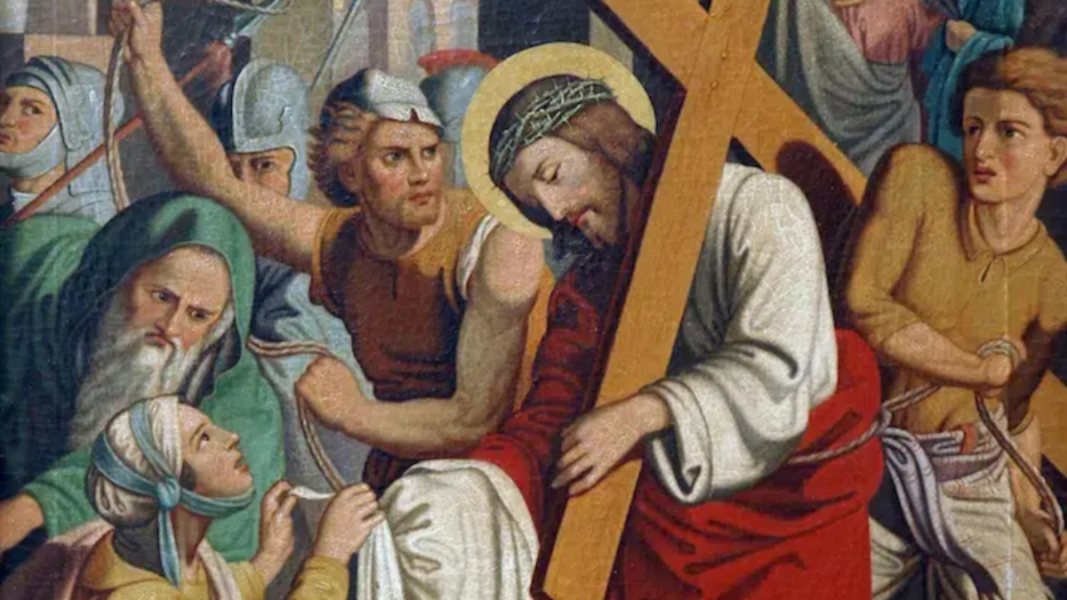
In the first installment, we posed the scandal of the cross and the inevitable question: if God wanted to forgive, why didn’t He do it «without blood»? Before delving into the theological core, it’s worth pausing on something elementary: the human sense of sacrifice. Only from there can we understand why Christ’s offering is not cruelty, but love taken to the extreme.
II
To try to rationalize this madness, it is necessary for us to position ourselves, first of all, at the most general level of understanding the problem: in common sense and in life’s experience regarding the concept of sacrifice. Indeed, it has always been considered worthy to give one’s life for others, and that dignity is magnified if the person who gives their life is much more important than the one saved. Let’s take an example that we often read in newspapers: the man who dies drowned while saving an unknown person who is sinking in the sea. Is this individual cruel, sadomasochistic, or repulsive? Anyone who reads this news will respond that by no means; that he is a hero and that saving a life is a noble and valuable act. However, the deceased’s family members, who see how the shipwrecked survivor has outlived their savior, may not think the same. He had a wife and children, and by saving an unknown person, he has left them orphans. For those children, who will now grow up without their father, their progenitor’s act has been (or may be) a profound mistake: repulsive and cruel, because it leaves them in solitude; or something sadomasochistic, because it was very likely that the savior would assume his own suffering and death given the sea’s furious state. Now, while the selfish judgment (let’s call it that) of those orphans is understandable, it is also possible that those children are educated by their mother with the idea that they had an exemplary father who did not hesitate to immolate himself to save an unknown person, and it is possible that that example from their father leads them to be better people, more generous, more dedicated to others, true civic icons.
Therefore, from a general point of view, the concept of sacrifice (in the sense of an act of self-denial by one person for the benefit of another/s) can only deserve our admiration. But, from another point of view, we do not deny that it is also, in a certain way, a madness, and especially if the savior’s greatness as a man far exceeds that of the rescued. Instinct urges us to preserve our existence, and therefore we ask ourselves: how is it possible that this man who had everything in life (an exceptional wife, admirable children, friends, health, wealth, and an excellent reputation) was able to offer his life for a vagrant, a loser, a rogue, a scoundrel, a mediocre individual who has done nothing worthwhile? It is irrational, because what moved that man to give his life for another was simply love or compassion, not prudence; the heart and not reason. Dying for another is, certainly, a madness, but not a sadomasochistic, cruel, and repulsive act. It is an act of immense nobility.
Christians, as it cannot be otherwise, think this way. And we believe that what a man can do for others (or for many), God (full holiness) did for all (we are all sinners), because the salvation of the entire human race, person by person, is only in God’s hands. And we know from the prophets that God does not delegate salvation: He does it Himself. Doesn’t Isaiah say:
“Behold, it is the Lord (…) He Himself comes to save you” (Is. 35:4).
Doesn’t Ezekiel indicate that God will shepherd the flock of Israel:
“I Myself will tend my sheep and have them pass under the rod” (Ez. 34:11).
In short, the great prophets announce that the salvation of men (of all, regardless of their sex or race) will not be carried out through human intermediaries, but by God Himself, who:
“God, after having spoken many times and in various ways to the fathers through the prophets, in these last days has spoken to us also by the Son” (Hb. 1:1), (…) «who, being the radiance of his glory and the exact representation of his being, and who sustains all things by the word of his power, after he had provided purification for sins, sat down at the right hand of the Majesty in heaven» (Hb. 1:3)
In short, I agree with Dawkins and Saint Paul that the mere fact of God incarnating to sacrifice Himself to death to save others is, certainly, a madness. But let us not stop at the outburst of the first nor at the astonishment of the second, and let us try to delve deeper into it.
Continues in Part III