


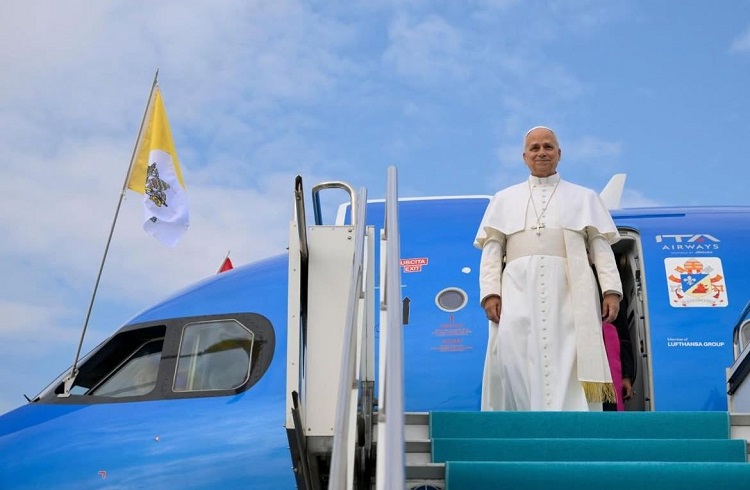
Leaks are beginning to emerge, without official confirmation from the Holy See, regarding the first possibilities for dates and itinerary of what would be Pope Leo XIV’s first apostolic trip to Spain. Although the definitive agenda remains open and subject to adjustments, various institutional and ecclesial sources already agree on a fairly defined outline for next June, with Madrid, Barcelona, and the Canary Islands as the settings for a visit that would have a marked pastoral, institutional, and symbolic weight.
According to an advance by La Iberia, in an article signed by Pablo Mariñoso, the Pontiff would land in Madrid on Friday, June 6, and return to Rome, presumably, on the 12th, after concluding his stay in the Canary archipelago. The capital would be the starting point for an intense visit that would begin with an official reception at Barajas Airport and a subsequent greeting to the King and Queen at the Palace of La Zarzuela.
The afternoon of Friday would be marked by a first pastoral gesture, with a visit to a Cáritas center in Madrid, before one of the most highlighted events of the trip: a large vigil with young people and faithful at the Santiago Bernabéu Stadium, whose organization is already being coordinated with the City Council of the capital. This event is shaping up as one of the great moments of the apostolic visit.
On Sunday, June 7, the Solemnity of Corpus Christi, Leo XIV would preside over a grand Eucharist in the center of Madrid, presumably along the Castellana axis, followed by an Eucharistic procession. In the afternoon, one of the most significant encounters of the trip would take place: a meeting with the university world at the Monastery of San Lorenzo de El Escorial.
The choice of this location is not minor. El Escorial constitutes one of the spiritual and historical hearts of Hispanidad, a place closely linked to Spain’s Catholic identity and managed by the Order of Saint Augustine, to which the Pontiff belongs. Additionally, upon arriving at the monastery, the Pope would pass by the world’s largest cross, that of the Valley of the Fallen, an element of enormous historical and religious weight that would endow the journey with a symbolic force that is hard to ignore, considering the attack suffered by the pontifical basilica.
Monday, June 8, would have a markedly institutional profile. Meetings with the Government and other State authorities are planned, without ruling out a reception at the Cortes Generales. That same day, the Pope would dedicate time to the Church in Spain, with a lunch with the bishops at the Apostolic Nunciature and an evening encounter with priests, consecrated life, seminarians, and faithful of the Diocese of Madrid, probably in the surroundings of the Almudena.
Tuesday, June 9, would close the Madrid stage with pastoral gestures directed toward the periphery, including the possible blessing of the cornerstone of new parishes, before the Pontiff’s transfer to Barcelona. In the Catalan capital, where he would also stay on Wednesday, June 10, the main celebrations would take place at the Sagrada Família, in the context of the centenary of Antoni Gaudí and the imminent completion of the most significant part of the works with the cross that crowns the temple.
The visit would conclude with the trip to the Canary Islands on June 11 and 12, following the desire expressed in life by Pope Francis to focus on the migratory reality. Although the specific events have not yet been disclosed, a direct encounter with immigrants who have recently arrived on Spanish shores is expected, in a clear sign of continuity with one of the great pastoral concerns of the previous pontificate. This gesture should generate serious concern about a possible call effect. What would happen if dozens of cayucos set out to sea to time their arrival with Leo XIV’s visit and a tragedy occurred?
As La Iberia emphasizes, the entire agenda remains pending official confirmation and conditioned by the Spanish political context, especially the eventual call for general elections. Nevertheless, Madrid, Barcelona, and the Canary Islands are already preparing for a historic visit.