


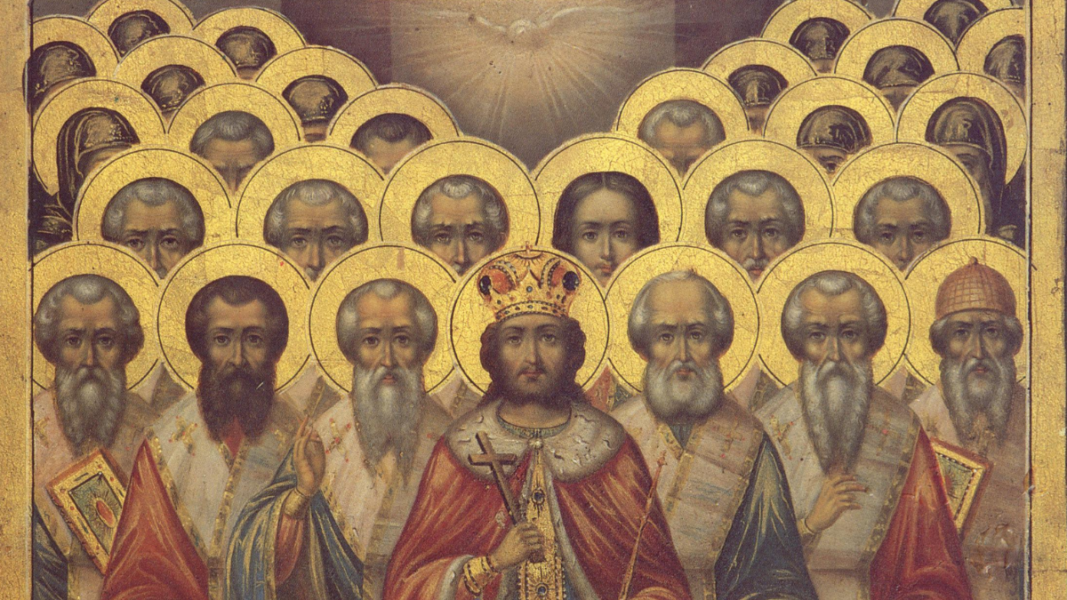
With the Creed, the Mass of the Catechumens is solemnly closed and the way is opened to the Mass of the Faithful. Situated after the Gospel and the homily, on Sundays and feast days, the Creed is the direct and fervent response of the Christian people to the proclaimed Word. It is not a personal reflection nor a passing emotion, but the clear and conscious adherence of faith: «Yes, Lord, I believe». Therefore, the entire assembly stands to recite it, manifesting outwardly the inner firmness of their faith.
A text born for baptism
In its origin, the Creed was not composed for the Mass. The great professions of faith—the Nicene-Constantinopolitan Symbol and the Apostles’ Symbol—arose in the context of the catechumenate, as a synthesis of the faith that baptismal candidates had to profess before receiving the sacrament. The Nicene-Constantinopolitan Symbol appears explicitly in the Council of Chalcedon (451), as a compendium of the faith defined in the councils of Nicaea (325) and Constantinople (381), against the heresies that threatened the revealed truth.
The term “symbol” comes from the Greek sýmballein, “to unite.” It originally designated an object broken into two parts, whose halves allowed those who possessed them to recognize each other. Thus, the Creed is what unites man with God and, at the same time, the visible sign of communion among all Christians who confess the same faith.
The entry of the Creed into the Latin liturgy
The introduction of the Creed into the Latin liturgy is probably due to the impetus of Charlemagne, at the end of the eighth century, in a context of persistent doctrinal confusion about the person of Christ. From the imperial chapel, its use spread progressively throughout Europe during the ninth and tenth centuries. Rome, however, adopted it with more caution. In the year 1014, when Emperor Henry II attended Mass in Rome and was surprised not to hear the Creed, the clergy responded that the Roman Church, not having been affected by heresy, did not see the need to confess it so frequently. Over time, however, the Creed was stably incorporated into the Roman Mass.
Since then, the Creed has become a theological and apologetic text, proclaimed especially on Sundays and solemnities to publicly affirm the dogma against errors.
A Trinitarian profession of faith
The Creed is a fully Trinitarian profession of faith, structured in three major parts. In the first, God the Father, creator of heaven and earth, is confessed. In the second, Jesus Christ, eternal Son of the Father, true God and true man, begotten, not created, consubstantial with the Father, is proclaimed, against Arianism that denied his divinity. In the third, the Holy Spirit, Lord and giver of life, is confessed, against the Macedonians who denied his divinity, and this confession is extended to faith in the Church and in grace.
This Trinitarian structure is also reflected in the liturgical gestures. During the Creed, the head is bowed three times: when confessing God the Father, when naming Jesus Christ, and when proclaiming the divinity of the Holy Spirit. At the heart of the text, like a precious jewel, is the mystery of the Incarnation: the Son of God made man by the work of the Holy Spirit and the Virgin Mary. At that moment, the priest descends from the altar and kneels, adoring the central mystery of the Christian faith. It is no coincidence that the musical tradition has developed pages of extraordinary beauty around these words: Et incarnatus est.
The Creed as an ecclesial proclamation
The Creed occupies a decisive position within the liturgy. It closes the part of the teaching—to which catechumens could attend—through a strong and unanimous proclamation of faith, and opens access to the mysterium fidei, the Eucharistic sacrifice. Before offering the Body and Blood of Christ, the Church demands a full confession of faith. There is no Eucharist without faith, nor sacrifice without adherence to the revealed truth.
Therefore, the Creed is not a private prayer, but an ecclesial proclamation. Interior faith becomes word, song, and visible witness. The Church believes and confesses as a single body.
Faith: gift received and witness offered
Faith is a gift from God, a grace that must be asked for and cared for diligently through formation, study, and prayer. It is a total adherence to Christ and to the truth that He reveals, even when it passes through darkness. One cannot accept part of the faith and reject another: denying a single revealed truth endangers the entire faith.
But faith cannot remain confined to the intimate or private sphere either. It is called to radiate, to be light for the nations and fire that sets the world ablaze. The Creed expresses precisely this public dimension of faith: it is sung with the whole heart to manifest outwardly what is lived inwardly.
The Creed is the great public profession of the Church’s faith before entering the sacrifice. It summarizes what we believe so that we can offer what we believe.