


Yesterday, strolling through Barcelona, I experienced a deeply dual, almost schizophrenic situation while visiting Santa María del Mar.
On one hand, because there are works of art that cannot be described. Not because they are complex, but because the experience they produce cannot be reproduced either in a photograph or in a text. It happens to me with Velázquez’s Christ, with the mosque of Córdoba, and it has happened to me again here. Photographs of Santa María del Mar do not remotely reflect the impact of seeing it in person. Santa María del Mar is not contemplated: one is inside it as one is inside a true idea. The body understands before the head does.
The main nave is a lesson in perfect geometric taste. A Gothic that already knew, with astonishing maturity, that it could dispense with emphasis to achieve the sublime. There is no rhetoric, no ostentation. There is exact proportion, a magnificent sobriety that effortlessly expresses man’s aspiration to the divine. Everything is in its place and nothing seems to need justification. It is an architecture that does not dialogue with the era because it does not need to: it speaks from a deeper, more stable, more true place. Beauty here is not decorative or emotional. It is in the measure, in the relationship between the parts, in the silent intelligence that spans the centuries without asking permission.
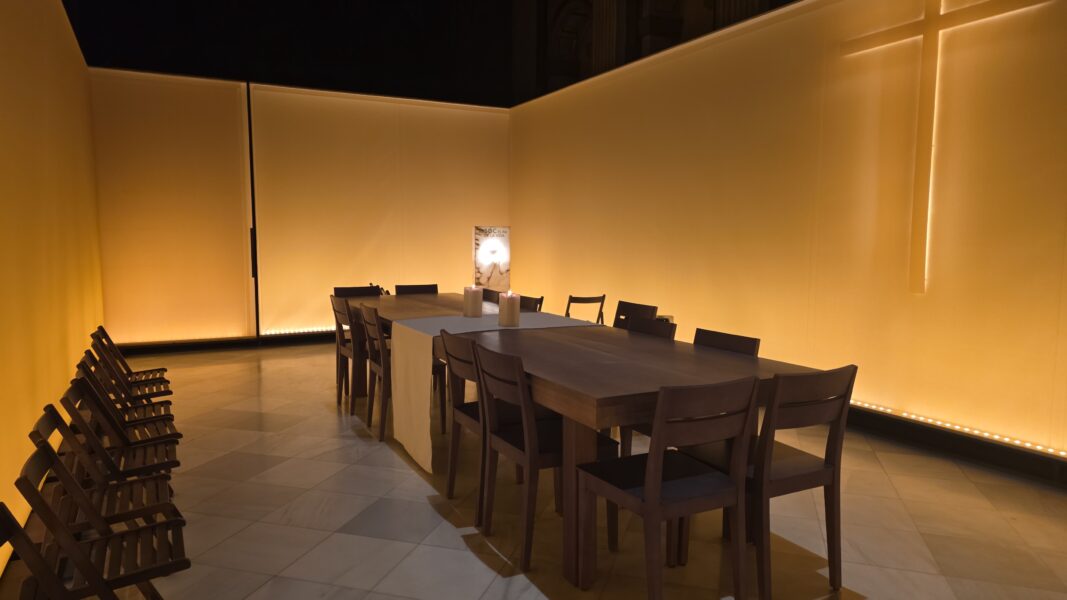
And that is why, perhaps for that very reason, the novel and absurd chapel of the Most Holy Sacrament seems so violently discordant. Someone had to be hurt by so much beauty and so much truth concentrated in the main nave. It is hard not to think of an ideological mind behind it, some Mason or, in any case, someone who could not bear a space proclaiming so clearly a hierarchy, a center, a meaning.
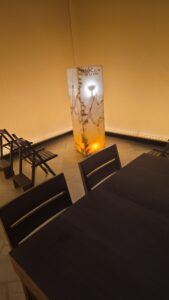
The chapel seems deliberately conceived as negation. A room with smooth walls, warm and uniform lighting, more suited to the private room of a design restaurant than to a temple. In the center, a long dark wooden table surrounded by chairs, as if prepared for a meeting. There is no orientation, no axis, no symbolic tension. The Most Holy Sacrament is reduced to a vertical piece illuminated, tucked away at the back, almost like the cabinet where the cutlery is kept, closer to a conceptual lamp than to a tabernacle. The engraved text, the interior light, everything refers to a contemporary aesthetic language that seeks to accompany without presiding.
It is impossible not to read a theology there, or better, an anti-theology. Christ is present, but as just another piece of furniture. He can accompany a table, witness a meeting, be part of the atmosphere. He does not order the space, does not structure it, does not claim centrality. It is sacrality reduced to coexistence. The logic of the living room transferred to the heart of worship. The same sensitivity that has spread in certain current movements, like Hakuna, where the Most Holy Sacrament is placed on pallets, custodias are dispensed with, minimalist tabernacles are chosen, and an amiable, emotional aesthetic is built, apparently respectful but deeply reductive. IKEA adoration. Not open sacrilege, but covert sacrilege: the one that does not deny the real presence, but mundanizes it until it becomes irrelevant.
Leaving Santa María del Mar today has been like leaving two different churches. One, built with the certainty of someone who knows what they believe and expresses it in stone, proportion, and silence. Another, improvised from discomfort, from the need to lower, domesticate, neutralize what is too true. The visit has been beautiful and unpleasant at the same time. A dual experience that reflects a very current tension: that of a faith that knew how to build for eternity and another that, unable to bear that grandeur, prefers to hide it behind a table.