


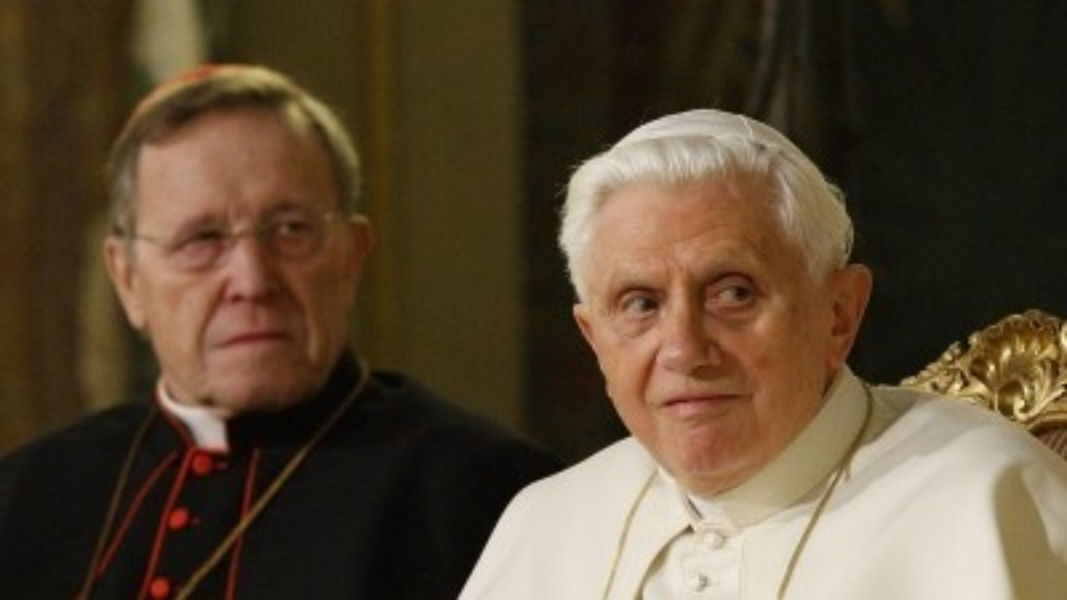
As the third anniversary of the death of Benedict XVI (December 31, 2025) is reached, a theological dispute that many considered archived returns to the forefront: the 2001 debate between the then Cardinal Joseph Ratzinger and Cardinal Walter Kasper on the relationship between the universal Church and the local Churches. What was at stake then is even more decisive today, the very constitution of the Church as a reality of divine institution, and not as a structure moldable by political or sociological criteria, as reported by The Catholic World Report.
The core of the clash: local autonomy or primacy of the universal
Kasper argued, in summary, that the local bishop should have greater margin for decision in his diocese, with less interference from Rome, especially in the pastoral application of moral doctrine and sacramental discipline. The article highlights that one of the issues already emerging in 2001 was access to communion for the divorced who had remarried civilly without annulment.
Ratzinger responded by emphasizing an idea that runs through all his theology: the Church is not a federation of “national churches” with adaptable doctrine, but a single and universal reality with theological priority. That priority does not depend on organizational tastes, but—according to the author’s reading—on christological foundations: the unity of the Body of Christ, one faith, one baptism, one Eucharist.
Synodality, episcopal conferences and the risk of “nationalizing” the faith
The text links that debate to the ecclesial climate of recent years. What is discussed today under the label of “synodality” would be, to a large extent, a new version of the same conflict: who decides and how far the capacity to “adapt” teaching and discipline goes.
Here another sensitive point appears: the role of episcopal conferences. The article maintains that Ratzinger defended that authority resides in the bishops as pastors of their dioceses, and that the conferences have a mainly consultative character. In that line, it warns of the risk that national apparatuses become bureaucratic structures that, moreover, end up eclipsing the diocesan bishop.
The underlying warning: when “pastoral” renegotiates morality
The author does not stop at the organizational chart. He warns of the most serious consequence: that, in the name of local autonomy, synodality or subsidiarity, the moral commandments are treated as flexible “ideals”, reinterpretables according to context. He cites as an example the German case and its “synodal way”, seen as the explication of what was previously hinted at: the claim to reconfigure the binding force of Catholic morality to accommodate it to the “changes of the times”.
The Ratzinger-Kasper debate is a dividing line. It is not just discussing a distribution of competencies, but whether the Church understands itself from Revelation—with an authority that comes “from above”—or if it adopts, even with pious language, a horizontal model that ends up looking too much like a political assembly.
Why it returns now: Leo XIV and the crossroads
If Leo XIV promotes a more “synodal” Church, it is advisable to reread Ratzinger to avoid synodality becoming a mechanism of doctrinal erosion. True reform can only be christological and spiritual, not a power reengineering that ends up relativizing faith and morals under the appearance of “accompaniment”.
Source: The Catholic World Report