


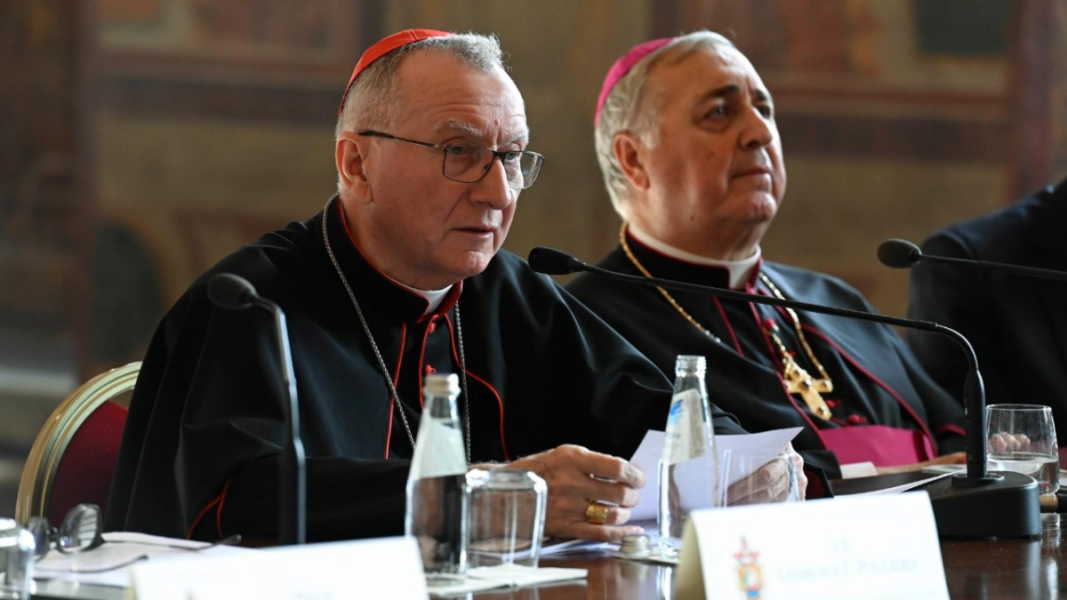
The cardinal Pietro Parolin, Secretary of State, spoke this Saturday, January 17, at the 325th anniversary of the Pontificia Academia Eclesiástica with a lectio magistralis centered on “peace and justice”, amid the new crises of the international order. His diagnosis, to a large extent, is realistic. The system born after World War II is cracking, international law is being relativized, and force is once again imposing itself as a political method. However, the key to the speech lies not only in what it denounces, but in the language in which it does so, the language of global governance, institutional architecture, and multilateralism, with a markedly immanentist tone that, at times, sounds more like a chancellery than a Church.
Parolin stated that “the international order is no longer” that of eighty years ago and called for abandoning nostalgia to act as protagonists, formulating proposals and strategies to rebuild a credible framework. The Holy See feels increasingly comfortable speaking the language of the UN—integral security, supranational institutions, multilateral balance—and less inclined to ground its word in what is proper to it, that is: the primacy of God and the moral judgment that arises from the Gospel and natural law.
Peace and justice: pillars that are invoked… while being hollowed out from within
The Secretary of State insisted that peace and justice cannot be reduced to “aspirations” or “empty claims”. He denounced the questioning of principles such as the self-determination of peoples, territorial sovereignty, and even the rules that limit war, as well as the erosion of the framework of international law in areas like disarmament, cooperation, fundamental rights, or trade.
He also quoted a passage from Leo XIV‘s message for the 2026 World Day of Peace, where the Pope defended the “disarming path” of diplomacy, mediation, and international law, and lamented violations of agreements reached with difficulty, in a context that would require strengthening—and not delegitimizing—supranational institutions.
The problem is that this framework, when it becomes the axis of the discourse, ends up reducing peace to a product of procedures and justice to institutional engineering. If the Holy See’s contribution is limited to recommending “more institutions” and “more multilateralism”, its voice becomes indistinguishable from that of any international moralistic body. The Church does not have authority because it manages the geopolitical board better, but because it announces the truth about man and reminds us that power without God inevitably ends in idolatry, violence, and lies.

“Integral security”: the catalog that encompasses everything
Parolin called for expanding the concept of security beyond the military and terrorism, to include food, health, educational, environmental, and energy security. He added a relevant point: religious security, threatened not only by violence and discrimination, but by the instrumentalization of faith, the privatization of worship, and indifference toward the transcendent.
This last element is the closest to what is specifically ecclesial, but it remains framed as just another component of the catalog of global risks. Even when the Church speaks of persecution or religious freedom, it does so in terms of “security” and “stability”, as if the religious fact were a variable within a system, and not a matter of truth, salvation, and worship due to God.
Multipolarism, rearmament, and “armed peace”: when trust is replaced by deterrence
The cardinal described a multipolarism governed by power, with military, economic, and ideological conflicts. He criticized the use of “security” as a pretext for preparing rearmament campaigns and warned against the temptation of preventive attack, increasingly distant from international legality.
He recalled John XXIII when he called for replacing the balance of armaments with mutual trust, and alerted against the mentality that believes peace only arrives when the enemy is annihilated, manufacturing the category of “enemy” from the will to power.
The diagnosis is sensible, but it lacks the dose of reality that the Church should deliver without complexes: there is no peace without conversion, and there is no justice when the moral law is denied. Diplomacy can contain conflicts; it cannot heal the heart of man. If the Vatican adopts a purely technical language, it ends up accepting the modern fiction that politics and law suffice to redeem history.
“Much doing, little saying”: diplomatic discretion in the face of media noise
Parolin championed the distinctive style of Vatican diplomacy and quoted the expression attributed to Fabio Chigi—future Alexander VII—in Westphalia: “much doing, little saying”, noting that the weight of the media and immediate communication has obscured that attitude.
The point is valid. But when “little saying” translates into a voice that avoids naming the supernatural foundation of the Church so as not to sound uncomfortable in the global forum, discretion can turn into dilution. The Holy See is not called to be effective through silence, but faithful through truth.
The Ecclesiastical Academy and the training of diplomats: between mission and technique
The speech was framed within the mission of the Pontificia Academia Eclesiástica, responsible for training priests for diplomatic service. Parolin recalled the reform by which the Secretary of State assumed the title of Grand Chancellor after the chirograph Il ministero petrino (April 15, 2025) and called for combining priestly formation with updated training in diplomatic sciences, oriented toward the future needs of the Holy See’s international action.
The inevitable question is whether priest-diplomats will be trained to bring the light of the Gospel to the world, or religious experts who speak the language of the international system without disturbing it. Because if the Church adopts the world’s grammar as its main language, it ends up looking like an NGO in cassock: respectable, moralistic, “useful”… but dispensable.
Parolin closed with a call not to delegate to others and to recover personal and collective responsibility, quoting an idea from Leo XIV on forgiveness: not to deny evil, but to prevent it from generating another evil and for resentment to decide the future. The phrase is good, but the Church cannot settle for managing consequences: it must point out causes. And the first cause of war is always the same: man’s rebellion against God, which is expressed in the idolatry of power and the contempt for the moral law.
In times of war, diplomacy is necessary. But the Church’s mission cannot be reduced to a program of “peace architecture”. If the Vatican wants to be truly different, it must remind the world—also in the halls of international politics—that peace without God is not possible, and that justice without truth cannot stand.