


By Joseph R. Wood
A good friend and distinguished Catholic commentator for many years called me this week to ask for my perspective on current U.S. foreign policy. It wasn’t the first time, and this time too I had nothing coherent to offer. That’s how it’s been for about fifteen years. Trained in the logic of the Cold War as a U.S. military and foreign policy official, I’ve found myself unable to adapt to the realities of the 21st century.
I realized around 2012 or 2015 that if I had been taken to the Oval Office (whose decor was then different from that of the Bush 43 Administration, but not yet saturated with golds) and told: “Well, smart guy, tell the President what to do with [insert your region or policy problem here],” I wouldn’t have known what to say. Today, the same.
In 2017, the French embassy in Washington woke up in early January with the realization that, after eight jovial years with the Obama crowd, they didn’t know anyone who was likely to be installed in the new Trump Administration. Those contact book entries had been discarded in the comfortable, even joyful, anticipation of a permanently “transformed” America, to use Obama’s expression. For the French, un problème sérieux.
Apparently, the embassy sent an urgent cable to Paris asking if anyone knew old Republicans who might be open to resuming contact. In a clear sign of desperation, they invited me to an inauguration party (I wasn’t really a Republican, but you get the idea). The star of the night was Rudy Giuliani. I saw some familiar faces, as surprised as I was to suddenly be à la mode again.
Later, I turned down a very tentative inquiry about a possible position in the Trump Administration. There were no more invitations to the French embassy.
I turned it down not because I was a high-principled never-Trumper, but because, in a rare moment of lucidity, I knew I no longer had anything to offer to the world of Washington politics.
During the Bush Administration, I had realized that my main contribution consisted of occasionally asking: “Remind me what it is we’re trying to do.” By 2017, even formulating that question seemed beyond my reach.
By then I was immersed in my doctoral studies in philosophy. My work in the military and foreign policy spheres had, over the years, the effect of fueling my interest in fundamental questions about immutable truths that can be attained in this life.
In other words, my active life only intensified my desire for a contemplative life. And not simply a retirement from paid work with material perks, but a withdrawal in the French sense of the verb retirer: to withdraw or step back from the world.
So, halfway through these thousand words assigned to me by TCT, the reader might well wonder: where does this Epiphany-time autobiographical reminiscence lead?
It leads to Socrates, Plato, Aristotle, St. Augustine, St. Thomas Aquinas, and the works of other philosophers on whom I like to scribble reflections.
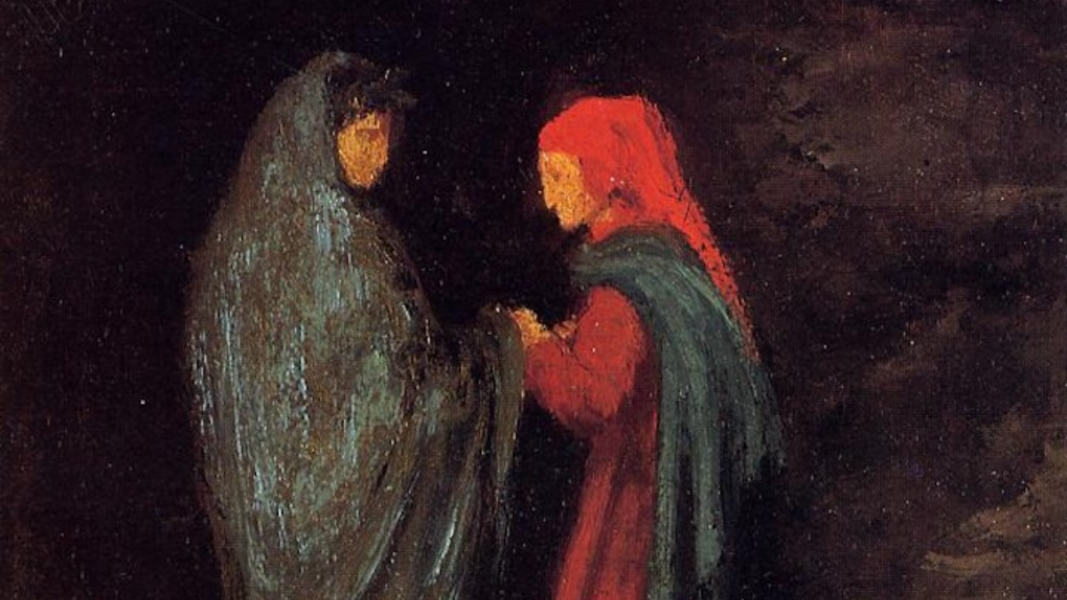
But perhaps somewhat surprisingly, it also leads to Dante. At this point, our editor might raise his eyebrows, since he knows quite a bit about Dante. So I’ll be prudent.
My friend and mentor in the CUA School of Philosophy, Dr. Kevin White, has taught courses on Dante and philosophy, and I was fortunate to attend one of them. A distinguished Thomist, he has taught at CUA for more than three decades.
White (who, by the way, owns a complete collection of the magazine Idler, the great project edited by TCT contributor David Warren) encourages his students both to learn Italian and to read Dante daily. In this new year, I at least follow the second part of his advice.
I’m rereading the Divine Comedy and I’ve already gotten through several cantos of the Inferno. I try not to rush, but also not to delay, because White also informs his students of the legendary saying that the place where one stops reading the Comedy is where one goes after death. I need to get to the Purgatorio soon and, without delay, to the Paradiso. You never know.
Moreover, it’s a pleasure to read and reread it. And Dante knew Thomistic philosophy well. He invokes a vast range of references, making notes essential for those of us less versed in ancient literature and history.
The beautiful translation by Robert and Jean Hollander is my favorite version (the only volume of Dorothy L. Sayers’s translation that I’ve read, Purgatory, is also magnificent). Jean handled the language mainly, and Robert the notes.
In the first circle of Hell, Limbo, Dante is led by his guide Virgil to meet pagan poets and philosophers who lacked faith but died otherwise without sin. It’s not Paradise or the Beatific Vision, but it’s not remotely as terrible as the lower circles will be.
Within Limbo there is a “noble castle” where thirty-five souls reside. Hollander notes that, of those thirty-five, in their earthly lives, three-fifths were contemplative and two-fifths active.
Thus, Dante recognizes that, among those who lack faith, the philosophical or contemplative life offers some advantage with respect to eternity, but that the active life also has its merits.
Aristotle thought that the true telos of the human being, the end for which we are made, is happiness as contemplation of the divine in the excellence of intellectual virtue, though he accepted the good of political life because most people cannot fully live that telos. Cicero saw the good in both the philosophical life and the active roles of political and military leadership, leaning toward the latter as more noble.
St. Augustine and St. Thomas Aquinas accepted the necessity of activity when facing an unavoidable duty. But they followed Christ’s warning that Mary had chosen the better part over Martha (who, nonetheless, was in a better situation in her activity than the sinless but faithless pagan contemplatives).
A very close friend, who knows me well, suggested that in the new year I focus on writing things that simply help people. Here’s a start: read Dante. He fills his Comedy with examples of all kinds of life.
It’s something very worth considering for those active ones who find themselves perplexed by the headlines and circumstances of the moment.
About the author
Joseph Wood is an affiliated assistant professor in the School of Philosophy at the Catholic University of America. He is a pilgrim philosopher and an accessible hermit.