


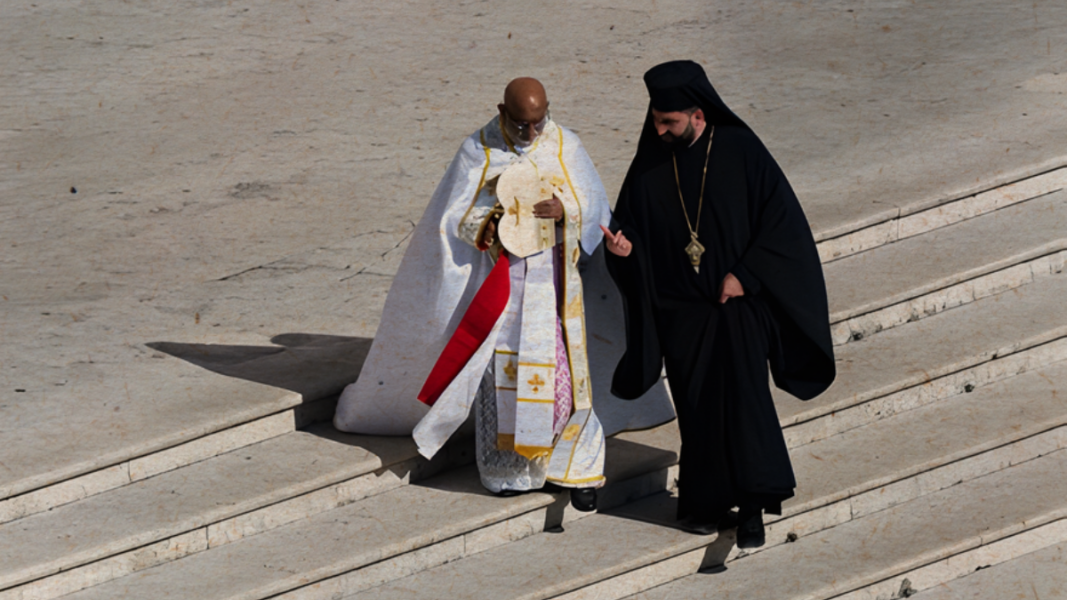
Response to the Open Letter from an Orthodox Faithful to the Pope of Rome Leo XIV
Dearly beloved brother Nikolaos Mannis:
Although, obviously, I am not Leo XIV and, therefore, my response to your letter may be quite disappointing to you, I can also tell you, from my own experience, that if you are not satisfied with this one, you’re out of luck. For I don’t know how many letters—also open, though not exactly inclusive—I have addressed to the same exalted recipient; and it’s a good thing that since then I am well settled, because otherwise I would have already had some apoplexy or something like that.
My intention is simply to present—to your consideration, with all frankness—some arguments, for, in matters of ecumenism, this would have to be the true way, in addition to prayer, so that the unique source of all truth may deign to enlighten us and thus we can see how reason complements faith.
I would like to begin by addressing the ecclesiological issue. Just as Protestantism is based on a myth—the idealization of the first three centuries, with which it claims to connect, while from there on everything would have been an unstoppable process of corruption—the schismatic Orientalism is based on the myth of the idealization of the first millennium, of which it claims to be the exclusive continuer, while the Western Church would have become corrupted. In the end, such an ideological assumption is innate to any process of rupture with the official Church, as can be observed in what may be the latest one: post-Pius sedevacantism, which also speaks, on the one hand, of a total historical corruption—the one brought about by Vatican II—and, on the other, of a connection with the previous stage.
However, what is certain and indisputable, historically, is that, just as no formal heresy can be pointed out in Vatican II, there was also no rupture nor, consequently, was any break in continuity needed at the beginning of the 4th century; nor did the same happen in the middle of the 11th century. In the latter case, there was simply one more of the—unfortunately—constant political ruptures between the Roman see and the Constantinopolitan see, with the misfortune that the circumstances no longer allowed for reconciliation, which until then had been no less customary. From there on, a fallacious argument was woven in the Eastern churches that Rome was to blame: for imposing a theology of primacy and for innovating in the orthodox doctrine, which would only be the previous one.
Now, Rome and the Westerners may be guilty of many things, such as, for example, the Crusades, without which—and even with all their errors—the truth is that Constantinople would have fallen much earlier, for it precisely fell when the popes could no longer organize any. But that, on one hand, does not cover up a historical evidence: that the primacy of the Roman see did not arise in the 11th century; nor does it, on the other hand, establish any theological reason that dictates that doctrine could only evolve up to that same century.
It is observable that the separated Eastern churches became doctrinally paralyzed and as if frozen, which is already indicative that those who had broken with the doctrinal dynamic were they. What happened in the Church united to Rome was the natural continuation of that same dynamic, that is, evolution as doctrinal explication, founded on the magisterium of the Roman see, with which previously the Eastern sees had also remained in communion of subordination, since, both juridically and doctrinally, Rome was always the last and supreme instance, being thus the only one whose authority extended to all.
When He says: “The Holy Spirit will lead you to the fullness of truth” (Jn 16, 13), where did Christ indicate that this fullness of truth would be closed in the 11th century? Regarding the evolution of dogma, I consider this text by St. Vincent of Lérins to be very clarifying:
Is it possible for there to be progress in religious knowledge in the Church?: certainly it is possible, and the reality is that this progress takes place; (…) but this progress can only take place on the condition that it is a true progress in the knowledge of the faith, not a change in the faith itself. What is proper to progress is that the same thing that progresses grows and increases, while what is characteristic of change is that the thing that changes becomes something totally different; it is therefore fitting that through all times and all ages the understanding, science, and wisdom of each individual and of the whole body of men grow and progress both on the part of the entire Church and on the part of each of its members; but this growth must follow its own nature, that is: it must be in accordance with the lines of dogma, and must follow the dynamism of a single and identical doctrine; let religious knowledge therefore imitate the way bodies grow, which, even as they develop with the passage of years, nevertheless preserve their own nature; (…) this is also what happens with Christian dogmas, for the laws of their progress require that they be consolidated through the ages, develop with the passage of years, and grow with the passage of time; (…) thus, by contemplating how through the centuries those first seeds have grown and developed, we can rejoice in harvesting the fruit of the first labors (Commonitorium, ch. 23).
If the Trinity can only have one personal principle, which is the Father—as I will address in the next section—and the Easterners cling to that with zeal and rightly so, how can the Church, which must be its reflection here, as a visible communion tending toward the invisible Trinitarian communion, have many personal principles of authority?
Only to one apostle did Christ hand over the keys, with all that that means (cf. Mt 16, 19), and only to that same one did He entrust, three times, the universal shepherding (cf. Jn 21, 15-17), thus giving him authority over all the others and their successors.
On the eminent and exclusive function of the Roman see by reason of its consideration as the definitive Petrine see, these magisterial texts may be illustrative, which, not being precisely posterior to the 11th century, also do not innovate something that until then would have been unusual:
Dz 41: You will bring us joy and rejoicing if, obeying what we have just written to you by the Holy Spirit, you cut off at the root the impious anger of your envy, in accordance with the exhortation we have made to you in this letter about peace and concord.
Dz 57a: And why should we not have written to us precisely about the Church of Alexandria? Do you not know that it has been customary to write to us first, and thus determine from here what is just? Therefore, certainly, if there was any suspicion against the bishop there, it should have been written to the Church here.
Dz 57b: (…) If any bishop has been judged in any cause, and believes he has good cause for the judgment to be renewed, if it pleases you, let us honor the memory of the most holy Apostle Peter, and by those who examined the cause, or by the bishops who dwell in the neighboring province, let it be written to the bishop of Rome, and if he judges that the judgment should be renewed, let it be renewed, and let judges be appointed. But if he proves that the cause is such that what has been done should not be reopened, what he decrees shall be confirmed.
Dz 57e: It will seem very good and very fitting that from any provinces the priests come to their head, that is: to the see of the Apostle Peter.
Dz 87: (…) We carry the burdens of all who are burdened, or rather, the blessed Apostle Peter carries them in us, who, as we trust, protects and defends us in everything, as heirs of his administration.
Dz 100: You have truly strengthened the vigor of your religion, for you approved that the matter should be referred to our judgment, knowing what is due to the Apostolic See, inasmuch as all of us who are placed in this place desire to follow the Apostle from whom the episcopate itself and all the authority of this name proceed. (…) The Fathers (…) not by human but by divine judgment decreed that any matter that was treated, even if it came from separated and remote provinces, should not be considered finished until it came to the notice of this See, so that the decision that was just might be confirmed with all its authority, and from here all the Churches might take (…)
Dz 109b: By the Lord’s disposition, it is the competence of the blessed Apostle Peter, the mission received from Him, to take care of the Universal Church, and in fact Peter knows, by the testimony of the Gospel [Mt. 16, 18], that the Church has been founded upon him, and his honor can never feel free from responsibilities, since it is certain that its government depends on his decisions. All this justifies that our attention extends even to these places in the East which, by virtue of the mission entrusted to Us, are in a certain way before our eyes. Far be it from the priests of the Lord to incur the reproach of contradicting the doctrine of our elders. (…) Since the occasion calls for it, review, if you please, the sanctions of the canons, you will find which is, after the Roman Church, the second church, and which the third. With this the order of government of the Church appears distinctly; the pontiffs of the other churches recognize that, nevertheless, they form part of one and the same Church and one and the same priesthood. (…) No one ever dared to lay hands on the one who is Head of the Apostles, and whose judgment it is not lawful to resist; no one ever rose up against him, except he who wished to become guilty of judgment. The aforementioned great churches preserve their dignities by the canons: that of Alexandria and that of Antioch [cf. 163 and 436] have them recognized by ecclesiastical right. They keep, we say, what was established by our elders, being deferential in everything, and receiving, in exchange, that grace which they, in the Lord who is our peace, recognize they owe us. (…) Not long ago, that is: under my predecessor Innocent, of happy memory, the pontiffs of the Eastern churches, grieving at being deprived of communion with the blessed Peter, asked for peace through legates, as your charity remembers. On that occasion, the Apostolic See forgave everything without difficulty (…)
Dz 110: To the Synod of Corinth we have directed writings by which all the brethren are to understand that there can be no appeal from our judgment. Indeed, it was never lawful to treat again a matter that has been, once, established by the Apostolic See.
Dz 112: It is not doubtful to anyone, but rather, for all ages it has been known that the holy and most blessed Peter, prince and head of the Apostles, pillar of the faith and foundation of the Catholic Church, received the keys of the kingdom from the hands of our Lord Jesus Christ, Savior and Redeemer of the human race, and to him has been given the power to bind and loose sins, and he lives and judges in his successors to the present and always.
Dz 149: [Letter from the council to Pope Leo] For, if, where there are two or three gathered in his name, there He said He was in their midst [Mt. 18, 20], how much familiarity did He not show with five hundred twenty priests who preferred the knowledge of his confession to their homeland and labor? To them you, as the head to the members, directed them through those who occupied your place, showing your benevolence.
I consider these texts sufficient, of which the last two are respectively from the Council of Ephesus and that of Chalcedon, so that there may be no room for doubt that the authority of the Roman see was then recognized by all Christendom.
To not lengthen this letter further, I leave the weighty Trinitarian theme for a second one, in which I will try to address in the most exhaustive way the famous question of the «Filioque».
Note: Articles published as Tribune express the opinion of their authors and do not necessarily represent the editorial line of Infovaticana, which offers this space as a forum for reflection and dialogue.