


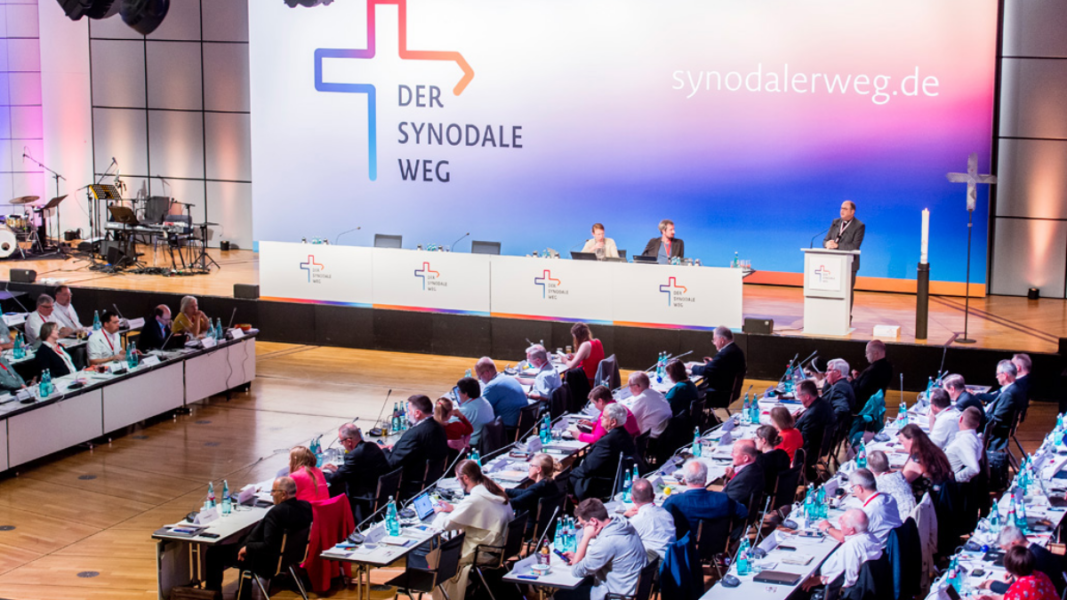
The Church in Germany arrives at 2026 with a question that no longer admits evasions: does it want to continue being Catholic—that is, universal, apostolic, and hierarchical—or does it prefer to consolidate a national-type structure, closer to a Protestantized model of ecclesial governance? The so-called Synodal Way, initiated in 2019 under the umbrella of “reform,” now culminates in its most delicate point, the claim to create a permanent Synodal Council with real decision-making power, shared between bishops and laity.
The issue is not administrative. It is ecclesiological. Authority in the Church does not arise from a parliament, nor from a sociological majority, nor from the cultural climate of an era. It arises from the sacrament of Holy Orders. The bishop is not an assembly delegate; he is the successor of the Apostles. And that reality is not corrected with mixed commissions nor “balanced” with parity bodies, no matter how sympathetic they sound to modern ears.
Those who present the Synodal Council as “coresponsibility” are selling a concept that, in practice, implies a direct invasion of episcopal authority. If that body arrogates to itself competencies over finances, pastoral guidelines, discipline, and even moral orientation, the bishop is reduced to a decorative figure. And if the bishop is a decorative figure, the Church ceases to operate according to the constitution that Christ gave it.
That is why the project cannot be dismissed as a debate on “internal organization.” It is about the nature of the Church. The Holy See, if faithful to its mission, is not there to homologate local experiments, but to safeguard Catholic unity and confirm the brethren in the faith. Rome can dialogue, yes. But it cannot sign its own renunciation.
Not just governance: it’s doctrine and morals
The German problem does not end with the power structure. The Synodal Way has been pushing for years resolutions that clash head-on with Catholic moral doctrine and the constant magisterium. The liturgical blessing of same-sex couples—no matter how many linguistic makeovers are applied—is a rupture: it is not “pastoral care,” it is contradiction. What the Church cannot recognize as conforming to the created order is not blessed.
In the same logic appears the pressure to open a “sacramental role” to women, reintroducing debates closed by the magisterium, and the insistence on presenting celibacy as a mere disciplinary whim, as if it did not have a profound theological and spiritual meaning. When a local Church tries to rewrite morals, sacraments, and discipline as if they were interchangeable pieces, it is not “reforming”: it is deconstructing itself.
The factor that no one confesses: money
There is also an element that weighs like lead: the church tax system has turned the German Church into an economic power. That financial power conditions the scenario. An open conflict with Rome would multiply legal and patrimonial problems. And, at the same time, a complacent Rome would send the world a devastating message: that doctrine can be negotiated and that discipline is decided by organized pressure.
A clear condemnation could accelerate a rupture; excessive tolerance could normalize error and weaken the authority of the Apostolic See. But there is a truth that is worth saying without beating around the bush: it is not legitimate to buy unity with the coin of doctrinal ambiguity. Catholic unity is not a pact of coexistence. It is the faith itself.
2026: time to choose
That is why 2026 will not be a “technical” year. It will be a reality check. A Synodal Council with binding power is not an “adaptation”: it is an alteration of the Catholic way of being Church. And if it is allowed, others will copy it. What is at stake is not just Germany: it is the precedent.
Leo XIV—as every Pope—has the duty to confirm in the faith. Not to indefinitely administer a conflict until it becomes normality. Modernism always advances in the same way: first it asks for “dialogue,” then for “exceptions,” then demands “structures,” and finally claims that Rome bless it.
If 2026 serves for anything, it must be to recover the essential: obedience to the received faith, moral clarity, the hierarchical nature of the Church, and the conviction that truth is not voted on. A Church that does not dare to be Church ends up resembling the world too much. And when that happens, the world does not convert: it simply absorbs.