


The Traditional Latin Mass is going through a peculiar moment under the pontificate of Leo XIV: the restrictive norm of Traditionis Custodes is not repealed, but in practice, there is a climate of expectation regarding a more flexible management, with meetings, permissions, and dispensations that suggest a stage of “waiting” rather than a definitive closure of the matter.
There is no formal announcement of a turnaround, but there are sufficient signs to speak of a change in tone —despite the slow pace—. And in Rome, when the tone changes, the way the law is applied also changes.
A law that sought to close the debate… and has not closed it
Traditionis Custodes (2021) was interpreted at the time as Francis’s bet to contain the expansion of the 1962 rite, especially in contexts where the liturgy had ended up becoming an identity flag or opposition to the Second Vatican Council. The logic was clear: unity through regulation, and regulation through control.
However, what has remained afterward is not a strict uniformity, but a mosaic: permissions in some places, restrictions in others, and a reality sustained by exceptions. The norm remains “in the books,” but its application no longer seems monolithic.
Leo XIV: diagnosis of polarization, without a decree of rupture
According to what was reported by The Catholic Herald, Leo XIV would have acknowledged that the liturgical conflict is “very complicated” and would have warned against the political instrumentalization of the liturgy —on both sides—. That diagnosis is important: if the problem is polarization, an imposition without nuances usually produces the opposite effect.
For that reason, more than a sharp turn, what is perceived is a strategy of decompression: listening, avoiding gestures that inflame the discussion, and allowing time to do its work.
Gestures that carry weight: Burke in St. Peter’s and significant encounters
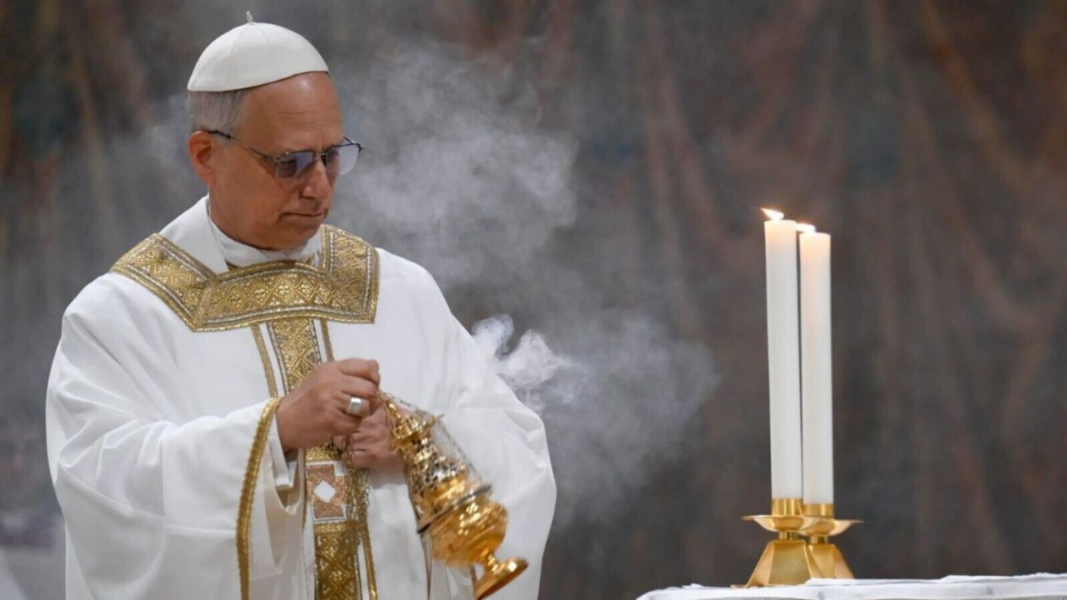
In that line, the British medium highlights concrete facts that, in Rome, are not minor. One of them is the encounter between Leo XIV and Cardinal Raymond Burke, after which Burke would have raised the issue of the traditional liturgy. And, above all, a highly symbolic gesture: the celebration by Burke of a solemn Traditional Mass in St. Peter’s Basilica, with the Pope’s explicit permission.
It is not a repeal. But it is a message: the ancient rite is not treated as a foreign body to the heart of the Church, even though it remains regulated.
The Pope’s audience with Bishop Fernando Rifan, apostolic administrator of Campos (Saint John Vianney), a singular figure due to his link to the traditional rite within a fully regularized structure, is also mentioned.
Renewable dispensations: the key to a “porous” application
The most delicate point is not in the gestures, but in the mechanics. According to the same medium, it would have been explained that, when a bishop requests it from the Dicastery for Divine Worship, an exemption for two years, renewable, could be granted to celebrate with the 1962 Missal.
If that becomes habitual practice, the scenario changes without needing to touch a single comma of the legal text: the system would continue to say “restriction,” but reality would function as conditional permission.
And that situation, precisely, is what fuels the discomfort: a framework that is not applied equally everywhere creates comparative grievances, confusion, and a sense of arbitrariness.
A tension that does not disappear: youth, fraternities, and signs outside Rome
While Rome calibrates, ecclesial life continues. Traditional celebrations at large events with the presence of young people, with support from communities like the FSSP, and other scenes in Europe that are read as signs of practical continuity of the rite in certain environments, without formal rupture with authority.
It is not a marginal phenomenon: where it is celebrated with stability, it usually attracts young families, vocations, and a profile of Catholics who do not resign themselves to the liturgical tradition being treated as a problem to be managed.
The current scenario: neither suppression nor normalization
The result is an unstable balance, a «liturgical limbo.» There is no suppression, but neither is there clear normalization. There is restrictive law, but also exceptions; there is caution, but also gestures; there is discourse of unity, but a plural reality that is difficult to fit with a decree.
Under Leo XIV, the Traditional Mass seems to have entered a phase of truce, where the immediate objective is not to resolve the conflict, but to avoid the Church breaking further from within. The big question is how long that “provisional solution” can last before Rome has to truly choose a path.