


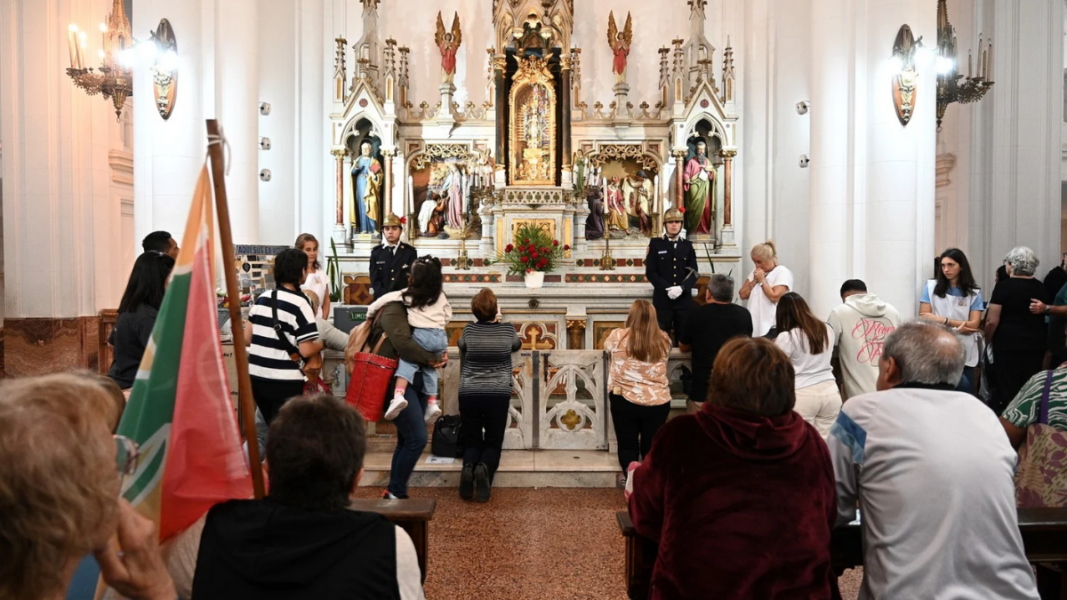
There is a fact that repeats itself in not a few parishes in the West: pews full of women and children, and a striking absence of young men. For some, it is an inevitable sociological phenomenon. For others, a simple generational issue. The approach proposed by The Remnant is more direct and, at the same time, more uncomfortable: many men do not flee from the Church due to excess demand, but due to lack of it; not because of its hardness, but because of its softness.
The author argues that a part of “mainstream” (dominant trend) Catholicism has become unrecognizable to those seeking a solid faith, a clear moral order, and a spiritual life that does not depend on fashions. And when the Church presents itself as a catalog of negotiable “good ideas,” the result —he says— is predictable: men leave, and those who remain tend to reinforce increasingly weak dynamics, creating a vicious circle.
The Rejection of “Beige” Catholicism
The text starts from an intuition shared by many young people: if a man from Generation Z truly rejects the world —its hedonism, its relativism, its ideology— he will also reject the “diluted Catholicism” offered to him as an alternative. He does not seek a Christianity that copies the language of the times, but one that contradicts it.
The label the author uses for that domesticated version is revealing: “beige Catholicism.” A Catholicism without edges, without doctrinal clarity, without discipline, without a sense of spiritual combat. A Catholicism that promises belonging and emotional well-being, but rarely demands conversion, sacrifice, or obedience to the truth.
First Cause: The Erosion of Immutable Truth
The first major reason for rejection, according to the article, is the weakening of Catholic conviction. The Church —it reminds us— was built on martyrs, not negotiators. The author turns to historical figures who preferred to die rather than yield in the faith, precisely to highlight the contrast with an ecclesial climate where truth seems “elastic.”
When doctrine is presented as revisable, and morality becomes a set of “processes” or “accompaniments” without a clear goal, the message a man receives is devastating: there is no treasure here to guard, but a discourse that adapts. And a serious man does not risk his life —nor his reputation, nor his family— for something that tomorrow could be redefined in a new “listening session.”
The author attributes this phenomenon to a mix of doctrinal liberalism, modernism, and misunderstood ecumenism: a dynamic where clarity is considered “rigidity” and firmness is labeled as a lack of charity. In that environment, the man seeking certainty, moral hierarchy, and transcendence concludes that he is being offered a product without substance.
Second Cause: The Promotion of Vice and Tolerance of Sin
The second cause: the normalization of vice within ecclesial life. The article argues that moral corruption —especially in the clergy— has been one of the most destructive weapons against faith and against Christian masculinity.
When a young man sees scandals, sexual confusion, banalization of the liturgy, and pastors incapable of calling sin by its name, he understands that he is being asked to adhere to an institution that does not take its own doctrine seriously. And if the Church renounces forming strong consciences, it ends up producing weak men: incapable of resisting the world and, therefore, incapable of leading in the family and in society.
The argument is not sentimental. It is moral and spiritual: if the Church stops combating vice, it loses authority to demand virtue. And without virtue, there are no men.
Liturgy, Reverence, and Vocations: The Sign That the “Mainstream” Does Not Want to See
The author poses a contrast that, deep down, many prefer to ignore: where a more integral faith is preserved, a more reverent liturgy, and a clearer moral discipline, visible fruits appear. Not only stronger families, but communities with a sense of belonging and, frequently, vocations.
It is not a naive idealization. It is a practical observation: man is attracted to what demands height from him. Tradition —in its liturgical and doctrinal form— does not promise comfort; it promises holiness. And holiness implies combat, sacrifice, and order. Precisely what the world does not give and what the Church, according to the author, has stopped demanding in too many places.
“Hero” Priests to Form “Heroes”
The text concludes with a frontal call to the clergy: one cannot be a priest “halfway.” Man does not follow a spiritual bureaucrat or an entertainer; he follows a pastor willing to give his life. If the priesthood is presented as a career, an administration, or a therapy, it does not summon men. If it is presented as an exacting and supernatural fatherhood, then yes.
That is why the article insists that the recovery will not be aesthetic or tactical. It will be doctrinal and moral. It will be returning to preach the full faith, with its rigor and its beauty, with its clarity and its authority. It will be returning to call for conversion, penance, purity, reverent worship. In a word: to real Christian life.
The Way Out Is Not to Dilute the Faith, But to Offer It Whole Again
The final thesis is simple: men are not attracted by hiding the truth, softening the Gospel, or accommodating morality to avoid discomfort. That may fill a room, but it does not forge men. And without virtuous men —fathers, husbands, priests— a society crumbles.
If many young men turn away from “mainstream” Catholicism, the author’s approach concludes, perhaps it is not because the Church is too demanding. Perhaps it is because, in too many places, it no longer is. And where Catholic faith is lived without adulterations —with clear doctrine, dignified liturgy, and unambiguous morality— what is scarce today is not lacking: men willing to build, to sacrifice, and to serve God above the world.