


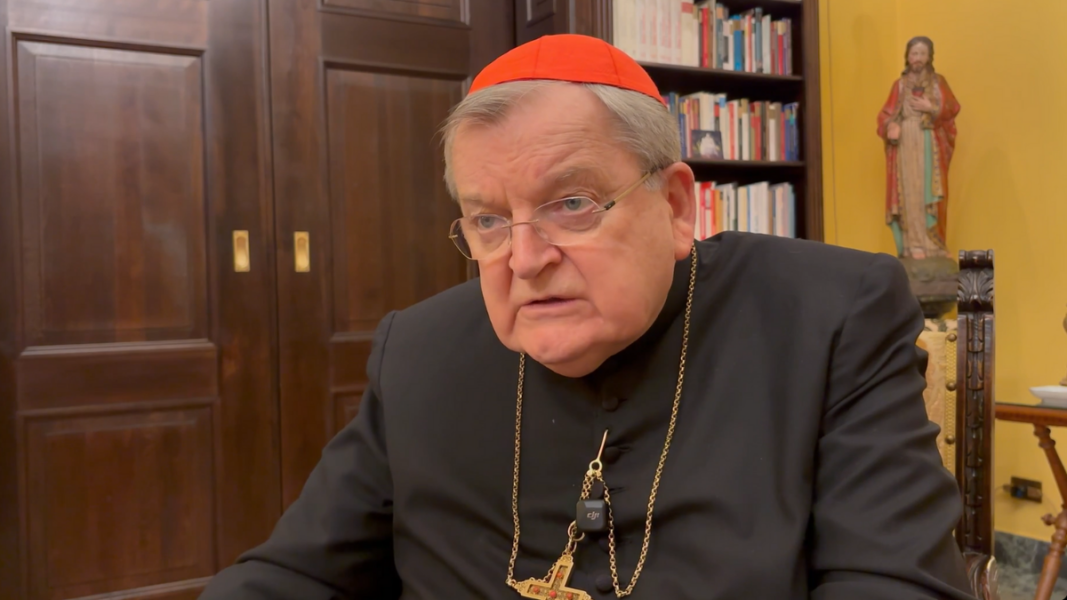
Cardinal Raymond Burke has described the extraordinary consistory held on January 7 and 8 as “a great benefit” for the opportunity it provided to the cardinals to get to know each other personally and share concerns about the situation of the Church. In a video interview published on January 11 by College of Cardinals Report, Burke expressed satisfaction that Pope Leo XIV wants to convene more meetings of this type, with another consistory scheduled for June 27 and 28.
Improvements in the format: criticisms of work in small groups
Burke pointed out, however, that the format used should be “reexamined” to better fit what is traditionally understood by an extraordinary consistory. As he explained, the classical model was based on a general debate among all the cardinals on a central theme, normally introduced by an exposition from a reference theologian or canonist.
In contrast, the January consistory was structured mainly in small linguistic groups, with subsequent pooling through reports. In the cardinal’s opinion, this system limits real exchange among the members of the College and makes it difficult for everyone to know firsthand the arguments and concerns raised by others.
He also criticized the fact that part of the sessions took place in a large space with tables close to each other, which—he said—makes conversation difficult due to ambient noise.
Themes communicated late and time wasted voting
Burke also regretted organizational problems: he assured that the cardinals received only two days before a list of four themes and that time was wasted voting on which two would be addressed due to lack of margin, instead of the Pope deciding directly which points to address in that meeting and which to leave for the next.
According to his account, some cardinals had not even received the prior communication of the themes, which required dedicating part of the working time to explaining the content to them.
Concern: too many activities for the Pope
One of the issues that, according to Burke, arose in the meeting was the concern about the volume of acts, audiences, and meetings assigned to the Pope, especially during the Holy Year, to the point of being able to divert him from essential tasks of the Petrine ministry.
The cardinal emphasized that, although it is understandable the desire of the faithful to see the Pope, there is a risk: that the public agenda compromises the necessary time for study, discernment, and crucial governance decisions, such as the appointment of bishops or the examination of documents before their publication. In that sense, he warned against the image of a Pope reduced to a “political” figure in permanent public exposure, instead of a teacher of the faith and supreme pastor of the Church.
Burke concluded by reiterating his gratitude for Leo XIV having resumed the practice of convening consistories and expressed his desire for the format to be perfected to favor a true common debate among the cardinals.
We leave below the complete transcription and translation of Card. Burke’s statement on the consistory:
I think the great benefit of the Extraordinary Consistory, which is the first Extraordinary Consistory since 2014, about 12 years ago, was that the cardinals had the opportunity to get to know each other and to talk to one another, especially—well—in the small groups; of course, one spoke with a certain number of cardinals, but then, during the breaks and, in general, throughout the days of the consistory, there was the opportunity to get to know each other and to express our concerns about the Church and comment on them among ourselves; and that was a great benefit. And I am very grateful to Pope Leo for having already announced another Extraordinary Consistory for June 27 and 28, and for having said that he wants to hold an annual consistory afterward that lasts a longer period of time, instead of a day and a half: perhaps three or four days; so that is a great benefit. The question I have in mind has to do with the form of the consistory. The classical extraordinary consistory, as I experienced it in my years as a cardinal, was a general debate, and normally that is how an extraordinary consistory is described.
Usually there was a single theme, and normally it began with a scholarly exposition by a very respected and solid theologian or canonist, who presented the theme, and then there was a general debate among the cardinals. Undoubtedly that was the case in 2014 regarding the question of marriage and the Holy Eucharist, but this consistory followed a format that was used in 2022 when Pope Francis convened what was called a Meeting of Cardinals. He did not call it a consistory, in the sense that the cardinals were divided by language into small groups, and all the discussion took place in the small group, and then, in the general session, there was simply a report from the secretaries.
That was one aspect, and then another aspect was added: the format of the last synod, or perhaps the last two synods, I don’t know, in which, instead of being in small rooms where we could debate, we were all in the Paul VI Hall, in the audience hall, and the tables were next to each other; and that makes it more difficult to discuss; in fact, if someone has any hearing problem, because there is that general noise of voices talking. That part, I think, needs to be examined; and also I think that the situation of all the cardinals together speaking allows for a common listening and then addressing the issues. Now, there were two sessions in which the cardinals could intervene freely for 45 minutes, but each intervention was limited to three minutes; that meant that only 15 cardenals could speak in one session, another 15 in the other, and then some repeated, some spoke twice; and it was a large group, there were 166, I think, or something like that, and moreover it was not the entire college.
So I would think that this format needs to be reexamined to ensure that it respects the true nature of an extraordinary consistory. Furthermore, to go further on the exchange, the tables were categorized as: cardinals with jurisdiction outside Rome, or cardinals without jurisdiction, and cardinals of the Roman Curia; and the idea was expressed that the Pope wanted to hear from those cardinals who are normally not here, because he can hear the rest of us at any time when we are here; or, in the case of those without jurisdiction, that he wanted to hear from those who are actively engaged in the pastoral governance of a diocese or some institute. Well, that also hinders communication among the cardinals because, in the case of those of us who have no position and are here in Rome, at our tables there was never a report of what we discussed.
It was sent in writing; now an email address has been established where cardinals can write at any time; and well, that is effective for communicating a message to the Pope, and I trust that all those messages reach him, but, on the other hand, it does not contribute to the general discussion among the cardinals nor to the clarification of their own concerns, or to alerting them to concerns that they simply had not considered but that are very important. But I suppose it is a step forward compared to what happened during the pontificate of Francis when… Oh, yes, no, no, no; and I wanted to emphasize that: I am very grateful to Pope Leo that, as soon as the Holy Year ended, he immediately convened a consistory, and that he has now committed to having these consistories. That is a step forward and a very positive sign.
What happened—and I don’t know exactly how the consistory was prepared—is that we received quite late, I think it was two days before the consistory, a list of four themes, and then the first session, the afternoon of Wednesday—yes, Wednesday—January 7, was dedicated to voting on which two themes would be addressed. It was said that there was only time for two themes; therefore, we had to eliminate two, and thus we lost a session voting on that; and I think it would have been better if the Holy Father had simply said: “Well, I sent four themes, but now I realize that we can only discuss two,” and even discussing two in such a short period of time is not very realistic. It would have been better, I think, if he had decided: “We will discuss these two now, and the other two at our next meeting”; but, instead, we spent all that time voting on it in these small groups.
So there was a disappointment there; and then, the cardinals at my table—several of them—did not receive the communication of the themes at all, and therefore we spent a lot of time simply explaining to them what the themes were. So there was an organizational problem, that’s for sure; but, again, thanks to God at least the meeting took place. It was a beginning, and now I think the important thing would be to work on the format.
The themes were assigned and the instruction was to talk about those themes. I don’t know how other cardinals felt, but I wouldn’t have—I wouldn’t have felt—free to simply address another theme; or if I had done so, it would have been, you know, somehow disruptive to the assembly. So I can’t say if the other cardinals felt that way, but yes: that is how it was structured. There was no, for example, time for so-called free interventions on any concern one might have.
The themes were assigned, and then there was a whole structure that had to be followed at the tables in terms of each cardinal speaking, and then there had to be a time of silent prayer, and then a response from cardinals to cardinals, and then, of course, the report that is sent: it depends on the secretary’s ability to really reflect the entire discussion. As you can imagine, these discussions on a theme like evangelization were very, very broad and, and… but there were also specific points; and sometimes I simply noted that, in the report, some of those specific points were lost in a kind of desire to offer a general report. I don’t know. I did not participate in the press conference that was given on Thursday night at the end of the consistory, but I understand that and I am very understanding; and yes I think there should be a way—perhaps the best is the Holy Father himself—or some trusted cardinal, to speak to the faithful about what the Holy Father heard during those days regarding these concerns.
I think another thing too—and this was said, and it is true—is that the Holy Father’s program for the Holy Year was very packed. I mean, I followed it, I was at some of the Masses and so on, but sometimes there were several meetings every week, and that greatly limited his ability to attend to the governance of the Church in general: the appointment of bishops, and the study of documents and so on that were being published. And so the hope now— it was expressed—is that, with the Holy Year concluded, the Holy Father can dedicate himself to it; because people, rightly, say: “Well, he is a new Pope, and we want to see the grace of the Holy Spirit acting in him for the building up of the Body of Christ in unity among the bishops, among all the faithful. What direction is he giving?”. And, and, and… of course, that direction is—must be, will be—different.
I mean, it will relate to what his predecessors in the papacy were doing, but it will reflect a specific direction that he considers important. I had the impression that the Holy Father was very absorbed by all the important and beautiful activities of the Holy Year, but I have to say that, given the responsibilities of the Roman Pontiff, I question the fact of having him personally involved in so many meetings with people. I think that something has developed in the Church that could really compromise the office of the Roman Pontiff, in the sense that it is expected that the Pope is constantly meeting with people, in large events and so on. And that is wonderful, and I understand it: for example, people come to Rome, they want to see the Pope. But well, Pius XII instituted the general audiences, and I think… but if one goes further and has constant activities, then when does the Pope have time to study? And those meetings—granted—, I think Pope Leo meets with people gladly and easily, but that exhausts; and he is a young man and seems to be in very good health, but at some point any human being gets tired; and he needs full concentration, because it is very easy, in such important decisions, to make a mistake about the publication of a document or not, or the correction of a text, or the appointments of bishops, which is one of the most important jobs the Pope does.
He really has to be alert and have time to study those files. I am a great admirer of Saint John Paul II and his pontificate, but that is an aspect that, I think, and he… he was very oriented toward meeting people, and his travels and everything, and he did enormous good; but we have to remember what the main responsibilities of the Pope are and balance these things. And I also think that we must avoid the image of a Pope as a kind of political figure who is out there gaining consensus and so on. No: he is the teacher of the faith, the Supreme Pontiff, and therefore he cannot be constantly meeting with people and so on.
In short, I truly hope that Pope Leo considers it. Even Pope Francis, when clearly his health was declining and so on, traveled so much and, you know… I don’t know: it needs to be looked at and see the responsibilities of the Pope. I, Cardinal Zanon Gorkolewski, who lived in the apartment below mine and whom I knew quite well, used to always tell me that if the Church gets two things right, everything else will be in order: the appointment of bishops and the direction of seminaries; because if the people have good shepherds, they will follow them and flourish in holiness of life and in their commitment to the mission of the Church. And he was really right, and I think we must be very attentive to that.
I want to express my deepest gratitude for the College of Cardinals Report. Undoubtedly it was of great help at the time of the conclave, because, as many cardinals said—and they said it openly—, we do not know each other; and, of course, what a solemn responsibility it is to vote for the new successor—for the successor of Saint Peter—, and that report helped us to know some of the cardinals who were being considered for election to the papacy. And then I think it is so important that it be something ongoing, so that, when the time comes for the next conclave, there is a very lively knowledge of who all the cardinals are. And I think that, you know, also adding comments and interviews and so on with cardinals will be extremely useful, so that we, the other cardinals, can know what our brothers are thinking and form a judgment on who should be, who should be the most worthy. Because we make a promise that we would vote only for the person who is most worthy to be the successor of Saint Peter.