


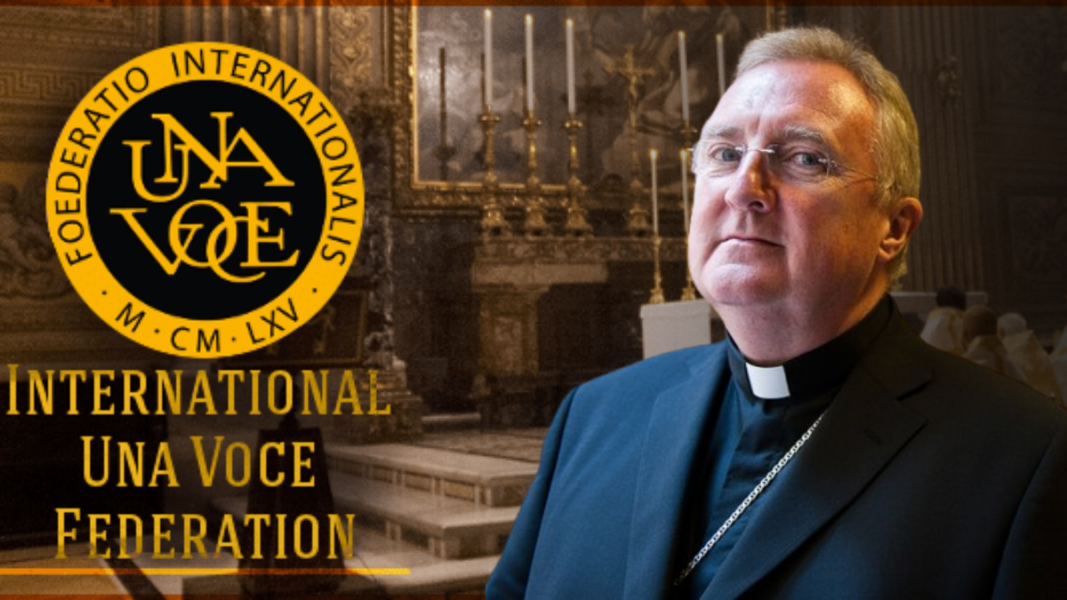
The International Una Voce Federation has published a critical analysis of the text that Cardinal Arthur Roche, prefect of the Dicastery for Divine Worship, would have distributed to the cardinals during the recent consistory in Rome. According to Una Voce, the document—disseminated by journalist Diane Montagna—insists on the need for “liturgical unity” as an argument to support restrictions on the Traditional Mass, without addressing the substantive objections raised by its critics.
Read also: They reveal Roche’s document on the liturgy
A text distributed, but not debated
According to the article, the liturgy was among the four issues initially proposed for the consistory, but the cardinals chose to address only two, leaving this point out. In that context, the text attributed to Roche would have been handed out, without formal discussion in the hall.
Una Voce maintains that there were versions in Italian and English, and even points out problems in the document’s translation, suggesting that the cardinal did not draft it personally.
The central thesis: reform and “unity” as foundation
Una Voce summarizes the text’s approach in three pillars: The liturgy changes and reforms throughout history through an “organic development”; The post-conciliar liturgical reform is linked to the authority of the Second Vatican Council and liturgical unity would be necessary to preserve the unity of the Church, supported by references to St. Pius V, Vatican II, Benedict XVI, and Francis.
The analysis considers that, instead of dialoguing with the criticisms of Traditionis custodes, the text “doubles down” and seeks to close the discussion with a historical-theological narrative already known.
The controversial point: “one and the same prayer”
Una Voce identifies as the core of the argument a quote attributed to Francis to justify Traditionis custodes: the idea that the Church must “raise… one and the same prayer” as an expression of unity, linking it to Paul VI’s Missale Romanum (1969).
In response to this, the text raises an objection that is worth explaining to the Spanish-speaking reader: the Catholic Church is not liturgically monolithic. There are Eastern rites in full communion with Rome and, in the West, proper uses and rites (for example, the Ambrosian). Additionally, in recent times, particular liturgical forms have been approved for specific contexts.
Una Voce’s point is that, if that legitimate diversity is admitted, it should be explained why the Roman Traditional Mass would be an obstacle to unity while other forms and rites would not be.
Vatican II: diversity without “rigid uniformity”
The article supports its criticism by citing two conciliar, references, the first: Orientalium Ecclesiarum (n. 6), where the Council asks the Eastern Churches to preserve or recover their own traditions and the second: Sacrosanctum Concilium (n. 37), where it is stated that the Church does not desire to impose rigid uniformity in the liturgy.
From that framework, Una Voce maintains that the argument “unity = uniformity” would be theologically weak and, moreover, poorly founded.
The debate on Paul VI’s translation
Another relevant point of the analysis is the use of Paul VI. Una Voce claims that the expression “one and the same prayer” would have been poorly translated or taken out of context, and that Paul VI’s intention in promulgating the new Missal was precisely to emphasize that, although vernacular languages were introduced, the Mass remained the same liturgical action: a “unique prayer” that unites the Church even amid linguistic variety.
The article concludes that that quote, used to justify restrictions on the Traditional Mass, would operate as an argumentative “maneuver”.
Historical criticism: reforms yes, “total rewriting” no
Una Voce also questions the parallelism between historical reforms (Trent and others) and the post-conciliar reform. In its judgment, those reforms did not involve a broad rewriting of texts, but adjustments based on manuscripts and editions considered more reliable.
Likewise, it maintains that Vatican II did not mandate each of the subsequent decisions of the reformers and recalls two principles of Sacrosanctum Concilium frequently used in this debate: that Latin should be preserved in the Latin rites (SC 36) and that innovation should not be made unless the good of the Church genuinely and certainly requires it (SC 23).
Una Voce’s Conclusion: it is not dialogue, but “rearguard reaction”
Finally, the article ends by stating that the text attributed to Roche does not intend to enter into a real discussion about Traditionis custodes, but rather “to avoid the debate” by insisting on an interpretive framework favorable to the suppression or restriction of the Traditional Mass. And it expresses the desire that, before advising Pope Leo XIV on this topic, the cardinals can also hear a complete response to those theses.