


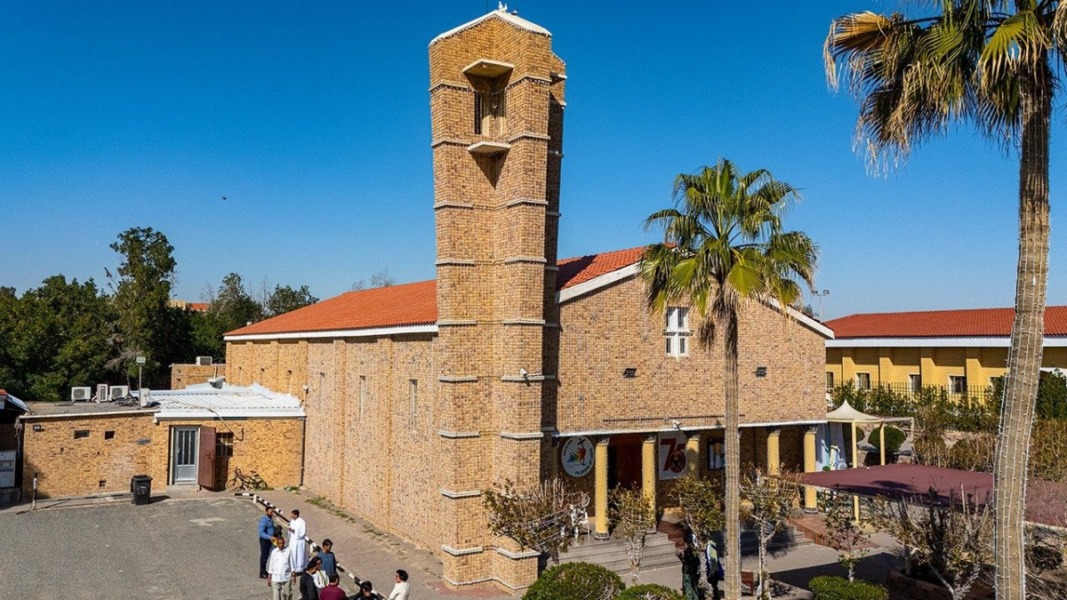
The Catholic Church in the Gulf is experiencing these days an unusual event: the solemn celebration of the proclamation of the church of Our Lady of Arabia, in Ahmadi (Kuwait), as a Minor Basilica. The act—presided over by Cardinal Pietro Parolin, Secretary of State of Leo XIV—takes place within his official visit to the country from January 15 to 16, 2026 and underscores the historical and spiritual weight of a temple that the joint communiqué itself presents as the first Catholic church built in Kuwait and a reference point for the Catholic community in the region.
An exceptional title in the Arabian Peninsula
The proclamation of Our Lady of Arabia as a Minor Basilica is not a minor gesture or merely ceremonial. According to Vatican sources, it is the first minor basilica in the Arabian Peninsula, a recognition usually reserved for temples with special historical, liturgical, and pastoral relevance. The elevation was granted on June 28, 2025 and is now officially celebrated with a solemn liturgy in Ahmadi.
The title of minor basilica elevates the symbolic rank of the temple, links it in a special way to Rome, and makes it a point of reference for the faithful, especially in territories where the Church lives as a minority.
The solemn Mass: Friday the 16th, at 10:00, in Ahmadi
The joint communiqué between the State of Kuwait and the Holy See sets the central date: the solemn celebration for the proclamation of the Minor Basilica will take place on Friday, January 16, 2026, at 10:00, in Ahmadi, and will be presided over by Cardinal Parolin.
A history that begins in 1948
Our Lady of Arabia is described as the “mother church” of Kuwait and the first Catholic church built in the country. Its origin dates back to a temporary chapel blessed on December 8, 1948, in the years when the Catholic presence began to organize stably in the emirate.
Later, the temple was consolidated in the 1950s: the Apostolic Vicariate of Northern Arabia indicates that the new temple was blessed on April 1, 1956, a date that marks the transition from a provisional chapel to a sanctuary with a permanent vocation.
A Catholic community marked by migration
In Kuwait—as in other Gulf countries—the Catholic community is largely made up of immigrant workers and their families. Therefore, a recognition like that of a minor basilica also serves a pastoral function: it gives visibility to a Church that lives discreetly, concentrated in a few temples, and depends on a peculiar ecclesial organization in the region.
Our Lady of Arabia belongs to the Apostolic Vicariate of Northern Arabia, which also covers Bahrain, Qatar, and Saudi Arabia.
The diplomatic background: relations with the Holy See since 1968
Parolin’s visit is not limited to the religious dimension. The communiqué recalls that Kuwait and the Holy See have maintained diplomatic relations since 1968, when the emirate became the first country in the Gulf Cooperation Council to establish them. The text also evokes the milestone of the visit of Emir Sheikh Sabah Al-Ahmad Al-Jaber Al-Sabah to the Pope on May 6, 2010, in addition to other institutional exchanges in 2009 and 2015.
Kuwait, for its part, takes the opportunity to reiterate its official discourse of mutual respect and peaceful coexistence between religions, framed in its Constitution.