


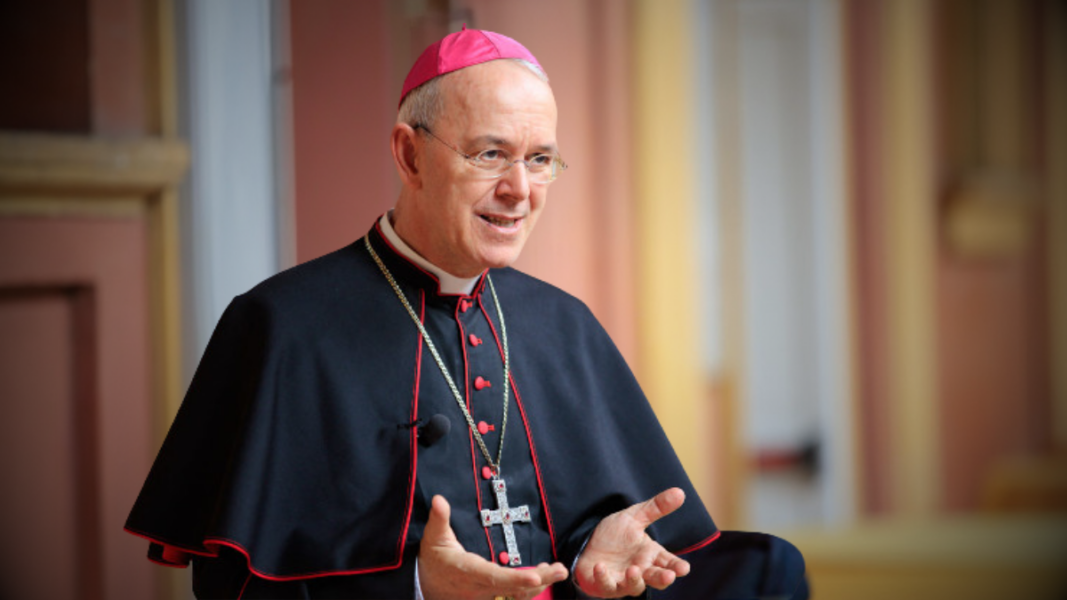
Monsignor Athanasius Schneider, auxiliary bishop of Astana (Kazakhstan), has stated that he personally proposed to Pope Leo XIV the promulgation of an Apostolic Constitution on the traditional Latin Mass to “regularize” the coexistence of the two uses of the Roman Rite and eliminate restrictions such as those imposed by Traditionis custodes. In an interview with Christopher P. Wendt (Confraternity of Our Lady of Fatima), Schneider argues that it would not be appropriate to respond with an “anti–motu proprio,” but rather to elevate the matter to a more solemn text with clear legal norms.
“Not an anti–motu proprio, but a more solemn document”
Schneider explains that, in the long term, the solution would not involve “directly annulling” Traditionis custodes, but rather a legal act of higher rank than a motu proprio. According to his approach, the Pope should promulgate a document “above” that type of text to establish a new and stable framework.
In his words, the purpose would be a “solemn regularization” that guarantees complete freedom and a “peaceful coexistence” of both forms, “without limitations or impediments”.
What would change in practice: limit on the restrictive power of bishops
The most concrete point of the argument is legal and pastoral: Schneider states that if the Pope established that framework by pontifical law, a bishop could not prohibit or restrict the celebration of the traditional liturgy wherever a priest wished to celebrate it legitimately.
In the dialogue, the case of Charlotte (North Carolina, USA) is cited as an example of recent conflicts over celebrations of the 1962 Missal. Schneider’s thesis is that the new text should establish that the bishop would have “no more right” to limit the traditional form than to prohibit the Novus Ordo.
“Two ordinary forms,” not “extraordinary”
Schneider goes beyond the usual language following Summorum Pontificum and argues that both should be considered ordinary forms of the Roman Rite, not one “extraordinary.” With this, he seeks to reinforce the idea of a stable right for priests and faithful to celebrate and attend the traditional liturgy.
Why he proposes an Apostolic Constitution
The bishop argues that an Apostolic Constitution is one of the most solemn forms of the magisterium and pontifical government and can incorporate legal norms. For this reason, he sees it as more appropriate than a motu proprio to resolve the conflict definitively.
As examples, he mentions that St. Pius V promulgated the Missal after Trent through an Apostolic Constitution and that Paul VI did the same when promulgating the 1969 Missal.
It is clear that the liturgical tension will not be resolved with slogans or gimmicks, but with clear and stable decisions that restore peace and justice in the concrete life of parishes. For now, it remains to wait patiently to see how the liturgy issue unfolds.