


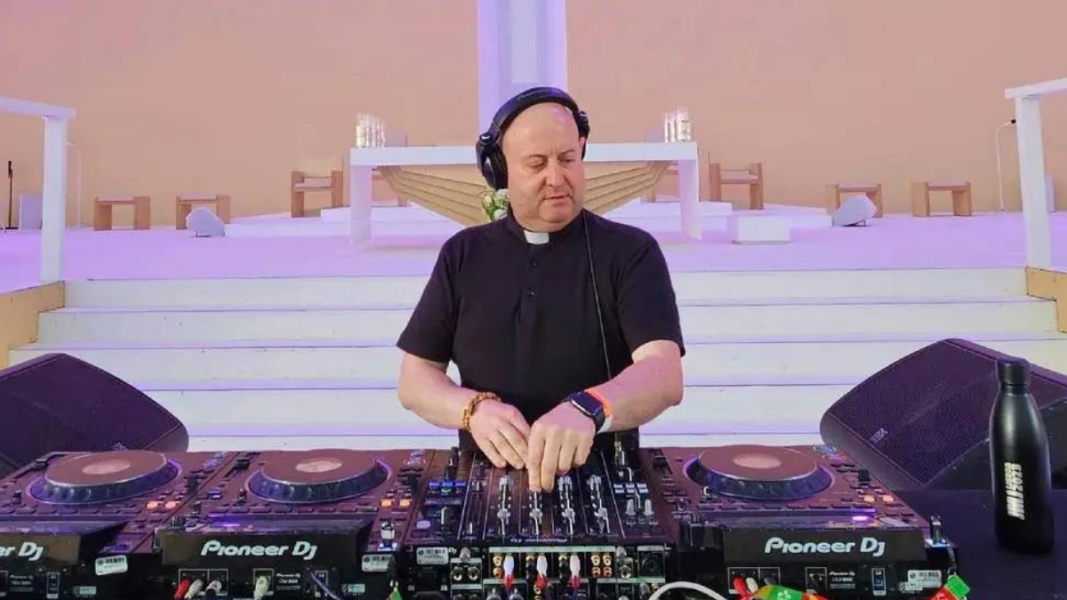
In an exhausted Lebanon due to crises, threats, and insecurity—with the background of military pressure, the issue of Hezbollah’s weapons, and Israeli bombings in the south and the Bekaa Valley—a seemingly minor controversy has ended up dividing public opinion: the visit of the Portuguese priest Guilherme Peixoto, known as “Father Guilherme”, to celebrate Mass in Beirut and then perform as a DJ in a nightclub. This is reported by La Nuova Bussola Quotidiana, which describes the episode as a symptom of the ecclesial confusion of our time.
The priest became famous at the JMJ de Lisboa 2023 by playing music during a vigil with Pope Francis. Since then, according to the report, he has multiplied performances in youth environments with the intention of “bringing young people closer to God” through techno-house. In Beirut, he was invited by Maronite priests from the Universidad del Espíritu Santo to celebrate an open Mass on Saturday, January 10 on the university campus.
From Mass to the Club: Tickets, Complaint, and Failed Ban
The second part of the plan was a shift in tone: a midnight session at AHM, a nightclub in the capital. The event was publicly promoted and tickets were initially sold—according to the medium—between 35 and 40 pounds, with a subsequent increase to 95 pounds on the eve after the controversy broke out.
The trigger came on January 4, when a group of about eighteen people—including some priests—presented a petition to a judge requesting urgent measures to prevent the concert, considering that it “violates the morals and teachings of the Church” and distorts the image of the faith and Christian rites. On January 9, the judge rejected the petition due to procedural irregularities. That same day, the club assured that there would be no religious symbols and that the priest would not wear clerical clothing, which deactivated the planned protest in front of the venue.
More Followers in the Booth Than in Front of the Altar
The chronicle of La Nuova Bussola focuses on an uncomfortable fact: those who went to the club, for the most part, had not attended the Mass. Some confessed to going out of “curiosity” or because of the social media phenomenon. Others defended that “the Church is not just going to Mass” and celebrated the “bridge” with young people. There even appears the argument of emotional obedience: a young woman states that she trusts because she believes that Pope León XIV supports it, having seen a video of the Pontiff during a concert by the priest in Slovakia (data that the medium presents as a comment from an attendee, not as a verified fact).
Once inside the venue, the article describes an ordinary nightclub atmosphere—private security, bar, audience dressed to go out partying—and a “repetitive” nineties techno session, with “mystical” interludes of bells, fragments of “Gloria” and “Alleluia,” and projections on screens with images like a white dove, John Paul II, and a rainbow. The closing included “Give Peace a Chance” and a video with Francisco’s “All, all, all.” The report concludes by summarizing the night “like any other,” perhaps with “a bit less drugs,” and a final feeling of wasted pastoral opportunity.
The Heart of the Problem: Evangelization or Banalization
The underlying discussion is not whether a priest can use contemporary languages, but what is communicated when the priestly symbol is transferred without filters to a DJ booth. If to “bring closer” it is required to empty the sacred of its signs—without cassock, without symbols, without explicit reference to the truth of the Gospel—the result looks less like evangelization and more like adaptation: the world is not converted; the Church mimics itself.
Authentic evangelization has never consisted of competing with entertainment, but of offering what entertainment cannot give: meaning, truth, conversion, sacraments. And when the priest appears as a “night influencer” and daytime pastor, the practical message ends up being the one the audience itself saw: more attraction in the club than at Mass.