


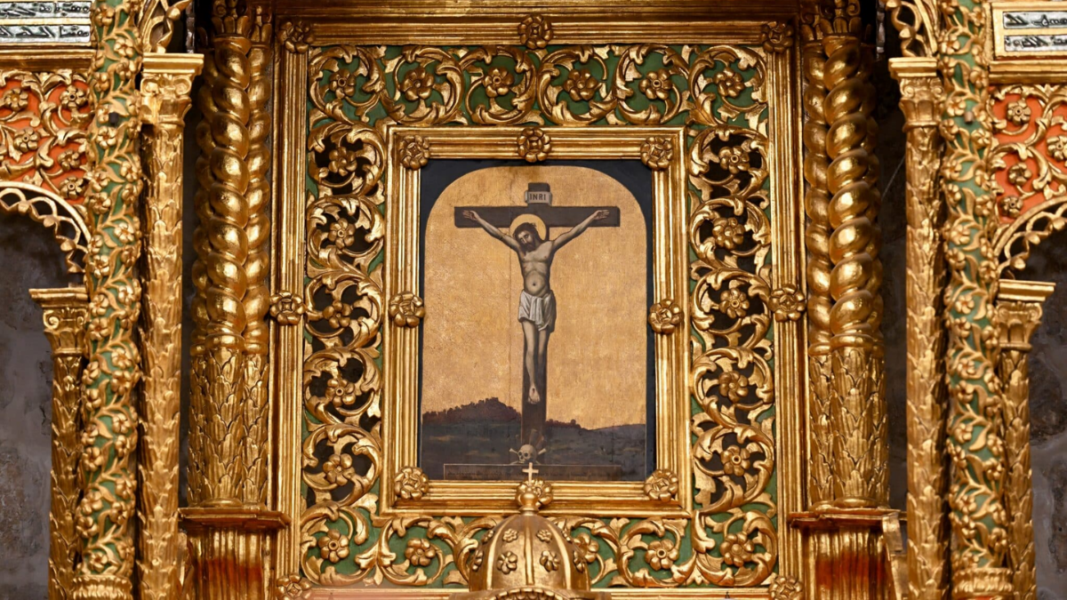
The historic altar of the Syriac Orthodox Patriarchal Monastery of San Marcos, in the Old City of Jerusalem, has been unveiled for the first time in nearly 350 years following a thorough restoration. The reopening, on January 11, allowed the details in gold leaf and the Baroque decoration to be seen again, which had remained hidden for centuries under damage, retouches, and ancient repairs.
According to OSV News, the Syriac Orthodox patriarchal vicar for Jerusalem, Jordan, and the Holy Land, Mons. Mor Anthimos Jack Yakoub, described the completion of the work as “a miracle.” The restoration was carried out by a team of five Mexican experts linked to the Catholic channel María Visión, and it lasted for two years, with an interruption of eight months due to the Hamas attack on October 7, 2023 and the subsequent war, which complicated any project in the area.
The importance of the monastery is not only artistic. According to Syriac Orthodox tradition, this place is identified with the house of Mark, where Jesus would have instructed Peter and John to prepare the Passover, and it is also associated with the Upper Room, the setting for the Last Supper, the washing of the feet, appearances of the Risen One, and Pentecost. In the archbishop’s words, from there the first Church “was strengthened” and the Gospel spread to the peoples.
The community had been wanting to recover the altarpiece for years. Its color had faded due to ancient interventions—including a chemical “golden” spray applied some time ago—and an inscription at the top of the altar indicates that the last official restoration was carried out in 1733. Studies cited in the report suggest that the piece could be about 400 years old. The tests also revealed a critical problem: the ensemble was infested with termites and, without urgent intervention, could collapse within a year.
The project had a cost that was difficult for a small community to assume: nearly half a million euros (about 600,000 dollars). The solution came, as they recount, through a “providential” coincidence with Emilio Burillo, founder of María Visión, who committed to providing the team and the work for free. The initiative was also expanded to other elements of the temple: the liturgical altar, the domes, the decoration, the icons and their frames, the episcopal throne, the baptistery, and other historic furnishings.
Among the restored pieces is also the Miraculous Image of the Virgin Mary, venerated by the community and attributed by tradition to St. Luke. Restorer Carlos Lozoya explained that the icon was very darkened by the passage of time, candle smoke, and accumulated dirt, and that the process allowed the original colors to be recovered without damaging the painting. The team sent samples to specialists in Madrid to determine the age of the icon, with results expected by the end of January.