


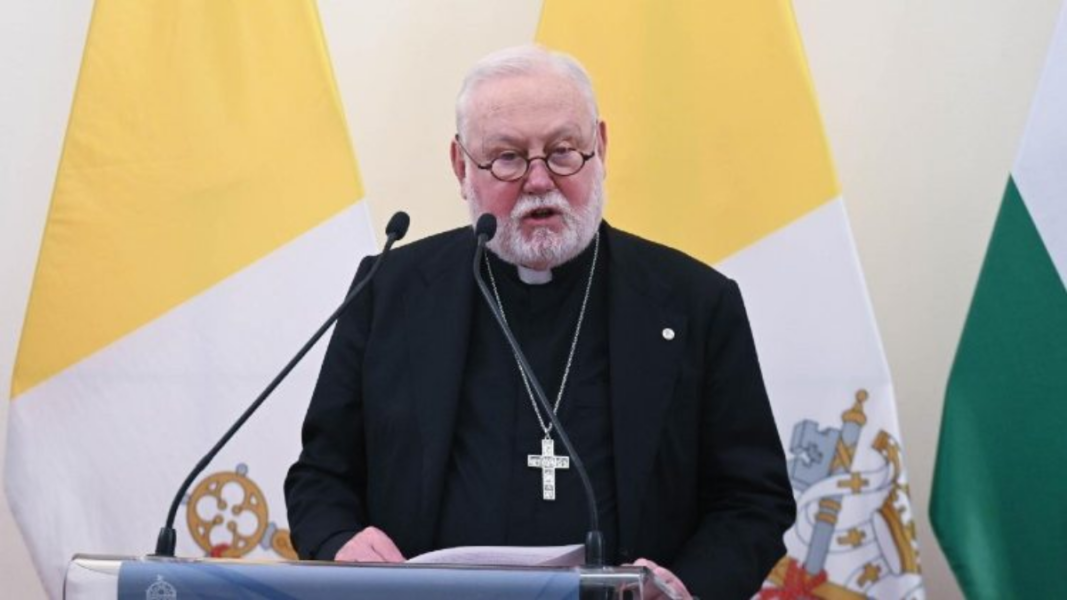
The Vatican Secretary for Relations with States, mons. Paul Richard Gallagher, denounced on this January 13 in Rome that surrogacy turns the person into an object of transaction and constitutes a “new form of colonialism” sustained by market mechanisms that end up exploiting the most vulnerable. He did so during the dialogue “A Common Front for Human Dignity: Preventing the Commodification of Women and Children in Surrogacy”, held at the Embassy of Italy to the Holy See (Palazzo Borromeo).
The intervention was supported by the recent words of Pope Leo XIV, who on January 9, 2026, before the Accredited Diplomatic Corps, described the practice as a violation of the dignity of the child—reduced to a “product”—and of the mother—instrumentalized in her body and generative process—, by transforming gestation into a “negotiable service”.
“The center cannot be the adult’s desire”
Gallagher argued that the underlying problem is the commodification of the person: even when presented as a “generous” gesture, contractual logic ends up placing the adult’s interest above the child’s well-being. In his analysis, the child becomes “delivered” by virtue of a contract and the woman is reduced to a reproductive instrument, with direct social consequences on the understanding of motherhood and human dignity.
The prelate also emphasized that formal consent is not always a guarantee against abuse: many agreements are signed under economic pressure and through intermediary agencies that limit real freedom of decision.
Against regulation: “the only coherent response is to abolish”
The meeting also addressed the international debate on whether it is advisable to ban or regulate the phenomenon. Gallagher warned that regulation can be “inadequate and counterproductive”, because by facilitating and “ensuring” procedures, it increases demand and, therefore, supply: more contracts, more women exposed to exploitation, and more children treated as merchandise.
Italy defends its penal tightening since 2024
In the same dialogue, the Italian Minister of Family, Birthrate and Equal Opportunities, Eugenia Maria Roccella, participated and defended Italy’s legislative line, rejecting that it can be spoken of as a “donation” in surrogacy: “a pregnancy cannot be contractualized”, she argued, insisting that the priority must be the protection of the minor and coordinated action in multilateral forums.
The Holy See: international work and defense of the minor
Gallagher concluded by appealing to shared work at the international level to prevent the practice from becoming entrenched especially in poorer countries, recalling that “no one has a right to a child”, that it is a gift, and that the Holy See’s diplomacy will continue to insist on the protection of children’s rights.