


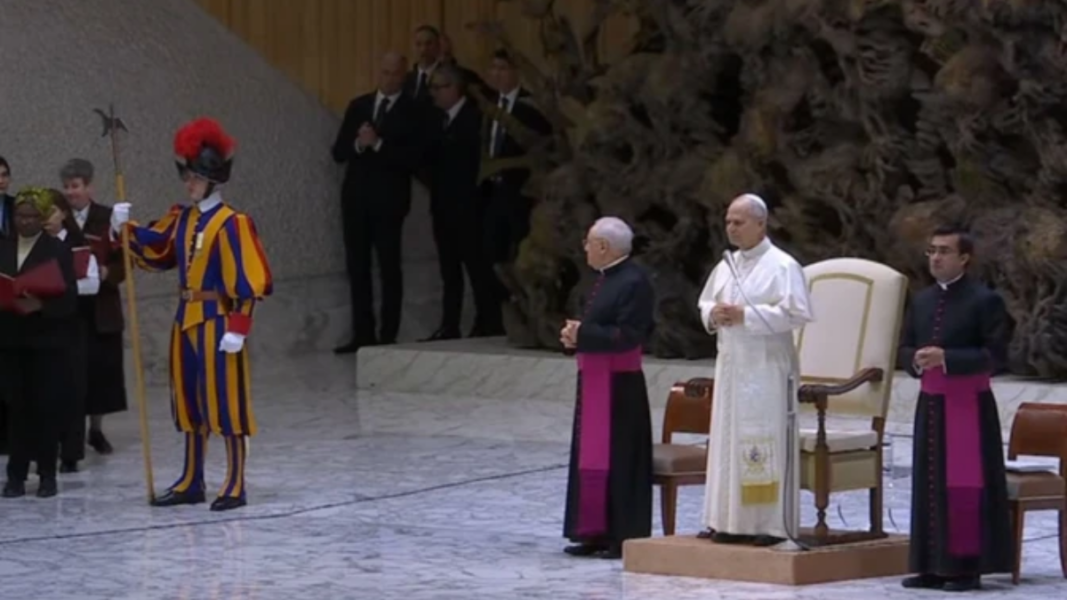
In the General Audience of January 14, 2026, held in the Paul VI Hall before pilgrims from Italy and various countries, Leo XIV continued with the second catechesis of his new series on the Second Vatican Council, beginning the reading of the dogmatic constitution Dei Verbum on divine Revelation.
The Pope emphasized as the central idea that God addresses man “as to friends” and that in Jesus Christ that relationship becomes fully personal and definitive: a new and eternal covenant that is expressed in a real dialogue, made of true word and listening, and that is cared for in liturgical and personal prayer. He also warned that friendship with God can be eroded by daily lukewarmness, and invited to not disregard the call of Christ and to guard it as a path of salvation.
We leave below the complete words of Leo XIV:
Dear brothers and sisters, good morning and welcome!
We have begun the cycle of catecheses on the Second Vatican Council. Today we begin to delve into the Dogmatic Constitution Dei Verbum on divine Revelation. It is one of the most beautiful and most important documents of the conciliar assembly; to introduce ourselves to it, it may be useful for us to recall the words of Jesus: “I no longer call you servants, because a servant does not know his master’s business. Instead, I have called you friends, for everything that I learned from my Father I have made known to you” (Jn 15:15). This is a fundamental point of the Christian faith that the Dei Verbum reminds us of: Jesus Christ radically transforms the relationship of man with God; from now on, it will be a relationship of friendship. Therefore, the only condition of the new covenant is love.
In commenting on this passage from the fourth Gospel, Saint Augustine insists on the perspective of grace, which is the only thing that can make us friends of God in his Son (Commentary on the Gospel of John, Homily 86). Indeed, an ancient motto said: “Amicitia aut pares invenit, aut facit”, “friendship either arises among equals or makes them such.” We are not equal to God, but God himself makes us like him in his Son.
Therefore, as we can see in all the Scriptures, in the Covenant there is a first moment of distance, since the pact between God and man always remains asymmetrical: God is God and we are creatures. But with the coming of the Son in human flesh, the Covenant opens to its ultimate end: in Jesus, God makes us children and calls us to become like him despite our fragile humanity. Our likeness to God, then, is not achieved through transgression and sin, as the serpent suggested to Eve (cf. Gen 3:5), but in the relationship with the Son made man.
The words of the Lord Jesus that we have recalled – “I have called you friends” – are taken up in the Constitution Dei Verbum, which states: “Through this revelation, the invisible God (cf. Col 1:15; 1 Tm 1:17) speaks to men as friends, moved by his great love, and dwells with them (cf. Bar 3:38), to invite them to communion with him and to receive them into his company” (n. 2). The God of Genesis already manifested himself to our first parents, dialoguing with them (cf. Dei Verbum, 3); and when this dialogue was interrupted because of sin, the Creator did not cease to seek to meet his creatures and establish a covenant with them each time. In the Christian Revelation, that is, when God becomes flesh in his Son to come and seek us, the dialogue that had been interrupted is definitively restored: the Covenant is new and eternal, nothing can separate us from his love. The Revelation of God, therefore, has the dialogical character of friendship and, as happens in the experience of human friendship, it does not tolerate silence, but is nourished by the exchange of true words.
The Constitution Dei Verbum also reminds us of this: God speaks to us. It is important to understand the difference between the word and chatter: the latter stops at the surface and does not achieve communion between persons, while in authentic relationships, the word not only serves to exchange information and news, but also to reveal who we are. The word has a revelatory dimension that creates a relationship with the other. Thus, by speaking to us, God reveals himself to us as an Ally who invites us to friendship with him.
From this perspective, the first attitude we must cultivate is listening, so that the divine Word can penetrate our minds and our hearts. At the same time, we are called to speak with God, not to communicate to him what he already knows, but to reveal ourselves to him.
Hence the need for prayer, in which we are called to live and cultivate friendship with the Lord. This is realized, first of all, in liturgical and communal prayer, in which it is not we who decide what to hear from the Word of God, but it is he himself who speaks to us through the Church. Furthermore, it is fulfilled in personal prayer, which takes place in the interior of the heart and mind. During the day and the week of the Christian, time dedicated to prayer, meditation, and reflection cannot be lacking. Only when we speak with God can we also speak about him.
Our experience tells us that friendships can end because of some clamorous gesture of rupture, or also because of a series of daily inattentions that wear down the relationship until it breaks. If Jesus calls us to be his friends, let us try not to disregard his call. Let us welcome it, care for this relationship, and we will discover that friendship with God is our salvation.