


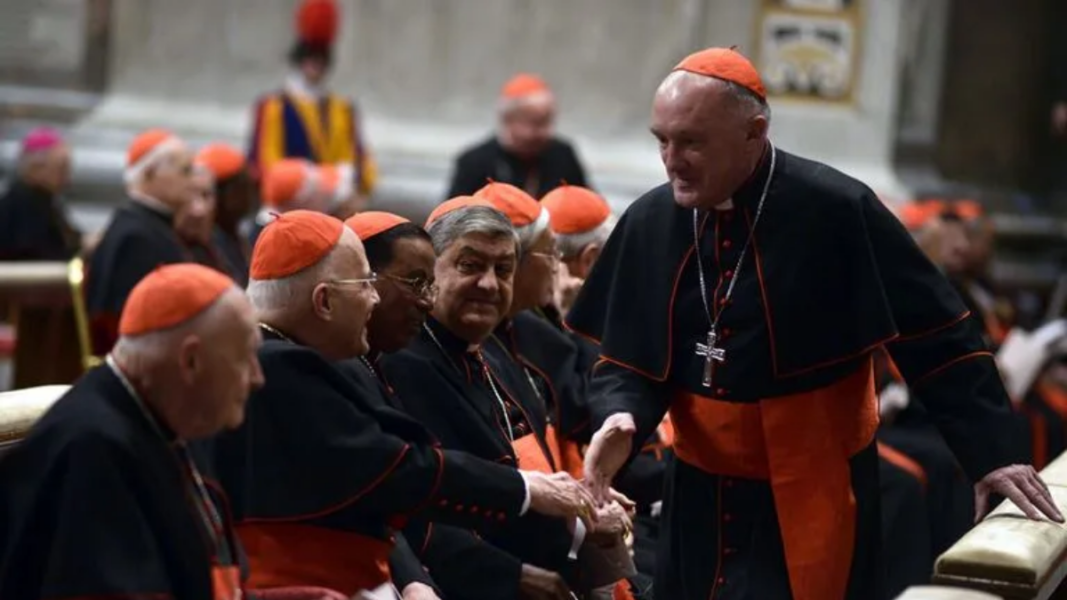
At the end of the extraordinary consistory, several cardinals appeared before the press to answer questions about synodality and the participation of the lay faithful. In the press conference, as reported by The Catholic Herald, Cardinal Luis José Rueda Aparicio, Cardinal Stephen Brislin, and Cardinal Pablo David intervened, in an exchange that revealed both the desire to consolidate the synodal process and the doctrinal limits required by a Catholic understanding of authority and priesthood.
The British medium posed a central question: how to ensure that synodality—presented by some as a process still “in its infancy”—remains anchored in doctrine and tradition, and what distinction is being drawn between the legitimate participation of the laity and the proper functions of the ministerial priesthood and the episcopate.
“We are not Church if we are not in mission”
Cardinal Pablo David from the Philippines framed synodality within the mission. He affirmed that the mission can no longer be understood as a task delegated to missionary congregations, but as the mission of the entire Church. In that framework, he insisted that Christian life is not only following, but also “apostolicity”: actively participating in the mission of proclaiming the Gospel, especially to those who live wounded, hopeless, or in situations of rupture.
From that perspective, David presented synodality as a form of co-responsibility: listening to and counting on those who are not ordained ministers—laity and religious—in the life of the Church.
Clericalism as an obstacle
Furthermore, David pointed out clericalism as a structural problem that hinders real participation. According to his approach, talking about co-responsibility is empty if a mentality of control is maintained in which the clergy perceives itself as the exclusive owner of ecclesial direction by the fact of ordination. In his vision, synodality seeks precisely to open channels so that other voices can be heard, avoiding a Church governed by the logic of “I command.”
He also rejected the idea that synodality is a “novelty” invented now: he maintained that it has been present since the origins, although today a specific vocabulary is being recovered. For him, terms like communion, participation, mission, and co-responsibility describe the same reality.
A process with divergences: “conversations in the Spirit”
David was explicit in admitting that the synodal path will bring disagreements to light. In his view, the existence of divergences should not cause alarm, but rather spur more dialogue, through what he called “conversations in the Spirit”: a form of mutual listening oriented toward discernment, not only personal opinions, but the action of the Holy Spirit in ecclesial life. He acknowledged, however, that community discernment is a discipline still “in development,” whose criteria are being refined in the process itself.
On the other hand, the Colombian cardinal, Luis José Rueda Aparicio, maintained a more gradualist tone. He emphasized that synodality advances at different rhythms in each country and that in some local churches there is greater experience and availability of the laity than in others. For that reason, he asked for patience: evangelizing renewal and the maturation of broader participation require time, without forcing uniform models for the entire Church.
The most delicate point: in persona Christi
The debate became especially sensitive when the issue of hierarchy and priesthood was addressed. In response to direct questions about the “divinely constituted” nature of the hierarchy, David affirmed that the hierarchy exists and that the Church recognizes the ministerial priesthood. However, he insisted that this is only fully understood in relation to the common priesthood of the faithful, a theological principle highlighted by the Second Vatican Council.
According to The Catholic Herald, the cardinal took it a step further by affirming that the ordained “do not have the monopoly” of acting in persona Christi. He argued that Christ is not only head, but head and body, and that the baptized participate in that reality by the same dignity of baptism.
Here a real risk opens up: when the language about participation is formulated in a way that seems to dilute the distinction between common priesthood and ministerial priesthood, the matter ceases to be merely pastoral and enters doctrinal territory. The question is not whether the laity should be listened to—something evident—but whether synodality is understood as consultation or as a form of “co-governance” that confuses the sacramental structure of the Church.
Between reform and continuity
In its analysis, The Catholic Herald also warns of the contemporary use of the term “clericalism,” which often functions as a broad label to denounce abuses without specifying exactly what is being condemned. The risk is that, by using it routinely, the hierarchy itself ends up being presented as suspicious, instead of precisely distinguishing between legitimate authority and abuse of power.