


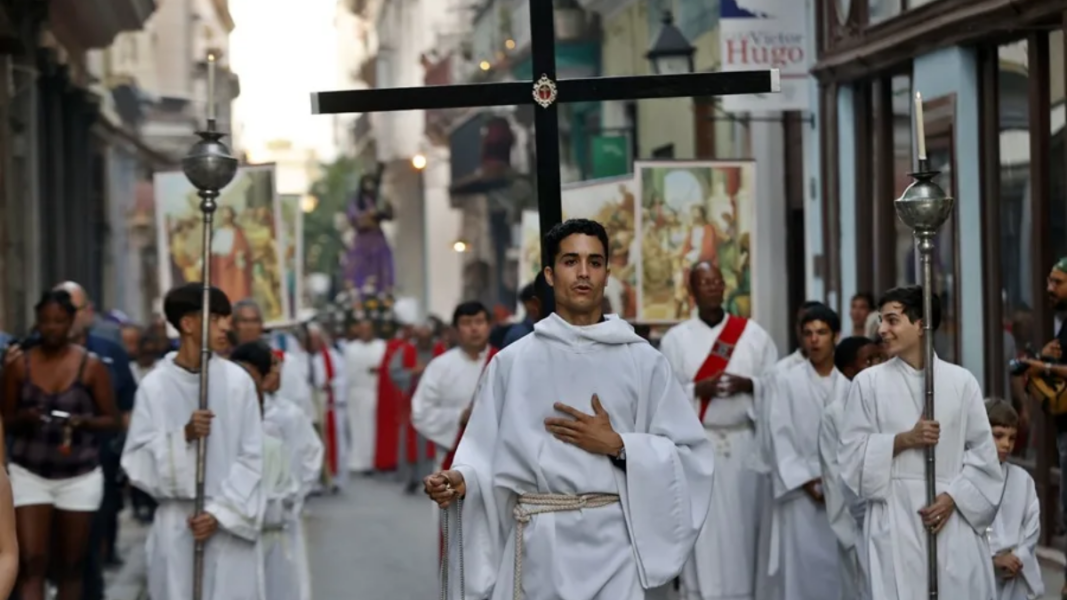
There are phrases that, even while pretending to defend the Church, end up saying exactly what they shouldn’t. And this is one of those cases.
A viral tweet attributes the following statement to a priest: «Catholics are the only institution that will outlast the State, the Masons, or the PSOE.» The phrase is forceful, combative, effective on social media… and theologically incorrect. The problem is simple: Catholics are not an institution.

The institution is the Church.
And it’s not a minor nuance, nor an academic subtlety, nor a scholastic quirk. It’s an essential difference, and forgetting it means unwittingly buying into the same conceptual framework used by those who reduce the Church to an NGO, a lobby, or just another political actor.
What the priest says (and says well)
If one listens to the full audio, the priest does not fall into that error. He speaks of the Church’s endurance, its historical continuity in the face of regimes, ideologies, and passing powers. Nothing new under the sun: just open the Gospel or review two thousand years of history to see that empires, parties, and systems come and go; the Church remains.
That is correct. That is Catholic. That is doctrine.
The problem arises when someone decides to tweak the phrase for Twitter and ends up making it worse for theology.
The tweet’s slip-up: when language betrays the substance
Saying that «Catholics are an institution» is not a mere rhetorical imprecision. It assumes a deeply modern and sociological logic, where the Church dissolves into a mass of self-defined individuals, organized as an identity collective against other collectives.
But the Church is not the sum of Catholics, nor a civil association with a membership card. It is a divine institution, founded by Christ, with structure, sacraments, hierarchy, and objective continuity independent of the moral quality, number, or fervor of its members.
Catholics pass away. The Church endures.
We die. The Church continues.
We fail. The Church remains holy.
Confusing this does not strengthen the message: it weakens it.
When the mental framework is that of the adversary
Paradoxically, getting it wrong ends up aligning more closely with progressive discourse than with Catholic discourse. Because it is ecclesiastical progressivism that insists that «we are all the Church,» understood not as the Mystical Body of Christ, but as a horizontal assembly, mutable, hostage to the sociological consensus of the moment.
No: the Church is not «us.» We are within the Church, by grace, not by appropriation.
And precisely for that reason, the Church will outlast the PSOE, Freemasonry, and any State, not because Catholics are numerous, strong, or combative, but because Christ has promised that the gates of hell will not prevail against it. Period.
Defending well what is true
The priest says something true. The tweet spoils it. And precisely because the substance is good, it’s worth not letting a poor formulation tarnish it.
In times of doctrinal confusion, language matters. A lot.
Especially when speaking of the Church.
Because we are not an institution.
And precisely for that reason, we belong to one that will never pass away.