


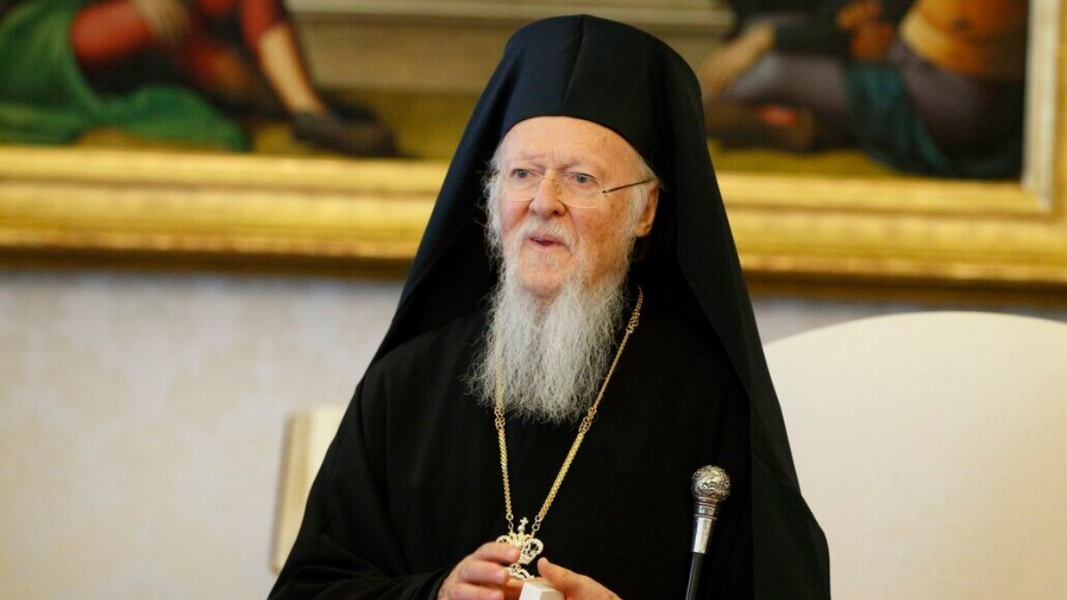
Russia’s Foreign Intelligence Service (SVR) has published an extraordinarily harsh statement against His Holiness Bartholomew I, Ecumenical Patriarch of Constantinople, accusing him of undermining the unity of Orthodoxy and acting with the alleged support of the United Kingdom’s intelligence services.
The statement, disseminated through the official website of the agency, represents a further step in the growing confrontation between Moscow and Constantinople, which have maintained an open conflict for years due to the Ukrainian issue and the recognition of new ecclesiastical structures outside the Russian orbit.
Extreme Language and Theological Accusations
In the text, the SVR goes so far as to describe the Ecumenical Patriarch as the “Antichrist of Constantinople”, an expression with a clearly theological charge and unprecedented in an official statement from a state intelligence service. According to the Russian agency, Bartholomew would be actively promoting division within the Orthodox world with the aim of weakening the Moscow Patriarchate.
The agency claims that the Patriarch has already “dismembered Orthodoxy in Ukraine” and that he is currently focusing his efforts on the Baltic countries, where—according to this version—he would be trying to replace the jurisdictions historically linked to Moscow with new structures dependent on the Phanar, the seat of the Ecumenical Patriarchate in Istanbul.
The Focus on the Baltic Countries
According to the statement, this strategy would include attempts to attract clergy and faithful from Lithuania, Latvia, and Estonia to abandon churches under Russian jurisdiction. The SVR claims that Constantinople would be promoting these initiatives with the support of local political actors, whom it controversially describes as “nationalists” and “neo-Nazis”.
“Relying on ideological allies in the form of local nationalists and neo-Nazis, it is trying to tear the Orthodox Churches of Lithuania, Latvia, and Estonia away from the Moscow Patriarchate, attracting their priests and faithful to puppet religious structures artificially created by Constantinople”, the text states.
Montenegro and the Serbian Church
The Russian statement adds a new front to the conflict by claiming that Bartholomew intends to grant autocephaly to the Montenegrin Orthodox Church, an entity not canonically recognized by the entire Orthodox world. According to the SVR, this eventual decision would be aimed at weakening the Serbian Orthodox Church, traditionally influential in the region.
An Ecclesiastical Conflict with Geopolitical Dimensions
The statement concludes by resorting again to religious language, in which the Ecumenical Patriarch is accused of “tearing the living body of the Church” and is compared to “false prophets who come dressed in sheep’s clothing, but inwardly they are ravenous wolves”.
These accusations, coming from a state agency and formulated in both political and theological terms, demonstrate to what extent the conflict between Moscow and Constantinople has transcended the strictly ecclesiastical sphere to insert itself into a broader dispute, where issues of canonical jurisdiction, national identity, and international geopolitics intersect.