


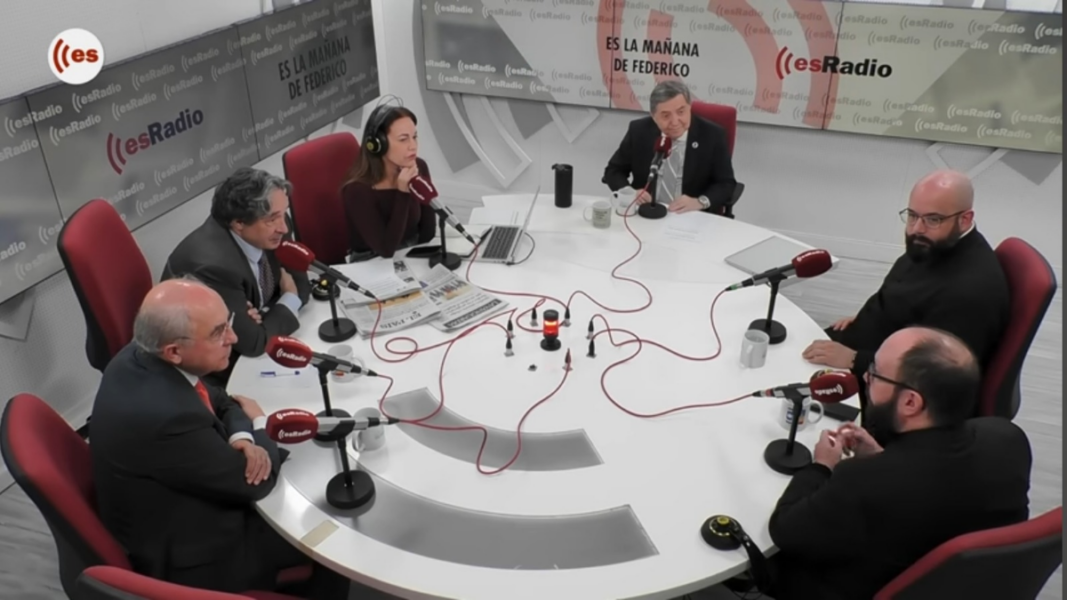
This morning’s interview by Federico Jiménez Losantos with Francisco José Delgado and Father Góngora, reference priests of La Sacristía de la Vendée, does not surprise those who have been following the evolution of the most well-known conservative communicator on Spanish radio. Receiving the priests of La Sacristía in prime time has not been an isolated episode nor a simple radio concession to a confessional niche. Rather, it fits into an intellectual process that the veteran communicator has been developing on air for months: a historical journey through the French Revolution and its consequences, read not as the foundational myth of political modernity, but as an original trauma.
In that narrative, the Vendée appears as more than a forgotten civil war: as the first ideological genocide of the contemporary era and as the laboratory of a State that, in the name of reason and progress, inaugurates a totalizing violence against faith, tradition, and the inherited social order. For a regular listener of EsRadio, this drift cannot help but be striking. Federico Jiménez Losantos does not come precisely from a humus counterrevolutionary: his intellectual biography starts in university Trotskyism and evolves toward a classical liberalism deeply marked by Spanish Enlightenment anticlericalism.
And yet, something is moving
Federico’s interest in the Vendée, in the Mexican Cristeros, or in the religious persecution in Spain in 1936 no longer seems merely historical. In those episodes, he discovers a pattern: when the modern State emancipates itself from any transcendent limit, the Church appears—paradoxically—as the last real counterpower. Not a political actor in the strict sense, but an instance that denies power its claim to totality.
That’s where the crack occurs.
Without explicitly embracing a theological worldview, Federico begins to recognize in the Church—the Church that resists, the one that is persecuted—something that classical liberalism intuited but never fully assumed: that freedom needs a prepolitical ground, and when that ground disappears, the State tends to occupy everything. The Vendée interests him not so much as a pious epic, but as a political warning.
In this context, his progressive attention to ecclesial voices that, until recently, would have been off his radar is understood. He has declared himself a reader of Olivera Ravasi; he listens with interest to the catechism that Father Zarraute develops from the texts of Monsignor Athanasius Schneider; he speaks naturally about the Traditional Mass and about a Church that, far from diluting itself in modernity, begins to resurge as a reaction to it.
It is not (for the moment) a conversion, nor does it seem to seek to be one. It is something else: an intellectual approach from the Enlightenment suspicion toward a tradition that, against all odds, continues to produce meaning.
The decisive factor: the young traditional priests
Francisco José Delgado and Father Góngora do not fit the cliché of the nostalgic or resentful priest. Their media presence—also in formats like La Sacristía de la Vendée—combines solid training, sharp rhetoric, and a surprising ability to navigate the contemporary cultural terrain without complexes or the need for permanent translation. They do not ask for permission or apologies. They speak from within a tradition that they do not present as an identity refuge, but as an intelligible proposal.
That charisma breaks barriers. Not only with Catholic listeners, but with profiles like Federico’s: intellectuals trained in modern suspicion who discover, almost against their will, that the Catholicism that had been presented to them as residual or reactionary possesses a historical and philosophical density that liquid modernity has not managed to replace.
Traditional Catholicism no longer only appeals to the convinced or resurges as a fashion among the youngest. It is beginning to do so with intellectuals who sought answers in the Enlightenment and find themselves with its ruins. What they never achieved at COPE with all the episcopal apparatus, it seems that a small group of young priests is beginning to achieve.