


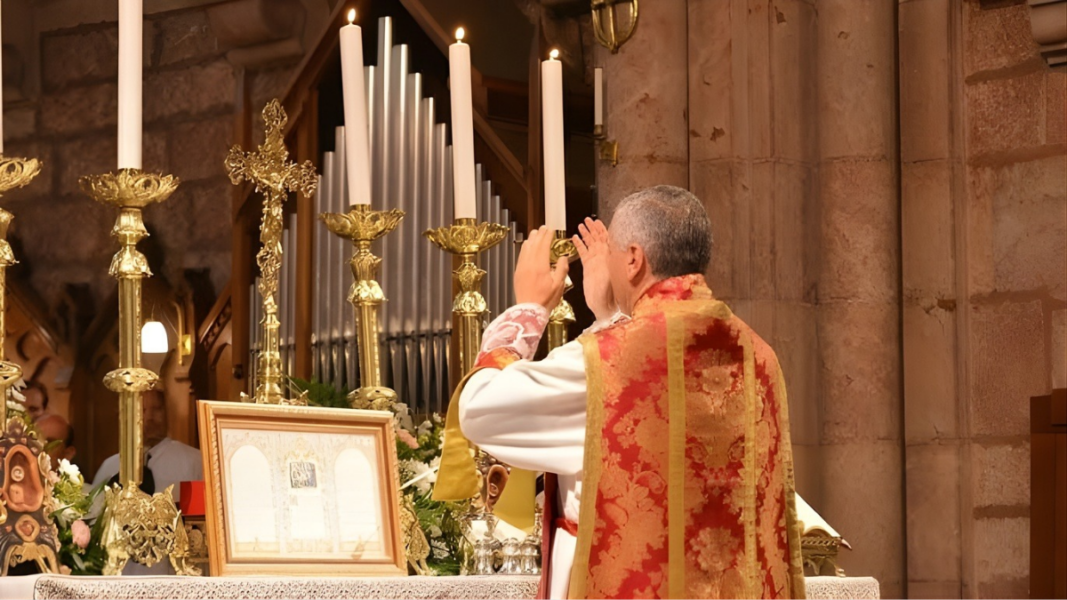
The faith of the Church does not arise from decrees, nor is it sustained by pastoral plans or strategies, nor is it imposed by administrative consensus. And that faith—lex credendi—is expressed in the lex orandi. Because the law of prayer is not a mutable regulation, but the organic, historical, and spiritual expression of the lived faith of the Church throughout the centuries. Therefore, any assertion about the liturgy that presents itself as definitive, totalizing, or exclusionary must be examined with special care. It is not enough to invoke authority, not even pastoral intention; it is necessary to respect the very nature of that which is being discussed. The liturgy belongs to the believing heart of the Church before its normative apparatus. It is worth remembering this in these days, when we are told that authoritative voices—in principle—seek to identify liturgical unity with the exclusive universalization of a specific ritual form, arisen in a very recent moment of ecclesial history, and presented—with surprising audacity—as if it were the ultimate measure of Tradition.
It will be said that the past is not denied, that the present is simply “oriented”; that the previous is not explicitly condemned, but tolerated in a transitory manner. But the history of the Church teaches that what is systematically relegated ends up being disauthorized in practice, even if it is preserved in language.
The Church has never known a lex orandi born by spontaneous generation: never did the common prayer of the People of God spring forth as a product of a pastoral laboratory, nor was it the result of a will to rupture, nor did it need to justify itself against what it itself had been for centuries. Authentic liturgy does not appear as a solution to a problem, but as the continuity of a life.
The traditional Roman liturgy—the Mass celebrated by saints, martyrs, doctors, missionaries, and entire peoples for centuries—is not an archaeological piece, nor an aesthetic option, nor a nostalgic sigh. It is a theological fact, a rite that has grown serenely, slowly, by sedimentation, by fidelity, by veneration, under the custody of the Church and not under the whim of a specific era. It has expressed in a stable manner the Catholic faith in the Sacrifice, in the ministerial priesthood, in the Real Presence, in adoration, in the transcendence of the Mystery.
To reduce this reality to a mere “sensitivity” or a “taste” particular—as is sometimes suggested with ignorant and, therefore, insolent lightness—is to fail to recognize what the liturgy is: theology in act, doctrine prayed, faith kneeling.
That is what lex orandi means, in its proper and strong sense: not a form interchangeable with others, but a spiritual norm that has shaped the lex credendi for centuries. To claim that this normativity suddenly exhausts itself in a recent concrete form, however legitimate it may be, implies a silent redefinition of the very concept of Tradition.
It is not a matter of denying that the Missal promulgated by St. Paul VI is legitimate. It is, and the Church celebrates with it, validly and laudably. But one thing is juridical legitimacy, and quite another is the claim to theological exclusivity and a certificate of ecclesial filiation. To identify without further ado the lex orandi of the Church with a missal elaborated just a few decades ago—however venerable its promulgator may be; in any case, no more so than St. Pius V—is a historical and theological reduction difficult to sustain. When it is affirmed that only one form guarantees unity, it is implicitly said that all the others endanger it. And that affirmation, even if not formulated that way, has painful and unjust ecclesial consequences. The Church does not progress by denying what it was, but by assuming it, purifying it when necessary, and preserving it when it has proven to be a vehicle bearing faith. The criterion is not novelty, but spiritual fruitfulness proven by time.
For centuries, the Church coexisted with a harmonious plurality of rites and uses: Roman, Ambrosian, Mozarabic, Carthusian, Dominican…, not to mention the varied Eastern manifestations. No one understood that diversity as a threat to unity; on the contrary: it was the proof of a deeper unity, not administrative or decretal, but doctrinal and sacramental.
It is difficult to understand why that which for more than a millennium did not harm communion but fostered it, and how, would now do so, unless a new—and not always explicit—conception of what “unity” means has been adopted. Because the current synodalist language—not synodal—entangled in a thousand dialectical twists, does not seem, at least until now, capable of expressing a unity that also does not give the impression of being produced.
It is striking that today “liturgical unity” is invoked precisely to do what the Church never did: de facto suppress a venerated rite simply for being ancient, while absolutizing another simply for being recent. Historical irony unmasks itself, all the more so when Tradition is constantly appealed to in order to justify decisions that, in practice, operate as a functional rupture with it. It is not a minor contradiction, but a quite notorious one, whenever— with astonishing hermeneutical elasticity—wise words spoken wisely are resorted to in order to protect continuity, not to amputate it.
To invoke continuity while restricting what guarantees it is an use of the argument that some would qualify as tortuous and we content ourselves with calling selective.
To love and claim the traditional Mass is not to question the Second Vatican Council nor to deny the authority of the Church nor to be rebellious Catholics. It is, simply, to use synderesis to reject that Tradition begins in 1965. It is to remember that the Church cannot disauthorize its own multisecular prayer without gravely impoverishing itself.
The Church can regulate, order, even reform; what it cannot do without harming itself is to treat its liturgical heritage as a problematic and shunned excrescence.
True liturgical peace—so prudently, serenely, humbly, and learnedly claimed and worked for by Benedict XVI—does not consist in imposing silences nor in creating winners and losers, but in recognizing that what was sacred for previous generations remains so today. And this is not a sentimental affirmation, but a deeply ecclesiological thesis, daughter of the sensus communis, even if some insist on covering the sun with a finger… upside down, as in the Roman circus.
When liturgical peace is presented as an anomaly to be eradicated, it is implicitly said that the coexistence of the ordinary and extraordinary forms of the Roman rite is an error. And that reading contradicts the visible fruits that such coexistence produces in the real life of the Church.
Authentic unity does not arise from forced uniformity, but from communion in the faith received, a communion that does not need to amputate its memory to feel secure. Whoever fears that the traditional Mass fractures the Church seems not to notice that what really wounds communion is the sensation—ever more widespread—that the Church distrusts its own past, or tolerates it only as an uncomfortable concession. Faith is not transmitted that way. Nor is the liturgy. Because when the ancient is permitted only under suspicion, it ceases to be tradition to become a watched exception.
To defend the Mass of all the saints and of all the centuries is not to look back with nostalgia, but to preserve the roots that sustain the tree. The lex orandi of the Church is not decreed: it is received, guarded, and transmitted. And when this is done with humility, unity ceases to be a mantra, as it is now said, to return to being what it always was: fruit of the truth shared, celebrated, and adored.
To avoid confusing faith with chronology, it is worth adding a precision that is rarely formulated explicitly, but underlies not a few current discourses: not everything that is universal in its use is so in its theological scope. Administrative universality does not equate, without more, to traditional universality. The Church has known universally binding decisions that were, however, provisional in the long history of the faith. To confuse both planes is a grave methodological error, even if it seems—only seems—pastorally effective.
When it is affirmed that a certain liturgical form is the only expression of the Roman rite, a historical fact is not being described, but a new thesis is being postulated. And as every new thesis, it should at least recognize that it is one. To present it as obvious continuity is a way of evading debate. Speaking of “unique expression” also has a not innocent collateral effect: it retrospectively transforms all previous history into prehistory. If only one form is fully expressive, the others become, at best, overcome stages; at worst, tolerated obstacles. And the Church has never spoken of its own prayer in this way. There is an internal contradiction here: Tradition is invoked to justify an interpretation that reduces Tradition to a specific point in time. It is a curiously brief Tradition, very intense in authority, but surprisingly short in memory.
It is also worth specifying what is meant by “division.” Because if such is considered the fact that Catholic faithful, in full doctrinal and hierarchical communion, celebrate according to a venerable and juridically recognized liturgical form, then it would have to be admitted that the Church was “divided” for centuries. Which is a conclusion difficult to assume without rewriting all previous ecclesiology. Real division does not arise from coexistence, but from symbolic delegitimization. When a liturgical form is permitted only under suspicion, under surveillance, under a narrative of exceptionality, the problem is no longer liturgical: it is ecclesial.
Finally, there is a pastoral paradox that is rarely mentioned:
the traditional liturgy is accused of being “identitarian,” while it is combated precisely for identitarian reasons. Not because it is heterodox, nor unfruitful, but because it does not fit into a certain narrative of the Church. And when liturgy is evaluated by its adequacy to a narrative, it ceases to be liturgy—opus Dei—to become opus humanum, an instrument, if not a thrown weapon.
To assert apodictically that a recent liturgical form is necessary for unity is equivalent to tacitly affirming that the Church did not have for centuries an adequate form to express that unity. This thesis is not usually formulated that way, but it is its logical consequence.
On the other hand, the moralizing appeal to an “obedience” more perinde ac cadaver than that of the constitutions of the minimal Company is sympathetic, because here what is at issue is not obedience to legitimate authority, but the nature of the object to which the assent of the intelligence and the will is given. But the fact is that obedience does not convert the contingent into the constitutive, nor the recent into essentially normative. To obey is not to redefine Tradition; it is to receive it with humility, in obœdientia fidei.
Unity is not protected by impoverishing the lex orandi. The Council is not honored by making it the flagship of a liturgy that it never celebrated and thus implicitly opposing it to the saints who prayed before it, in the Mass of all the centuries. Which is not a conflict to eliminate, but a false problem and, therefore, artificially generated, even based on surveys and statistics that do not withstand a tête-à-tête with arithmetic. Unless all this is nothing more than the product of incomparably sarcastic British humour…