


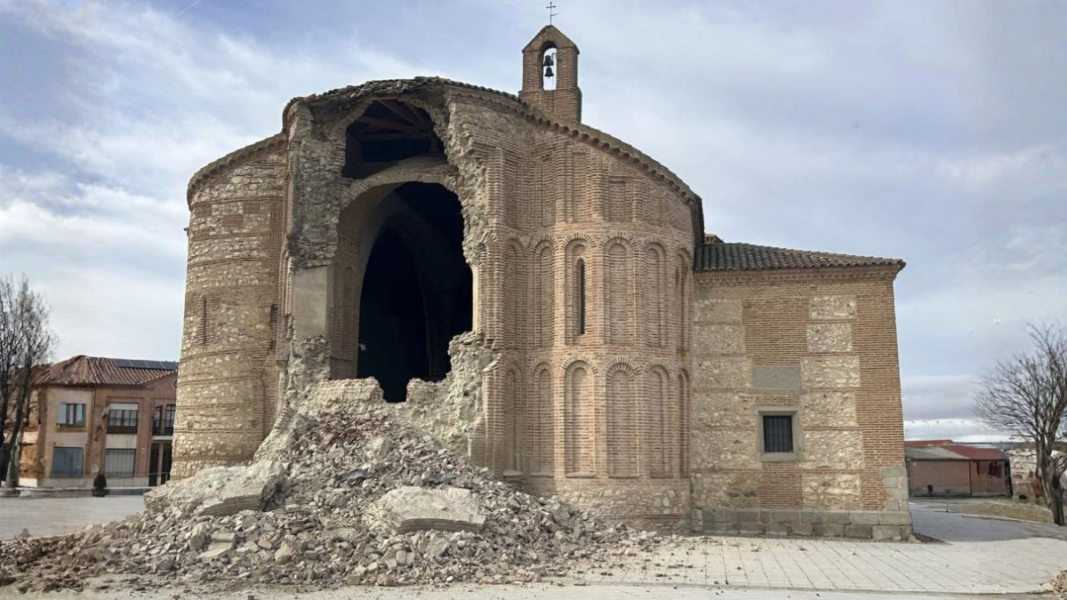
The Church of Our Lady of the Assumption—also known as Our Lady of the Castle—in the Valladolid locality of Muriel de Zapardiel suffered this Monday the partial collapse of a wall in its apse, an event that both the Junta de Castilla y León and the Archdiocese of Valladolid have described as a “catastrophe” for affecting one of the most valuable Romanesque-Mudejar temples in the province, declared an Asset of Cultural Interest.
The collapse occurred suddenly around 8:00 a.m., which required immediately cordoning off the building’s perimeter and declaring its total closure for safety reasons. The Minister of Culture, Tourism and Sports, Gonzalo Santonja, traveled to the site, accompanied by the diocesan delegate for Heritage of the Archdiocese of Valladolid, Juan Carlos Álvarez, who rushed there urgently along with specialized technicians.
An “absolutely unforeseeable” event
Both officials agreed in emphasizing the unforeseeable nature of the collapse. According to Álvarez, the diocese’s heritage services had conducted technical visits to the temple during the months of June and July without detecting any warning signs. “We saw the church inside and out and there was no concerning situation,” he stated.
Santonja, visibly affected by the state of the building, warned that, although actions will be immediate, it is likely that there are deeper structural damages than those apparent to the naked eye.
A jewel of Valladolid’s Romanesque-Mudejar style
Built between the late 12th and early 13th centuries, the church of Muriel de Zapardiel is one of the main examples of Romanesque-Mudejar in Valladolid. Its architecture, mostly made of brick, reflects the synthesis between Christian tradition and Islamic-rooted construction techniques typical of Castilian Mudejar.
The temple features three naves separated by pillars and arches, and preserves in the central nave a notable wooden Mudejar coffered ceiling. The chevet housed the original apses, decorated with blind brick arcades, one of the most characteristic features of this style in the region.
The complex is completed with a detached tower, also made of brick and separate from the main body, which may have originally had defensive or surveillance functions.
Artistic value and continued religious use
Inside, the church preserved elements of notable historical and artistic value, such as a 16th-century tabernacle and various liturgical furniture from different periods. Medieval burials have also been documented in the temple’s surroundings, confirming its continued use over centuries as a religious and community space.
Closure of the temple and suspension of worship
As immediate measures, the total closure of the temple and the suspension of worship have been decreed, which will be provisionally transferred to a municipal facility. The Town Hall has also begun planning the transfer of the religious images, including the Virgin, a Holy Week Christ, and the statues of Saint John and Saint Roch.
Analysis of causes and future restoration
Regarding the causes of the collapse, caution has been requested from the Archdiocese. Juan Carlos Álvarez recalled that this type of collapse usually does not respond to a single factor, but to the concurrence of several elements, so the priority objective will be to thoroughly analyze the origin of the collapse before undertaking the restoration.
The incident, which caused no personal injuries, reopens the debate on the conservation of historical heritage in small municipalities, where the passage of time and lack of continued use put at risk constructions of great cultural and religious value.