


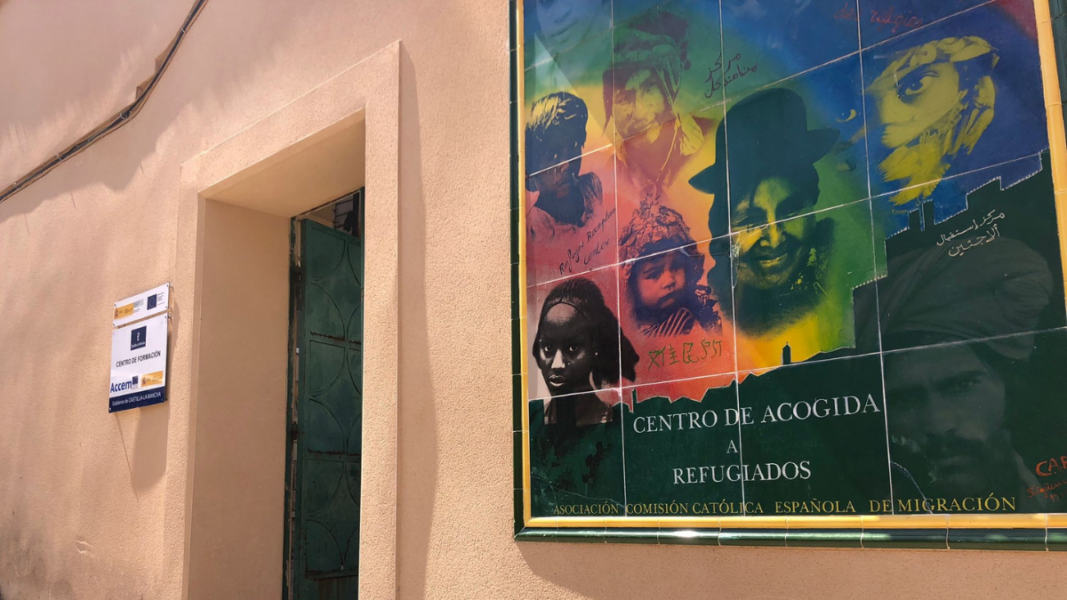
The ACCEM (Asociación Comisión Católica Española de Migración) has consolidated itself as one of the main operators of the public system for welcoming immigrants and asylum seekers in Spain. Its economic and operational dimension is no longer open to discussion. According to the 2024 Report published by the entity itself, ACCEM declared provisional total income of 225,118,355.31 euros, of which 88.16% came from the General State Administration, in addition to regional, local, and European funds. Therefore, it involves hundreds of millions of euros in public funding managed in a single fiscal year.
Thousands of employees, thousands of spots, tens of thousands of beneficiaries
That budgetary volume translates into a large-scale structure. In the same corporate report, ACCEM acknowledges having 3,839 employed persons and 770 volunteers, in addition to managing 9,812 welcoming spots throughout 2024. During that period, the entity claims to have served 42,757 people in its various programs and facilities. These figures position ACCEM not as a testimonial NGO, but as a structural actor in migration policy executed with public funds, with real capacity to condition its practical orientation.
The core of internal power: the General Assembly
As in any association, the supreme body of ACCEM is not the technical management or even the Board of Directors, but the General Assembly, responsible for setting strategic lines and electing those who govern the entity. The Board of Directors is indeed known: it appears in public organigrams and annual reports. At its top is Pilar Samanes Ara, president of ACCEM, identified in open sources as a religious sister of the Congregation of the Sisters of Charity of Saint Anne. Alongside her, positions such as the vice president José Antonio Arzoz Martínez or the honorary president Pedro Puente Fernández have been presented in various public biographies as priests with a long pastoral trajectory, especially in the social and migratory field.
This ecclesiastical profile at the top is neither illegal nor clandestine and is consistent with the historical origin of ACCEM as the Spanish Catholic Migration Commission, arising in the environment of the Spanish Church. The problem is not who directs, but who legitimizes that direction.
The email that never received a response
With the aim of clarifying this basic issue of governance, Infovaticana sent a formal email to ACCEM on September 5, 2025, requesting general information—not personal or protected—about the General Assembly. In that message, it asked to know the number of members with voting rights, whether they were natural or legal persons, and how frequently new assembly members were incorporated. The medium expressly emphasized that it understood the limitations of data protection and that the request was made from a criterion of transparency and democratic oversight.
To the date of publication of this article, ACCEM has not responded to that email.
An opacity that goes beyond silence
The absence of a response is not the only striking element. In open sources, there is no record of any public call for the ACCEM General Assembly, nor prior announcements, nor subsequent communications, nor reports, minutes, or informational references about the holding of said body. There are no press releases, nor entries on the corporate website, nor mentions in reports that detail dates, agreements, or debates of the Assembly.
The contrast is evident: it is easy to find public information about assemblies of neighborhood, cultural, or local associations, with minimal budgets and limited local impact. In those cases, calls, agendas, or at least summaries of the agreements adopted are usually published. In contrast, in the case of ACCEM—an association that manages more than 225 million euros in public funds annually—there is no accessible trace of its supreme governing body.
Public money, private control
The information requested by Infovaticana did not affect anyone’s privacy. Knowing whether the Assembly is made up of dozens, hundreds, or a very small group of members, or whether it is composed of natural persons or legal entities, is an essential structural datum to evaluate the degree of pluralism, openness, and internal control of an organization financed mostly with public money.
The lack of transparency on this point prevents knowing whether ACCEM’s strategic orientation responds to a broad and representative body or to a closed and little-renewed core, capable of perpetuating certain ideological and operational lines without a visible internal counterbalance.
Church, migration, and ecosystem coherence
This transparency deficit acquires greater relevance in the context of the migration debate. The Catholic Church in Spain has maintained for years a pastoral message clearly oriented toward welcoming, integration, and broad regularization of immigration, with little emphasis on repatriation or the structural limits of receiving societies. ACCEM, with recognized ecclesiastical roots and a directive top integrated by religious profiles, acts as the material manager of public welcoming and integration programs financed by the State.
It is not about asserting a direct causal relationship or questioning the legality of that activity, but about pointing out an ecosystem coherence between moral discourse, organizational structure, and execution of public policies. When that ecosystem is sustained on an invisible General Assembly, the question ceases to be ideological and becomes institutional.
A pending democratic demand
ACCEM publishes economic reports and organigrams, but does not allow even in general terms to know who composes the Assembly that elects its Board of Directors. In a context of maximum social, migratory, and budgetary sensitivity, that opacity cannot be considered neutral.
Transparency does not consist only in auditing figures, but in allowing society to know the internal power structures of those who administer public funds. As long as ACCEM does not respond to such an elementary question as who forms its General Assembly, a legitimate doubt will remain open: if the money is public, why does the internal control remain in the shadows?