


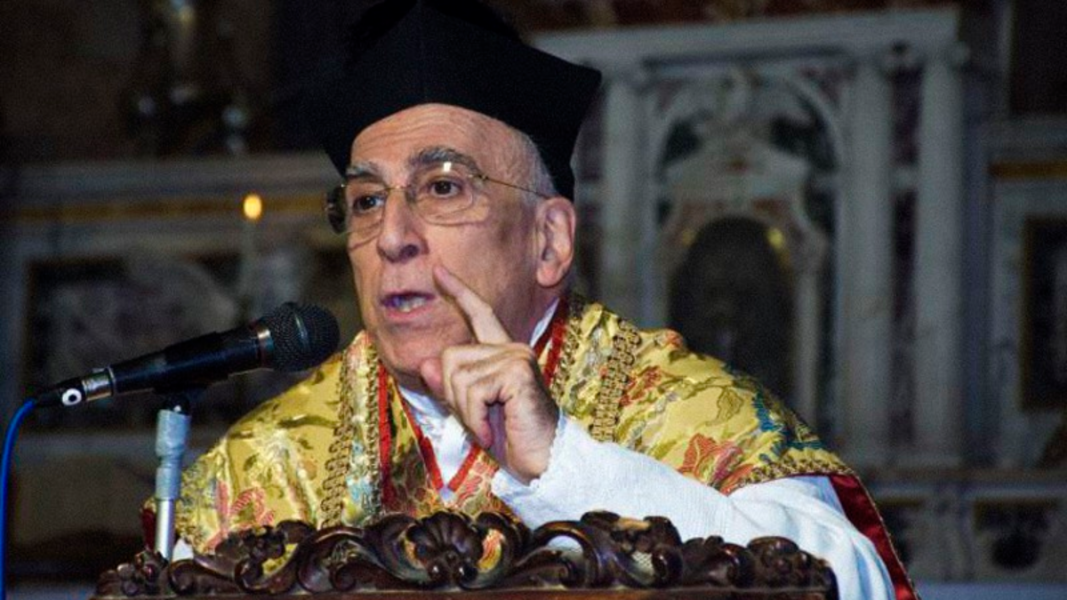
In the homily delivered on this January 11, 2026, on the occasion of the feast of the Holy Family, the Italian priest and theologian Don Nicola Bux recalled an elementary truth: the family does not arise from social consensus or cultural evolution, but from God’s express will. It is not a human experiment, but a divine institution.
The statement is not rhetorical. It has profound theological, moral, and social consequences. If the family has been willed by God, then it cannot be arbitrarily redefined or replaced by ideological constructs that contradict its nature. And yet, that is precisely what is happening in much of the West.
The family as a place of service, not self-affirmation
Bux recalled that the term “family” originally refers to a realm of mutual service. It is not a space for individual affirmation or power struggles, but a community ordered by reciprocal self-giving. This idea clashes head-on with a culture marked by individualism, where the dominant logic is personal self-realization even at the expense of others.
The loss of this principle explains to a large extent the current fragility of the family. When the willingness to serve disappears—between spouses, between parents and children—the bond becomes utilitarian and, therefore, dispensable. The family ceases to be a home and becomes a revocable contract.
Obedience, a forbidden word
One of the most uncomfortable aspects of the Christian message is obedience. Bux presented it not as humiliation, but as participation in Christ’s example. The Son of God Himself chose to live subject to Mary and Joseph for many years of hidden life. He did not do so out of weakness, but to teach.
Today, however, obedience is associated with oppression and authority is perceived as a threat. This mentality has also penetrated family life, eroding the father’s role, relativizing parental authority, and promoting a poorly understood equality that confuses dignity with the absence of order.
Indissoluble marriage against the logic of disposal
Another of the axes highlighted by Don Bux is the indissolubility of marriage. It is not a disciplinary imposition by the Church, but a demand derived from God’s design. Contemporary culture, however, applies to marriage the same logic of disposal that governs other areas: when it ceases to be functional, it is replaced.
This mentality has devastating effects, not only spiritual but also social. The trivialization of the marital bond weakens the family and, with it, the entire social structure. It is no coincidence that societies with the greatest family instability are also the most fragmented and aging.
Openness to life and the survival of nations
Bux directly linked the family crisis to the rejection of life. The systematic refusal to have children, presented as a neutral or even responsible option, is in reality a break with God’s creative mandate. The consequences are evident: demographic collapse, accelerated aging, and the progressive disappearance of entire peoples.
Fertility is not an optional addition to marriage, but one of its constitutive elements. When it is eliminated, marriage is emptied of content and society enters a suicidal dynamic that no economic policy can correct.
A cultural and spiritual battle
The message is not nostalgic or merely moralistic. It is a warning. The family is at the center of a cultural and spiritual battle that admits no neutrality. Either its divine origin is recognized and it is defended in its truth, or its progressive dissolution is accepted under increasingly sophisticated disguises.
The Holy Family of Nazareth is not an unattainable ideal, but a criterion. In it, it is revealed that true progress does not arise from breaking with the order willed by God, but from humble fidelity to that order. Remembering this today is not provocation: it is simple Christian realism.