


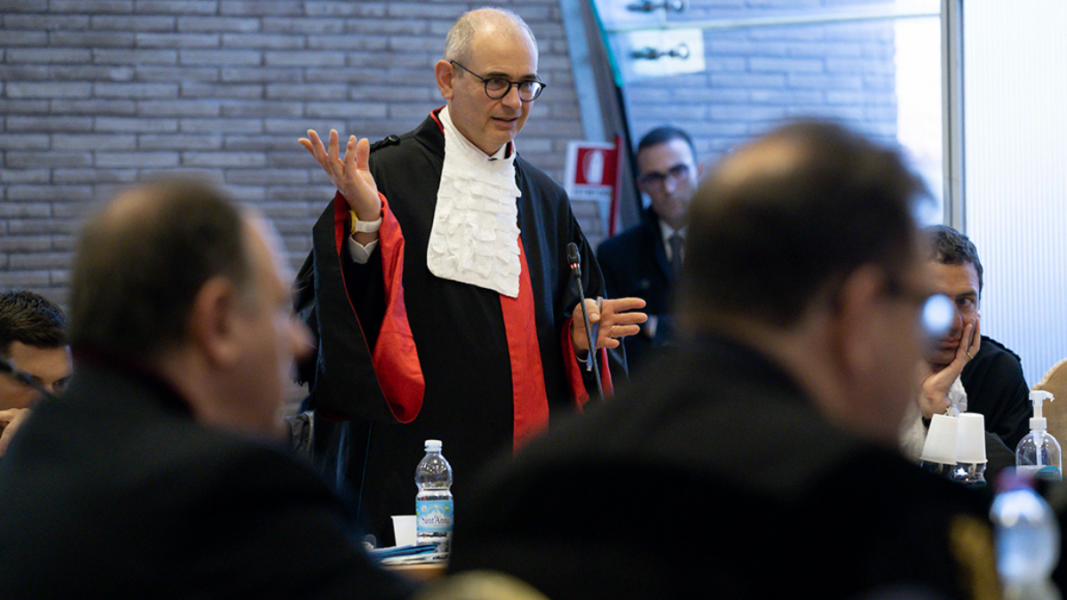
The decision of the Court of Cassation of the State of Vatican City, made public on January 12, marks a turning point in the process of the so-called Becciu case. Not so much for its technical content—two orders that confirm the inadmissibility of the Promoter of Justice’s appeal and take note of his abstention—as for what it implies in institutional terms: the exit from the scene of Alessandro Diddi and the real possibility that the appeal proceeds without the shadows that have burdened the process from its origin.
The Holy See Press Office limited itself, as usual, to communicating the facts: the Promoter of Justice’s abstention in one of the proceedings and the confirmation, in the other, that his appeal was legally inadmissible. The date of the next hearing of the Court of Appeal was also announced, set for February 3. But behind this communicative sobriety lies a decision of enormous scope.
Diddi’s withdrawal: a compelled gesture
As reported by Il Messaggero, Alessandro Diddi has taken a step back. Not for a minor issue, but to avoid the process collapsing under the weight of recusals, suspicions, and accumulated tensions. His abstention in the proceeding related to the London Palace effectively means his definitive exit from the most controversial case in recent Vatican justice.
The defenses of Cardinal Angelo Becciu and other defendants had formally raised the recusal of the Promoter of Justice, alleging a personal interest in the proceeding. The core of the accusation was serious: improper contacts and a web of relationships that would have influenced the construction of the accusation, especially through the memorandum of Monsignor Alberto Perlasca, the main accuser of Cardinal Becciu.
The Court of Appeal considered that recusal admissible. The Cassation, by taking note of Diddi’s abstention, has avoided an institutional collision with unpredictable consequences. The implicit message is clear: the process could not continue advancing with the Promoter under suspicion.
A process fraught with anomalies
The London Palace case arose from an opaque financial operation by the Secretariat of State to acquire a luxury property on Sloane Avenue. From there, the proceeding turned into a labyrinth of accusations of fraud, money laundering, abuse of power, embezzlement, and extortion, with nine convicted in the first instance, including a cardinal of the Church who has always proclaimed his innocence.
During the trial, disturbing elements emerged: contradictory testimonies, hypotheses of illegal recordings on Italian soil, the intervention of figures acting behind the scenes, and the persistent suspicion that the investigation had been driven more by political objectives than by a strict search for the truth.
All of this was aggravated by direct interventions from the previous pontificate, which modified the rules of the process through rescripts, to the detriment of the guarantees of the defense. That legacy weighs today on Vatican justice.
Cassation as a test of the new pontificate
That is why the decision of the Court of Cassation—composed of cardinals—has been perceived inside and outside the Church as a decisive test of the new course under Leo XIV. It is not just a legal formality: the credibility of the Vatican judicial system is at stake.
The Pope has made it clear on more than one occasion that he will not intervene in the process. That non-interference contrasts with the recent past and places the responsibility directly on the courts. Diddi’s withdrawal allows the appeal to be held without the most controversial element of the proceeding and opens the possibility of a real, unconditioned review.
It is not an acquittal, it is an opportunity
It is worth emphasizing clearly: nothing that has happened implies acquittals or automatic reviews of the convictions. What has been achieved is something prior and fundamental: restoring a minimum of procedural order so that the appeal can be held with guarantees.
Some defense lawyers have described Diddi’s abstention as a «wise» decision, insofar as it confirms the legitimacy of the objections raised and allows closing a stage marked by opacity. Whether that page closes definitively will depend on what happens from now on.
Judging by the fruits
The Becciu case has become, whether the Holy See likes it or not, the symbol of a broader issue: whether the Vatican is capable of administering justice with transparency, coherence, and respect for fundamental rights, even when the accused are part of the hierarchy.
The Cassation’s decision and Diddi’s exit do not resolve the problem, but they eliminate a major obstacle. Now the responsibility falls fully on the Court of Appeal. The fruits of this new stretch of the process will tell whether we are facing a true change of course or a minimal correction to avoid greater discredit.