


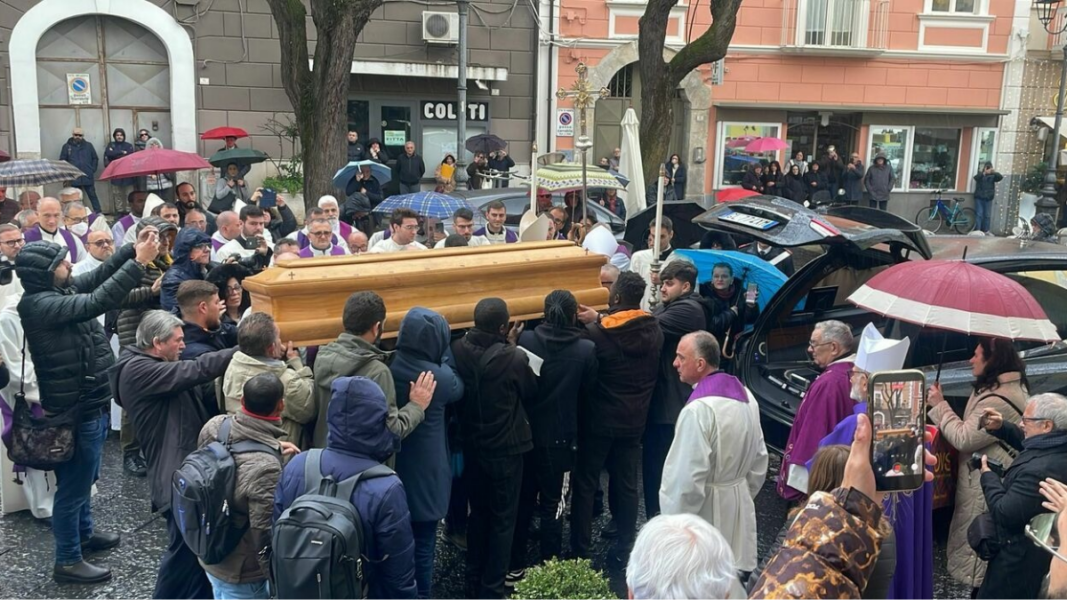
The funeral rites of the emeritus bishop of Caserta, Raffaele Nogaro, held in the city’s cathedral, have ended up becoming an almost perfect portrait of one of the most sterile and confusing stages of the European episcopate in recent decades. A Catholic funeral marked by the singing of Bella ciao, a partisan anthem and unequivocal symbol of the Italian political left, crudely summarizes the legacy of a prelate who made social militancy and ideological activism the central axis of his ministry.
Nogaro, who died at the age of 91, was for decades an emblematic figure of that episcopal model that emerged after the post-conciliar period, especially in Italy, in which the bishop’s identity ceased to be defined by the custody of the faith, liturgy, and sacramental life to dilute itself into a socio-political discourse permanently aligned with the progressive causes of the moment. Abstract pacifism, systematic opposition to the West, anti-militarist rhetoric, closeness to unions and left-wing movements, and a conception of Christianity reduced almost exclusively to social denunciation marked his trajectory as bishop of Sessa Aurunca and, later, of Caserta.
For years, Nogaro was celebrated in media and political environments alien to the Church as an “uncomfortable bishop” or “pastor of the poor,” while his diocese, like so many others governed by similar profiles, progressively emptied of vocations, religious practice, and sense of the sacred. His figure fits into a generation of pastors who confused dialogue with the world with the uncritical assimilation of its categories, and Christian charity with adherence to a specific ideological agenda.
That Bella ciao is sung in a cathedral as the finale to an episcopal funeral is not a folkloric anecdote, but an eloquent image of a Church that, at certain moments in its recent history, seemed ashamed of itself and sought to legitimize itself by imitating the languages and symbols of politics. For many faithful, that image does not evoke evangelical commitment, but decay, confusion, and loss of identity.
The death of Raffaele Nogaro thus closes a very specific page of the Italian episcopate: that of pastors more concerned with being accepted by the world than with proclaiming Christ. A page that, in view of the fruits, leaves an uncomfortable but inevitable question about the price the Church has paid for that pastoral sterility disguised as social commitment.