


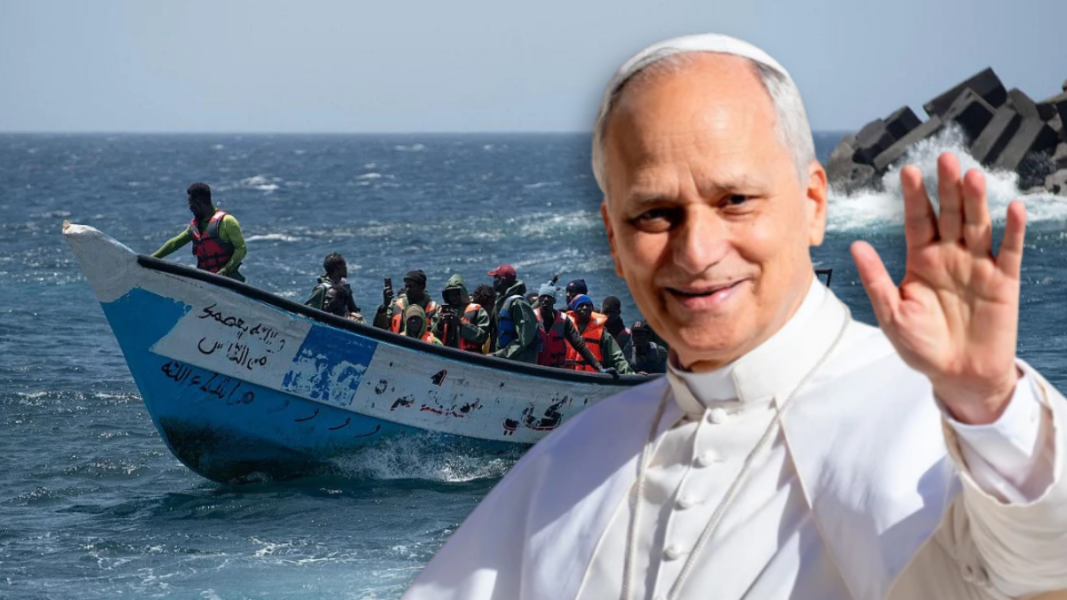
The announcement of an upcoming trip by Pope Leo XIV to the Canary Islands, scheduled for the month of June and publicly advanced by the Cardinal of Madrid, José Cobo, forces the reopening of a debate that is uncomfortable but absolutely necessary. It is not about questioning the intentions of the hierarchy, but about rigorously analyzing the real consequences that certain symbolic gestures have on the phenomenon of irregular immigration and, in particular, on the so-called pull effect associated with the deadliest routes on the planet.
There is a serious and persistent problem with the romanticization of migratory routes, a narrative that transforms itineraries dominated by violence, deception, and death into epic tales of overcoming adversity. This approach was reflected especially clearly in the well-known statements by the former mayor of Madrid, Manuela Carmena, when she expressed her enthusiasm upon seeing young migrants jumping the fences of Ceuta, presenting that act as the culmination of an almost heroic process. That misguided romanticism positions the migrant as the protagonist of a moral feat, and the border as the last unjust barrier of a civilization that would be obliged to receive them with open arms.
That narrative needs symbolic scenarios and has been building them over time. The border between Mexico and the United States, the rivers that cross it, the island of Lesbos during the Syrian crisis, Lampedusa in the central Mediterranean, or today, the Canary Islands, function as landmarks of an emotional geography that emphasizes arrival and deliberately erases the horror of the journey. However, these places are not abstract symbols: they are the final destination of routes controlled by mafias that profit from desperation and push thousands of people, including women and children, onto a path with a simply atrocious probability of death.
In this context, the visit by a top-level moral authority to an arrival port has an impact that cannot be ignored. Although not explicitly stated, the message conveyed is easily interpretable as a validation of the journey, as an understanding of the sacrifice made, and as a moral delegitimization of any return policy. That reading acts as a powerful incentive for those still at origin or in transit and reinforces the idea that arriving justifies everything that came before. That is, precisely, the core of the pull effect: turning the point of arrival into a beacon that guides deadly decisions.
The problem is not compassion, but imprudence. Symbolically pointing to the Canary Islands as a space of welcome without emphasizing with equal clarity that those routes should not be taken, that they must be cut off at the root, and that the only truly human response is to prevent people from embarking on them, amounts to feeding the criminal business of the mafias. There is no mercy in messages that, even if well-intentioned, push people to repeat an itinerary that leads too many to death or to an existence without a real horizon of integration.
That is why it is legitimate and necessary to ask whether certain gestures are compatible with the moral responsibility demanded by the gravity of the problem. The Church should not contribute, not even indirectly, to reinforcing a romantic narrative of irregular immigration. The authentic humanitarian message today involves deactivating the pull effect, clearly stating that these routes make no sense, and avoiding turning arrival ports into symbols that, far from saving lives, may be condemning many more.