


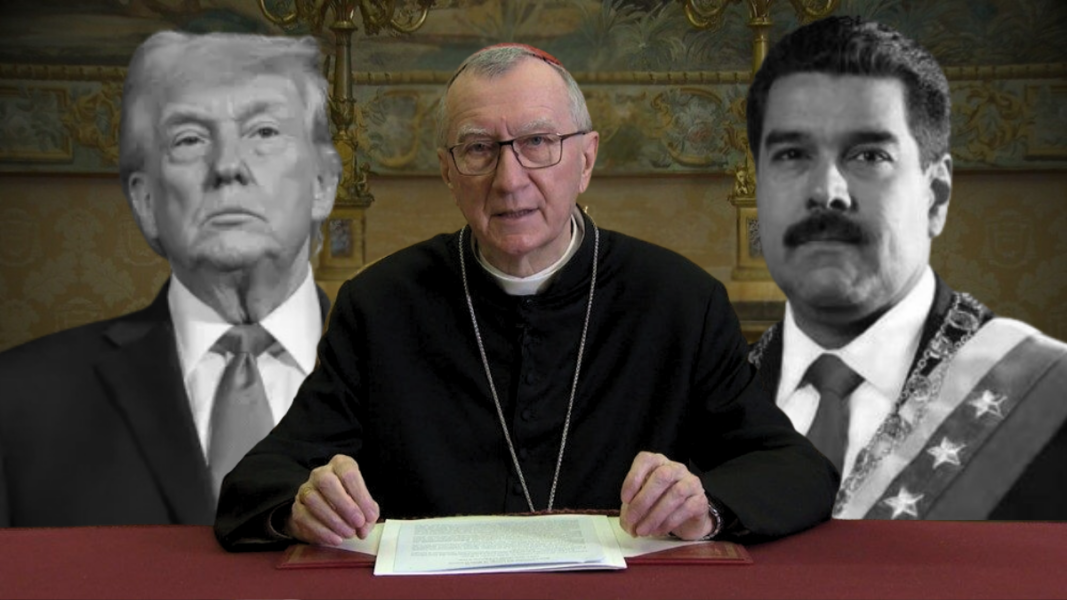
The Vatican, through Cardinal Pietro Parolin, Secretary of State of the Holy See, attempted until the last moment to avoid a violent outcome in Venezuela and seek a negotiated exit for Nicolás Maduro before the U.S. military operation that ended with his capture and transfer to New York to face drug trafficking charges.
According to an investigation published by The Washington Post, Parolin held an urgent and unannounced meeting on Christmas Eve with Brian Burch, the U.S. Ambassador to the Holy See, to learn about Washington’s plans regarding Venezuela and press for a diplomatic path that would allow the Venezuelan leader to leave without bloodshed.
According to government documents cited by the U.S. newspaper, the Italian cardinal acknowledged that Maduro had to leave power, but insisted that a safe escape route be offered to him, warning of the risk of violent escalation and greater regional destabilization.
Parolin, mediator to avoid violence
In the days leading up to the U.S. operation, Parolin reportedly sought to contact the U.S. Secretary of State, Marco Rubio, with the aim of buying time and facilitating a negotiated solution. In that context, he informed U.S. authorities that Russia was willing to grant asylum to Maduro, with personal security guarantees offered by President Vladimir Putin himself.
According to people familiar with the offer, the proposal involved Maduro leaving the country and retiring from political life, a possibility that the Venezuelan leader ultimately rejected. A week after the meeting at the Vatican, U.S. special forces carried out a raid to capture him, an operation that, according to the same sources, left dozens dead.
The Holy See, consulted by The Washington Post, regretted the leak of fragments of a confidential conversation and stated that those excerpts do not accurately reflect the content or the spirit of the exchange held during the Christmas period.
A broader diplomatic effort
The meeting at the Vatican was just one of multiple failed attempts—involving U.S., Russian, Qatari, Turkish intermediaries, and various international actors—to find an exit that would avoid armed intervention.
The Vatican’s role fits into a consistent diplomatic line. Parolin, who was apostolic nuncio in Caracas, has maintained a direct interest in the Venezuelan situation for years. The Holy See had already attempted, unsuccessfully, to mediate between the Maduro regime and the opposition a decade ago, and more recently had encouraged dialogue through high-ranking clergy in the country.
Pope Leo XIV, for his part, had publicly warned against the use of force. In November, after the presence of U.S. warships near Venezuela became known, he stated that “violence never brings victory” and that the key was to seek dialogue.
Russia, asylum, and failed calculation
According to the documents cited by the Post, Parolin conveyed to Washington the conviction that Maduro had been willing to leave power after the July 2024 elections, which were widely questioned, but was dissuaded by his hardline inner circle, fearful of reprisals.
The Vatican Secretary of State also reportedly suggested that the United States set a clear deadline for Maduro’s departure and offer guarantees to his family. Privately, he expressed being “very puzzled” by the lack of clarity on Washington’s final objectives in Venezuela and called for patience, caution, and moderation.
But the White House chose not to wait any longer and proceeded with the military operation.
The Pope’s final warning
After Maduro’s fall, Pope Leo XIV again insisted on the need for diplomacy oriented toward dialogue. In a recent intervention at the Vatican, he expressed concern that a “diplomacy that promotes dialogue” was being replaced by a “diplomacy based on force”.
“War has become fashionable again,” the Pontiff warned, pointing to the risk that resorting to violence becomes normalized as an instrument of international policy.
In this context, the efforts of the Vatican and Cardinal Parolin appear as an attempt to contain the violence, even though they failed to prevent an outcome that has opened a new stage of uncertainty for Venezuela and the region.
An immature diplomacy
The Vatican runs the risk of falling behind and confirming itself as an increasingly irrelevant actor in world geopolitics. Venezuela demonstrates that the fruits of a naive diplomacy that only speaks of peace and non-violence can cause thousands dead, tens of thousands of reprisals, and millions of forced displacements. The priority should not be non-violence but justice and the minimization of harm.
We must move toward a mature diplomacy that leverages the Church’s unparalleled capacity to obtain information and the moral authority it (ever less) still holds to be a serious actor and not an uninformed NGO.