


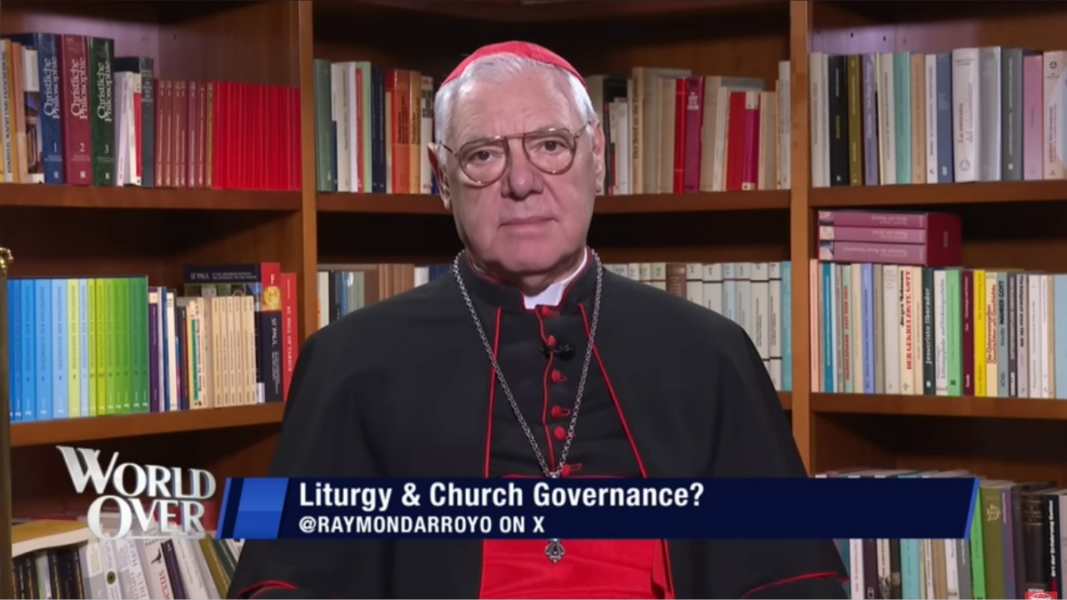
Cardinal Gerhard Müller, former prefect of the Congregation for the Doctrine of the Faith, has emphasized the need for doctrinal and ecclesiological clarity in the face of ambiguous interpretations of synodality, after participating in the first extraordinary consistory of Pope Leo XIV, held this week in the Vatican.
In an interview given to the program The World Over, Müller explained that, although the Pope initially proposed four themes for the meeting—synodality, mission, liturgy, and governance of the Church—the cardinals opted mostly to focus on the evangelizing mission and synodality, leaving out the specific debate on the liturgy.
The liturgy is not the central problem, but its ideological use is
Asked about the absence of the liturgical theme, in a context marked by restrictions on the Traditional Mass, Müller pointed out that the Holy Mass is the center of Christian life, but that the current issue is not doctrinal, but pastoral and disciplinary: the way of celebrating the ancient rite or the new one.
In his view, the cardinals preferred to dedicate the limited time of the consistory to the major external challenges facing the Church—secularization, atheism, ideologies contrary to Christian anthropology—rather than to internal debates. Nevertheless, he made it clear that the liturgy remains essential as the culmination of Christian life and worship of God.
The Church is not a democracy
The core of Müller’s intervention focused on synodality, a concept that—he warned—has generated confusion in recent years. The cardinal insisted that the Church is neither a democracy nor a parliament, and that it cannot be governed according to political models typical of modern States.
As he explained, the consistory served to reaffirm a fundamental distinction: on one hand, the Synod of Bishops, which belongs to the hierarchical structure of the Church and exercises authority by virtue of the sacrament of Holy Orders; on the other, the legitimate cooperation of the laity, based on the common priesthood, but without confusion of functions or authority.
Müller emphasized that this distinction is clear in Catholic theology, but that in recent times “there has been confusion in some minds,” making it necessary to return to a precise understanding of the Church as the sacrament of salvation, founded by Christ and not as a sociopolitical organization.
Criticism of recent synodal methods
The cardinal also expressed criticism of the working methods used both in recent synods and in this consistory, especially the predominance of sociological dynamics and small groups over theological debate in the plenary assembly.
Müller stated that many cardinals would like to recover the classical model of the consistory, in which each cardinal can intervene publicly with brief and well-prepared expositions, leaving the work in small groups for the final phase and not as a starting point.
The crisis of the Church is internal
Addressing the general situation of the Church, the former prefect was blunt: the current crisis does not come from the outside, but from within. In his view, doctrinal confusion, heterodox ideas, and the relativization of established truths—such as the impossibility of the female diaconate or the sacramental nature of marriage—have weakened the clarity of the Christian proclamation.
Müller recalled that Catholic doctrine is not the fruit of subjective opinions or circumstantial consensuses, but the faithful transmission of the revelation received from the apostles, safeguarded by the magisterium of the bishops in communion with the Pope.
In this sense, he rejected any appeal to the so-called “spirit of the Council” as justification for doctrinal ruptures, pointing out that ideological interpretations after Vatican II cannot be attributed to the Council itself, but to interested readings distant from the living Tradition of the Church.
A clear warning at the beginning of the pontificate
The words of Cardinal Müller, pronounced in the context of the first major meeting of the College of Cardinals under the pontificate of Leo XIV, constitute a clear warning against attempts to redefine the Church in political or sociological terms.
For the German cardinal, only a Church firmly anchored in the apostolic doctrine, sacramental hierarchy, and moral clarity will be able to face the challenges of the contemporary world without diluting its identity or betraying its mission.