


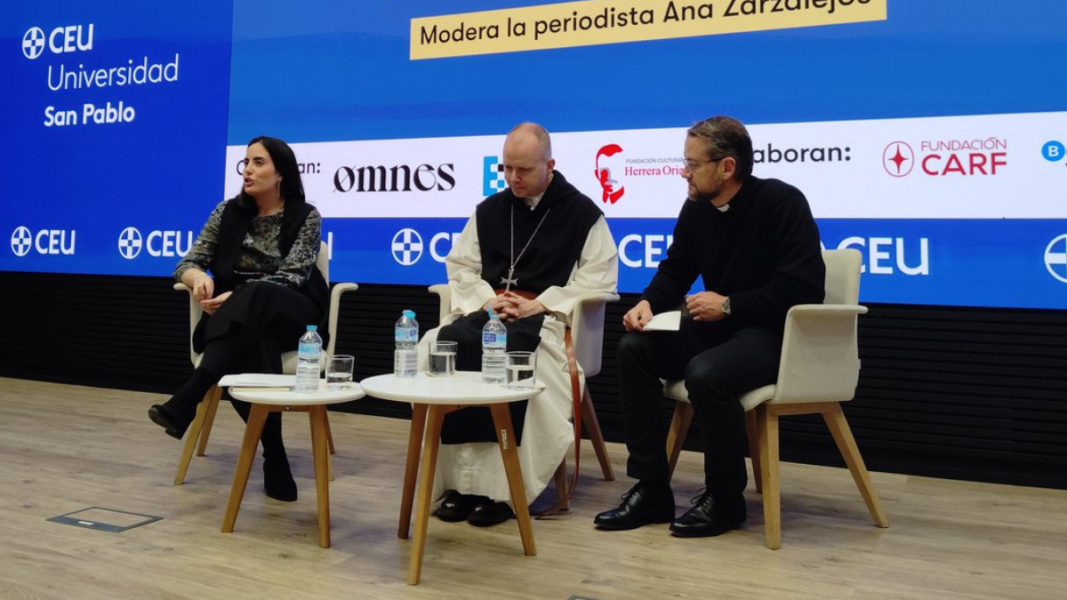
The Bishop of Trondheim and Cistercian monk Erik Varden offered a profound reflection in Madrid on human suffering from the Christian faith perspective, insisting that Christianity does not respond to pain with reassuring theories or quick solutions, but with the real presence of God who assumes man’s suffering and redeems it from within.
The intervention took place at the Universidad CEU San Pablo, as part of the Foro Omnes, where Varden addressed one of the issues that most scandalizes contemporary faith: how to believe in a good and omnipotent God in a world pierced by pain. Far from evading the difficulty, the Norwegian bishop emphasized that many abandon faith precisely because they expect an explanation that neutralizes suffering, when Christianity offers something different: a companionship, not an evasion.
Suffering is not explained, it is borne
Varden pointed out that the question of the “why” of suffering does not admit simple answers. Pain is part of the human condition and cannot be dismissed with arguments. Christian faith —he affirmed— does not seek to justify suffering or make it disappear, but to place it before God with reverence, recognizing its gravity without turning it into an absolute.
At this point, he insisted on a central idea in his thought: the human condition is wounded, but the wound is not definitive nor does it define man. It may condition life, but it does not exhaust its meaning or annul freedom. From faith, suffering is neither denied nor glorified, but neither is it made the last word on existence.
The cross, a place of freedom
One of the axes of his reflection was the cross, not as a symbol of passivity or resignation, but as a place of extreme interior freedom. Christ, by accepting suffering without renouncing the Father’s will —“thy will be done”— shows that even in circumstances that seem to paralyze man, a free and fully human response is possible.
From this perspective, the cross is not only the place of pain, but the place where love is offered without conditions. It does not eliminate suffering, but pierces it and transforms it from within.
Healing is not erasing the wounds
Varden insisted that Christian faith does not promise an immediate healing of all wounds. Conversion does not automatically erase pain or guarantee happy endings according to human criteria. There are fractures that remain, but that are not beyond the reach of grace.
Christianity does not announce only an all-powerful God who suppresses suffering, but a God who shares it, bears it, and turns it into a place of spiritual fruitfulness. In this sense, he recalled that Christians, as members of the Body of Christ, participate in his redemptive mystery: “by his wounds we have been healed.”
A thought consistent with his spiritual work
Varden has developed these ideas in his books, especially in Heridas que sanan, recently presented in Madrid and discussed in an interview given to El Debate. In that conversation, the bishop emphasized that there is today a double cultural temptation: to hide wounds to appear invulnerable or, on the contrary, to lock oneself in them until turning them into identity.
Faced with both, Varden proposes a more demanding and freer Christian gaze: to recognize the wound without absolutizing it, and to open it to grace. The wound —he pointed out— can become a place of spiritual depth and compassion, but not automatically: it requires a conscious decision not to remain prisoner of one’s own pain.
A suffering entrusted to God
During his intervention at the Foro Omnes, Varden affirmed that redemption is not an abstract idea or a future promise, but a real fact already accomplished, whose fruits unfold in time. Christ remains on the cross not as a overcome episode, but as the certainty that no suffering is beyond the reach of God’s love.
Entrusting pain to God —handing over to Him what cannot be understood or resolved— can open a path of healing, sometimes slow and silent, but real. The bishop himself assured that he has seen how deep wounds, lived in this way, become unexpected sources of good.
A valley of tears with hope
Varden concluded by recalling that human existence remains a “valley of tears,” but not one abandoned to darkness. Christian faith illuminates it from within, affirming that God walks with man and that every life has a meaning that is not annulled by suffering.
Every person —he pointed out— is called to discover the vocation for which they have been created, even, and sometimes especially, through pain. When this is lived from faith, it ceases to be a closed absurdity and is transformed into a path of communion with God, with the certainty that man is not alone and that he has been created to live in Him.