


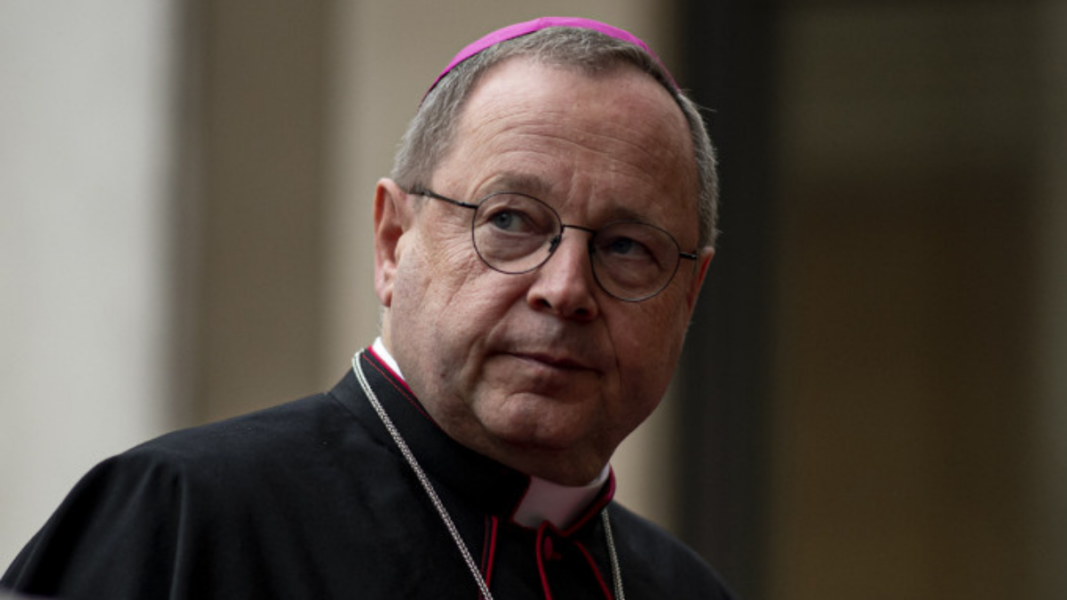
The German Bishops’ Conference will elect in February (23–26), during its plenary assembly in Würzburg, the president who will lead the body for the next six years. The name dominating all the odds is that of the current president, Georg Bätzing, bishop of Limburgo and the most visible face of the Synodal Way that has been straining ecclesial communion for years with reform proposals on sensitive matters.
But, just weeks before the vote, The Pillar reports, reelection is not guaranteed. Not due to formal impediments—he is 64 years old and could complete a second term—but because Bätzing himself has hinted at doubts amid the internal fatigue of a fractured episcopate and the growing pressure of leading a process that maintains a permanent standoff with Rome.
A president associated with the synodal drift
Bätzing came to the presidency after Cardinal Reinhard Marx stepped back in 2020. Since then, his leadership has been tied to the strategy of advancing the “Synodal Way” even as a part of the bishops warned of its ecclesiological and pastoral consequences.
In practice, Bätzing’s presidency has coexisted with increasingly visible fissures between those pushing the synodal agenda and those who see it as a path to rupture. And that context weighs heavily: the bishop has publicly acknowledged the reputational wear on the Church in Germany, but without assuming—according to his critics—fundamental responsibility for the course adopted.
The “Synodal Conference,” the key issue that conditions everything
The presidential election will take place with a decisive matter on the table: the vote on the statutes of the new permanent body planned to institutionalize the process, renamed the “Synodal Conference.”
The text was approved by the provisional synodal committee in November 2025 and subsequently ratified by the ZdK; the next step is the bishops’ vote in February 2026.
Rome, for its part, has warned in various interventions that a body of that type could undermine episcopal authority and clash with Catholic ecclesiology; hence, the promoters have accepted changes and committed to not taking the step without approval from the Holy See.
Whoever is elected president will have to manage, immediately, a delicate scenario: defending a controversial body in Rome, or containing the synodal impulse without provoking an internal explosion. That is, today, the heart of the problem.
Who could succeed him?
If Bätzing does not run—or if his candidacy stalls due to rejection by a significant minority—profiles are being considered with two common traits: participation in contacts with Rome and the ability to navigate a already worn-out board.
Among the most cited names in the German episcopal environment are bishops linked to the axis of negotiations and mediations, as well as figures considered “bridge” to avoid a frontal clash with the Vatican. In this context, Cardinal Rainer Maria Woelki also appears, but his belonging to the minority sector makes it politically unlikely that he will garner the necessary support.
A poisoned chalice: crisis of faith, institutional crisis, and economic crisis
Beyond the synodal architecture, the new president will inherit a gloomy panorama: a Church in Germany with a continuous loss of faithful, an episcopate without internal unity, and an agenda marked by unpopular decisions.
Added to this is the material problem: cuts and adjustments due to the forecast of falling income, resulting from the decline in registered Catholics and the weakening of the ecclesiastical financing system. In that context, presiding over the German Bishops’ Conference is not an honor: it is managing a conflict.
That is why the question is not only whether Bätzing can be reelected. The issue is whether anyone—including him—wants to assume the political and ecclesial cost of leading the German episcopate at the moment when the “Synodal Way” seeks to consolidate permanently and Rome keeps the brake on.