


By Daniel B. Gallagher
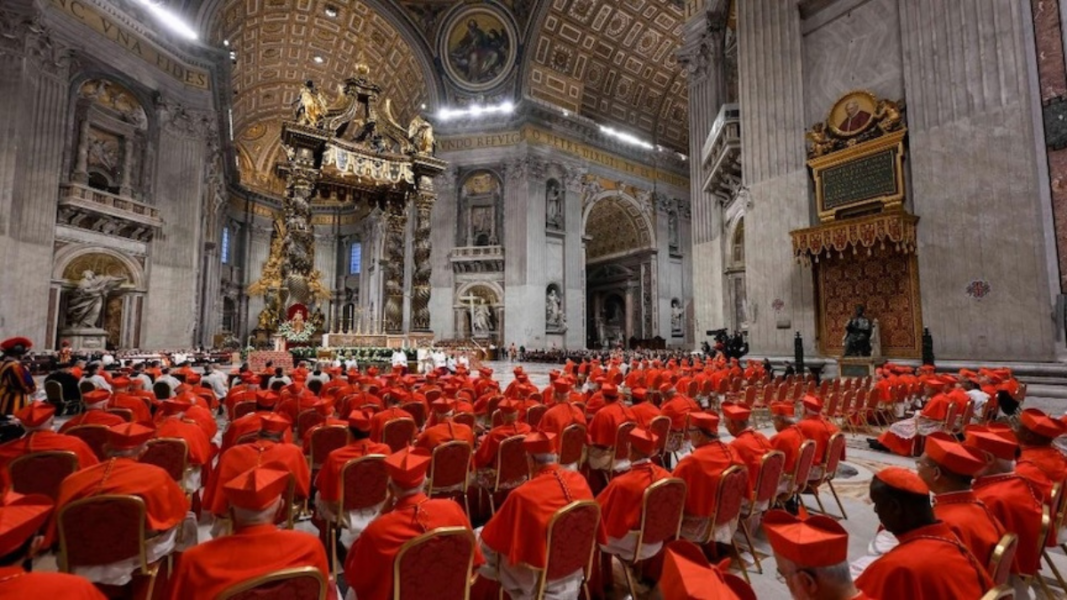
For a decade of service in the Vatican’s Secretariat of State, I felt constantly perplexed by the Holy See’s lack of willingness or ability to utilize already existing ecclesial structures for effective governance. As the cardinals gather in Rome over the coming days, it is worth rigorously examining some of the recent ways in which the Church has been functioning.
A financial problem? Establish a new commission to resolve it. Then create another to oversee the work of the first.
An issue about deaconesses? Appoint a group of experts to study it (2014). Then appoint another to study it again (2020), all the while ignoring the exhaustive study by the International Theological Commission on the permanent diaconate from 2002.
Perhaps the most baffling was Pope Francis’s creation of a “Pontifical Commission of Reference on the Organization of the Economic-Administrative Structure of the Holy See,” a body intended to collaborate with a Council of Cardinals that had already been designed by his predecessor, Benedict XVI.
The disproportionate growth of bureaucracy is an unmistakable sign of organizational dysfunction, something the Roman Curia has suffered from for years. One way to contain it is to revitalize precisely the body whose canonical purpose is “to assist the Roman Pontiff… in the daily care of the universal Church” (Code of Canon Law, 349).
There are two reasons for the underutilization of the College of Cardinals: (1) a lack of appreciation for the connection between the College’s occasional task of electing a new pontiff and its permanent function of assisting him in the daily care of the universal Church; and (2) a mistaken conception of what constitutes “grave matters” (quaestiones maioris momenti) and “matters of greater importance” (graviora negotia).
As for the first, non-resident cardinals (that is, those not destined for permanent curial positions in Rome) understandably find it frustrating that their role in the care of the universal Church is limited to casting votes in the Sistine Chapel. It would be reasonable for them to expect some continuity, so that they could accompany the man they have elected in the task of applying the vision of the Church they expressed during the General Congregations prior to the Conclave.
As for resident cardinals, it always struck me as strange that the Holy Father “grants” them audiences no less formally than to any other visitor he receives. The Holy See’s daily bulletin announces consultations with heads of dicasteries as if the Pope were meeting with some ambassador or external dignitary.
The consultative function of the cardinals could be exercised more effectively—if not more pleasantly and fraternally—through occasional phone calls and working lunches. The Holy Father should have the numbers of the 252 cardinals saved in his mobile phone, and each of them should have a direct line to him. It would be a healthy step toward that kind of collegiality that could sustain any synodality he has in mind. I retain anguished memories of escorting cardinals lost in the Apostolic Palace as they futilely tried to find the office they were supposed to visit that day.
The second problem is an excessive overestimation of what constitutes a “grave matter” or a “matter of greater importance” (cf. canons 349 and 352). When I worked in the Curia, I understood that to mean practically anything that could not be resolved routinely through the Roman Curia’s policies and procedures.
However, every time I suggested that some specific matter would be better handled through a consistory, my colleagues dismissed it as not being “grave” or “serious” enough. In their mindset, “grave” or “serious” meant sexual abuse, financial fraud, or public scandal. In mine, it meant any matter that deserved to be consulted with the closest collaborators, precisely because they know better than anyone how to address it.
From my experience in the Secretariat of State, non-resident cardinals were often one step ahead and could have avoided serious blunders (like the Williamson case in 2009). Even before the ink had dried on Summorum Pontificum in 2007, key cardinals were already wondering if and how the liturgical calendars of the Ordinary and Extraordinary Forms could be harmonized.
I suspect this is a perfect example of what the cardinal archbishops of large archdioceses can and will raise as a “grave matter” in this week’s consistory. Similarly, several cardinals whose wisdom I deeply admire have been insisting to the Holy See for decades on the prudence of moving holy days of obligation to Sunday. That clearly shows where their hearts and minds are.
If the Church and the Successor of Peter are to make better use of the College, there must be an explicit recognition that “grave matters” and “matters of greater importance” are by no means limited to crises and catastrophes.
Given the tasks that Pope Leo has assigned to the cardinals as preparation for the January 7 and 8 meeting, this extraordinary consistory offers a golden opportunity to revitalize the College’s role in the governance of the universal Church.
The fact that Praedicate Evangelium (“On the Roman Curia and its service to the Church in the world”) is on the reading list indicates that the Holy Father takes seriously the question of who works for whom. After all, Book II of the Code of Canon Law deals with the Roman Curia (chapter IV) only after the College of Cardinals (chapter III), and this—for better or worse—only after the Synod of Bishops (chapter II). Chapter I is naturally dedicated to the Roman Pontiff and the College of Bishops.
A Vatican official once assured Pope John XXIII that it would be absolutely impossible to open the Second Vatican Council in 1963. “Very well,” replied the good pope. “We’ll open it in 1962.”
In the same way, it is not too soon for Pope Leo XIV to pave a synodal path by beginning with revitalizing the active role of the College of Cardinals in guiding the universal Church.
About the author
Daniel B. Gallagher teaches philosophy and literature at Ralston College. He previously served as Latin secretary to Popes Benedict XVI and Francis.