


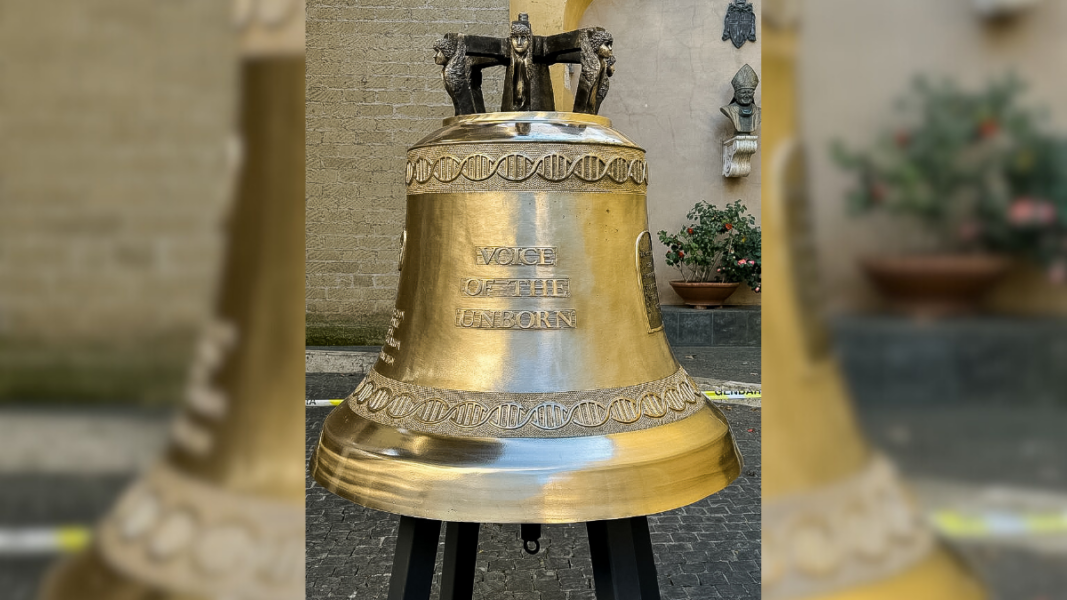
The Diocese of Ventimiglia–San Remo, in northwestern Italy, has inaugurated a bell dedicated to unborn children at the seat of its episcopal curia, an initiative promoted by Bishop Antonio Suetta that has provoked an immediate adverse reaction from regional center-left political representatives.
The so-called “Bell for Unborn Children” was installed on December 28, 2025, coinciding with the liturgical feast of the Holy Innocents, and its purpose—as explained by the diocese itself—is to daily remember the children who never came to be born and to call for prayer in defense of human life. The bell, which bears the inscription “To all unborn children”, rings every day at 8:00 PM.
Bishop Suetta emphasized that the initiative is not intended as an attack against women who have had abortions, but as a gesture in favor of life. In statements reported by La Nuova Bussola Quotidiana, he affirmed that “the sound of this bell is at the service of life and is not an invective against women who have gone through the drama of abortion”.
Political Criticisms and Accusations of “Moral Propaganda”
The reaction was not long in coming. Edoardo Verda, a councilor for the Democratic Party in the city of Imperia, described the bell as an act of “moral propaganda” and as an “intolerable intrusion into an area that does not correspond to religion, but to women’s self-determination.” In the same vein, Enrico Ioculano, a regional councilor for Liguria, publicly reproached the diocese that it “should review its priorities.”
In response to these accusations, the bishop recalled the Church’s constant doctrine, which clearly distinguishes between the moral condemnation of abortion and the pastoral accompaniment of affected women. Citing the Gaudium et Spes constitution of the Second Vatican Council, he reiterated that the Church defines abortion as an “abominable crime,” without ceasing to consider the woman as a victim of a broader moral and social wound.
“In abortion, a child dies and, at the same time, a mother suffers deeply,” Suetta noted. “Abortion leaves a heavy burden of pain, and the bell invites prayer and closeness to all women who suffer because of this.”
A Call Against the Trivialization of Abortion
The prelate framed the initiative as a response to what he described as a growing habituation in society to abortion in countries where it is legal. In his view, legalization has contributed to minimizing its biological and medical reality, to the point that many have stopped considering it a crime or a sin.
He also criticized progressive and feminist movements for presenting abortion as an absolute right, subordinating scientific evidence, natural law, and moral judgment to individual choice. For this reason, he defended that the bell seeks to “raise consciences” on an issue that—he affirmed—is not merely confessional, but anthropological and scientific.
Letter to Pope Leo XIV
The controversy escalated further when Laura Amoretti, counselor for Equal Opportunities in the Liguria region, sent a formal letter to Pope Leo XIV requesting that the Pontiff speak out against the initiative. In the letter, Amoretti argued that the installation of the bell has generated “concern and pain in many women and families” and has created “a climate of judgment and stigmatization” regarding personal decisions made in complex and painful circumstances.
Amoretti argued that, in a plural society and a secular state, this type of initiative risks becoming a form of public judgment on women’s bodies and decisions, potentially increasing gender inequalities rather than reducing them. Although she recognized the Church’s religious freedom and its social role, she maintained that “both religious and civil institutions should accompany and support people, rather than divide communities or expose legally recognized personal decisions to public scrutiny.”
A Permanent Sign of Prayer
The origins of the bell predate its installation. It was cast on February 5, 2022 during the diocesan initiative “40 Days for Life”, as a permanent and visible sign of prayer, remembrance, and commendation. “40 Days for Life” is a period of forty days dedicated to prayer, public witness, and training encounters focused on pro-life issues, an initiative in which the Diocese of Ventimiglia–San Remo had previously participated.
According to diocesan sources, its purpose has remained constant since then: to give a symbolic “voice” to unborn children and to keep the issue of abortion present in the public conscience through a daily audible sign. Since its inauguration, however, the bell has become a focal point of a broader public debate in Liguria, highlighting persistent tensions in Italy between religious expression, political authority, and differing positions on abortion and women’s rights.