


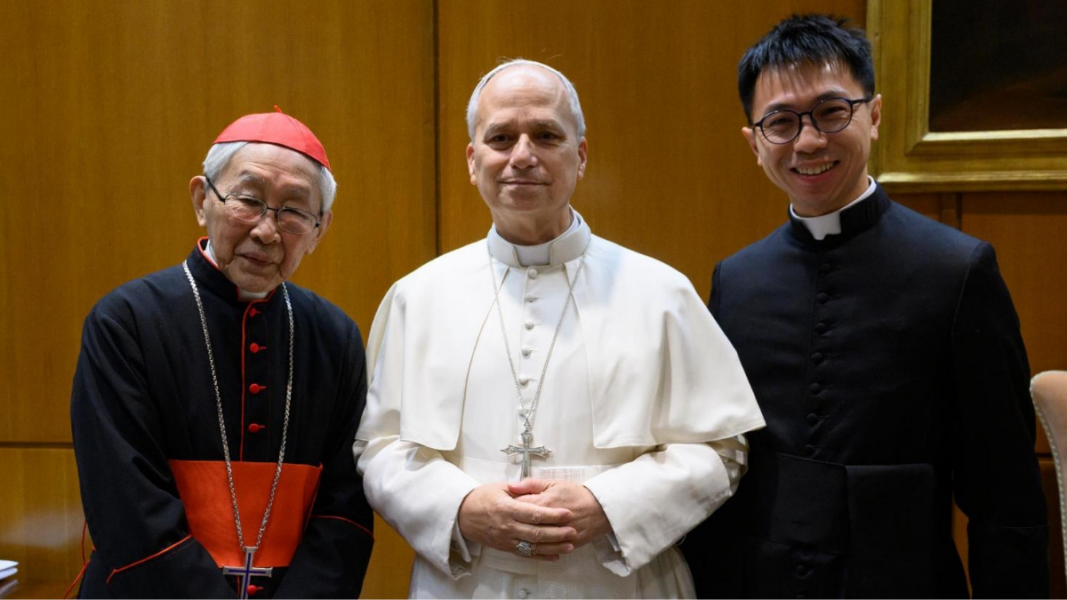
In a closed-door intervention during the Extraordinary Consistory of Cardinals held in the Vatican on January 7 and 8, Cardinal Joseph Zen launched one of the most severe criticisms made so far against the Synod on Synodality, which he described as a process «manipulated in a shielded manner», lacking genuine deliberative freedom and injurious to episcopal authority. His words were spoken in the presence of Pope León XIV and the approximately 170 cardinals gathered.
According to The College of Cardinals Report, the Hong Kong prelate used the three minutes assigned to each cardinal to refer directly to the Pope Francis’s accompanying note to the Final Document of the Synod on Synodality, developed between 2021 and 2024.
Zen intervened after the cardinals were informed that, due to lack of time, only two of the four initially planned topics would be addressed. The chosen ones were «the Synod and synodality» and the Church’s mission in the light of Evangelii Gaudium, which gave the cardinal the opportunity to formulate a frontal critique of the synodal process.
At the core of his intervention, Zen questioned Pope Francis’s assertion that, with the Final Document, he «returns to the Church» what has matured through listening to the People of God and the discernment of the episcopate. From there, he posed a series of questions that structure his entire denunciation:
«Has the Pope been able to listen to the entire People of God?»
«Do the laypeople present truly represent the People of God?»
«Have the bishops chosen by the episcopate been able to carry out true discernment, which must necessarily consist of ‘discussion’ and ‘judgment’?»
For Zen, these questions demonstrate that the synodal process was not truly deliberative, but carefully directed. In that context, he denounced what he described as «the shielded manipulation of the process», asserting that it constitutes «an insult to the dignity of the bishops».
The cardinal was particularly harsh in referring to the constant use of spiritual language to legitimize already-made decisions. According to Zen, the repeated invocation of the Holy Spirit in this context is «ridiculous and almost blasphemous», as it seems to suggest that the Spirit could contradict what He Himself has inspired in the Church’s bimillennial Tradition.
Another central point of the critique was directed at the assertion that the Pope, «bypassing the Episcopal College,» listens directly to the People of God and presents this method as the appropriate interpretive framework for hierarchical ministry. Zen questioned this conception at its root, warning of the risk of emptying the episcopate’s proper function of content.
The intervention also dwelt on the ambiguous status of the Final Document, defined as magisterial but «not strictly normative,» binding but open to local adaptations. In response to this formulation, Zen once again directly challenged the process:
«Does the Holy Spirit guarantee that no contradictory interpretations will arise, especially given the use of ambiguous and tendentious expressions in the document?»
«Must the results of this ‘experimentation and testing’—for example, the ‘creative activation of new forms of ministeriality’—be submitted to the judgment of the Synod Secretariat and the Roman Curia?»
«Will these bodies be more competent than the bishops to judge the different contexts of their Churches?»
The cardinal warned that, if the bishops legitimately consider themselves more competent for that discernment, the coexistence of divergent interpretations cannot but lead to an ecclesial fracture, similar to that experienced by the Anglican Communion.
From this perspective, Zen expanded his analysis to the ecumenical sphere, wondering with which part of Anglicanism the Catholic Church should dialogue after its internal rupture, and warning that the Orthodox Churches will never accept the synodality promoted in the previous pontificate. For them—he recalled—synodality has always meant the real exercise of the bishops’ authority acting collegially and walking together with Christ.
In one of the most forceful passages of his intervention, the cardinal concluded:
«Pope Bergoglio has exploited the word ‘Synod,’ but has made the Synod of Bishops disappear, the institution established by St. Paul VI.»