


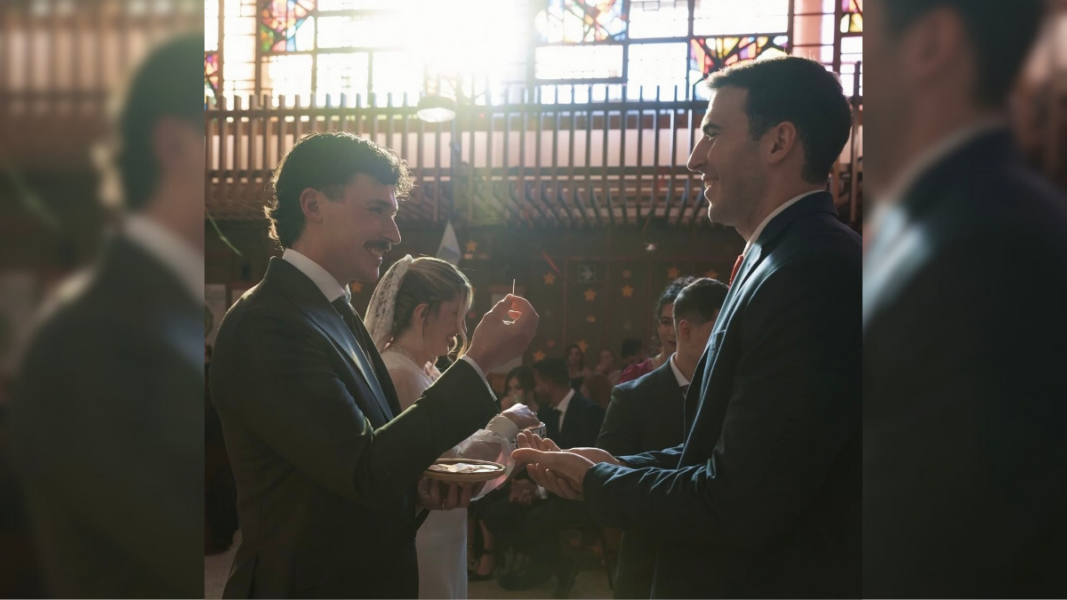
On December 31 at the San José School in Valencia, a wedding was celebrated that left an image that is causing scandal: the bride and groom distributing communion among the guests. A photograph that generates unease and bewilderment for those who know Catholic liturgy.
Nevertheless, without minimizing what happened or the imprudent and inappropriate nature of the situation, there is a factor that must be added to the context. Infovaticana has located a video published days earlier by the Jesuit priest Javier Bailén, who was in charge of the ceremony, in which he explained that he had his arm immobilized due to an injury that he describes as a test that life gives him at Christmas time, «because at Christmas we remember this, that God does not come strong, does not come perfect, does not come invincible…», reducing the divinity of Christ to a state of natural imperfection. It is easy to deduce that this priest was unable to distribute communion in the usual way, that is, to hold the ciborium and give the consecrated host.
Given this physical limitation, it is likely that the celebrant made the inappropriate decision for the bride and groom to assume the role of extraordinary ministers of the Eucharist. A decision that, while it allowed the ceremony to proceed, is not the most prudent from a liturgical point of view. In light of the scandal, it is clear that the participation of the bride and groom themselves in this role can create an off-center and bewildering image that distracts from the sacrament being celebrated.
Canon law indicates that extraordinary ministers of Communion —such as instituted acolytes or lay faithful designated by the bishop (cf. Can. 230 §3)— can only distribute it during Mass under strict conditions, such as the absence of ordained ministers or their real inability to distribute it.
Behind every photograph there are human circumstances that help explain decisions that, otherwise, would be more striking or questionable. However, it also underscores that good intention does not replace prudence. Even in the face of unforeseen events, there are alternatives that would have better preserved the solemnity of the ceremony and respect for the Eucharist, adjusting the method of distributing communion to a viable form.
Perhaps this unpleasant image also serves to remind us that the issue of extraordinary ministers of the Eucharist needs to be reconsidered or suppressed.