


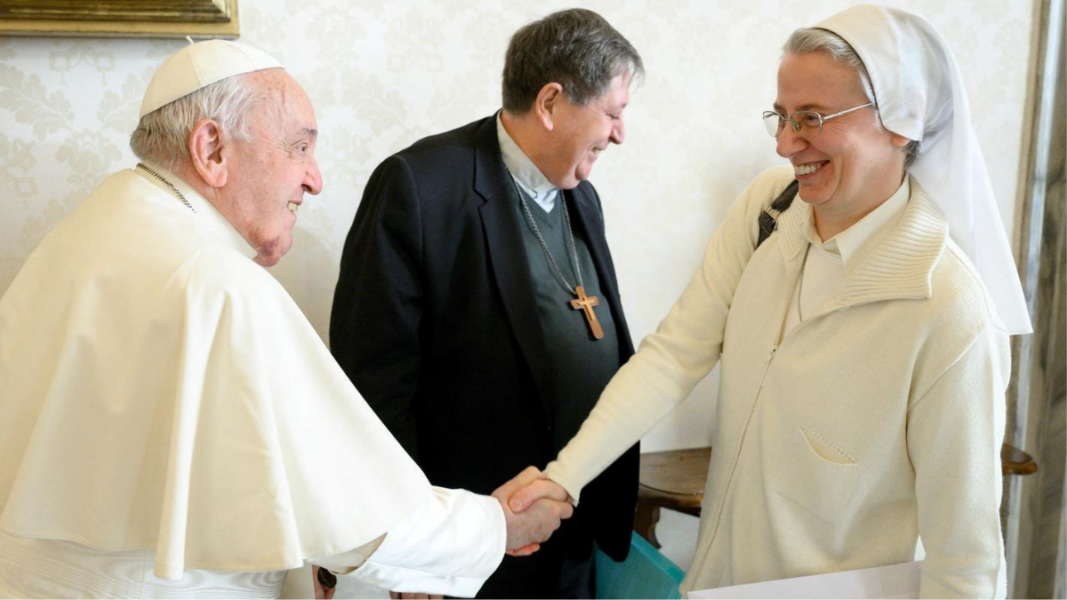
The appointment of the «prefect» of the Dicastery for Religious, Sister Simona Brambilla, formerly secretary of the same Dicastery, has highlighted a theological and canonical problem that is no small matter. The unexpected promotion, carried out in a surprising manner by the late predecessor of Pope Leo, creates an embarrassing situation for the latter, which he will nevertheless have to resolve soon.
The cause of the lightning appointment of the current prefect may lie in a certain form of pseudo-theological and politically correct feminism, which boasts of promoting women while seeking to halt the progress of Marian dogma so that the glory of Jesus is not overshadowed by… a woman!
The issue now is that Pope Prevost finds himself with a real «hot potato» that is difficult to peel. Allow us to offer some points of reflection in order to understand the inherited mess, for in reality, the figure of the «prefect» (as she signs with relative frequency) pleases neither Greeks nor Trojans.
It has been astonishing to find on the Bose blog an article by the ultra-progressive theologian Andrea Grillo protesting against the appointment of Sister Brambilla. The reason? An enthusiastic subscriber to post-conciliar Catholic «episcopalism,» Andrea Grillo says that granting vicarious jurisdictional powers to a woman is a return to Tridentine feudalism, an assault on the ecclesiology of Vatican II based on the sacramentality of the order. If the episcopate is, as the Council says, the fullness of the priesthood and the sole foundation of the hierarchy of service (egalitarian in Grillo’s imagination), what sense does it still make to pretend to delegate jurisdictional powers to someone who is not even capable of receiving the diaconate? In conclusion, making Brambilla prefect is an improper and retrograde measure for convinced progressives.
On the opposite side, we find the defenders of the uniqueness of the potestas sacra, who say, not without a certain consistency, that just as the sacrament of order is one, the potestas sacra is one, although it is distinguished between the power of governance and of order, proper or vicarious. To support their thesis, these scholars cite the current Code of Canon Law in its c. 274 § 1, which restricts to clerics alone the obtaining of offices for whose exercise the power of order or the power of ecclesiastical governance is required. They further argue that this canon follows the theological line of the Second Vatican Council in Lumen gentium no. 21 and in its explanatory note no. 2. They maintain that the cited canon has been repealed or undermined by the Prædicate evangelium, the new legal framework for the Roman Curia, approved by Francis in 2022.
Finally, we find the moderates, who say they are the majority, responsible for the aforementioned Prædicate evangelium maintaining a difficult balance in the vexata quæstio. For these, the pope can delegate his jurisdictional powers even to laypeople, but for strictly lay areas of governance; for example, the administration area managed by the Governorate of Vatican City State. However, to intervene in matters related to the sacrament of order, it is necessary that the one in whom it is delegated has in turn been ordained.
It is in coherence with this vision, assumed by the Prædicate evangelium, that at the apex of the Dicastery for Religious, a religious «prefect» and a cardinal «pro-prefect» (to ensure the legitimacy of the papal delegation for matters relating to the sacrament of order) were appointed, assisted by the «secretary,» also consecrated. Here is the «hamburger Dicastery,» as the friends of Cardinal Artime—pro-prefect in the midst of two women—call it when they fraternally joke with him.
But what do the moderates think about Brambilla? They too are not pleased with the cumbersome figure of «prefect.» They assure that they are awaiting a signature from the pope to put this dicastery in order and untie the complex knot left by Francis. The reason is simple: what sense does it make to place at the apex of a dicastery someone who is only half competent to exercise the office? All the more so when the pro-prefect could do it fully, thanks to the sacrament of order received. It is as if one put an unlicensed enthusiast to pilot a plane, but with certain notions of aviation, capable barely of taking off but not of landing, although, to be sure, a pro-pilot is placed beside him to prevent the aircraft from crashing on the first try. Who would board that plane?
The Simona Brambilla case finds itself at a crucial crossroads. Her only defense, from right and left, is political correctness, for being a promoted woman, it would be unpopular to take her down from the podium. But that, how long will it serve her? All the more so since the pope has on his desk evidence of the sister-prefect’s feminism, always inopportune, as well as clear data on her ideological orientation, implacable in relation to everything that is not the vanguard of the revolution.
One last detail about the «good» Simona: who will forget her and her secretary in the shows organized by the Dicastery for the jubilee of religious last year? In the poorest areas of Rome, in two different stages, with Palestinian scarves and LGTBI+ pride flags, to the sound of rock bands and a strong union presence, there we had the «prefect» and the «secretary,» with all their reactionary glamour, cheering on egalitarian and advocacy encounters in favor of the least… Was it something prophetic? Will Brambilla return to the existential peripheries?