


In recent years, an expression has been repeated insistently in certain ecclesiastical circles: “openness to novelty”. Presented as an evangelical and almost obligatory attitude, it is usually invoked in contexts of change, crisis, or reform. However, when it is formulated without doctrinal precisions or clear limits, it ceases to be a spiritual exhortation to become an ambiguous slogan, capable of justifying almost anything.
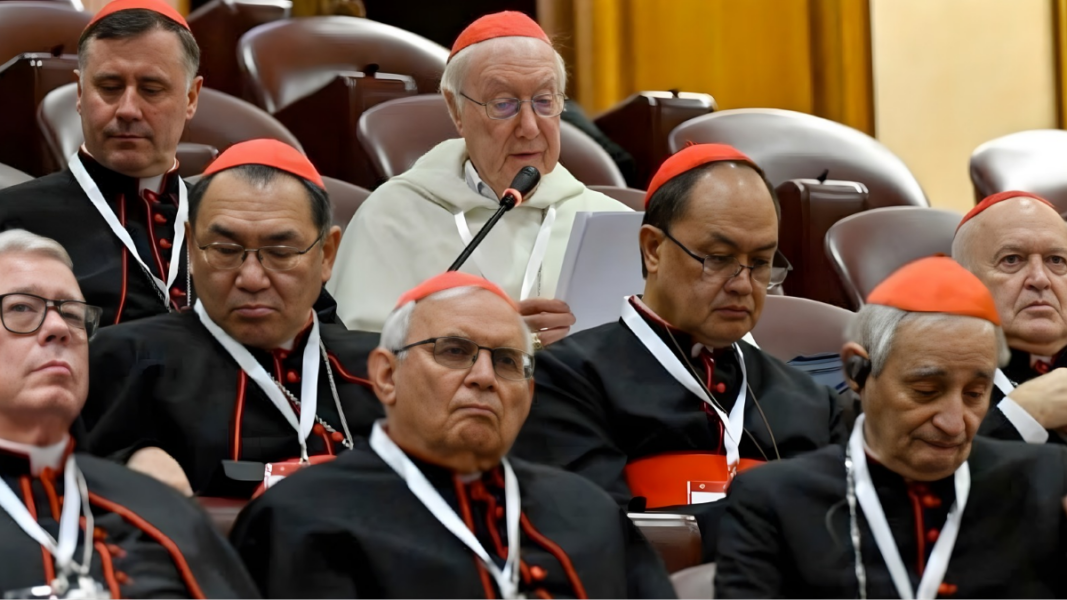
In the opening meditation of the Consistory, delivered by Cardinal Radcliffe, novelty was mentioned as one of the paths, or styles, of some cardinals—including himself, of course: “some of us will be defenders of memory, valuing tradition,” adding: “others will enjoy more the surprising novelty of God, but memory and novelty are inseparable in the dynamic of Christian life.”
The Church, certainly, is not an immobile reality nor a museum piece. It lives in history and faces real challenges. But it is also true—and this cannot be forgotten—that its mission does not consist in adapting to the world, but in converting it. When “novelty” is posed as a value in itself, detached from revealed truth and the living Tradition, the risk is not small: that change replaces the criterion, and novelty displaces fidelity.
Novelty is not synonymous with truth
In classical ecclesiastical language, novelty has never been an autonomous criterion. The Church has welcomed developments, clarifications, and deepenings, but always under an essential condition: continuity with what has been received. When St. Vincent of Lérins spoke of the development of dogma, he did so in terms of organic growth, not rupture or reinvention.
That is why it is problematic when “novelty” is appealed to without specifying what remains and what changes, what develops and what is preserved, what comes from the Spirit and what responds to external cultural pressures. In a context marked by doctrinal and moral confusion, this lack of precision does not help communion, but weakens it.
The danger of rhetoric without content
Expressions like “openness,” “listening,” or “novelty” may sound evangelical, but they are not neutral. Depending on how they are used, they can serve either for authentic discernment or to legitimize decisions already made in advance. Recent experience shows that, in not a few cases, these words have been employed to deactivate legitimate resistances, not to address them with arguments.
When openness is requested without clarifying to what, and novelty without defining its limits, what is generated is not hope, but distrust. Especially among those who perceive that, under spiritual language, changes are introduced that affect faith, morals, or sacramental discipline.
Memory and fidelity, not nostalgia
The constant appeal to “memory” is usually presented as a counterweight to novelty. But precision is also needed here. Ecclesial memory is not a sentimental recollection of the past, but the living presence of what has been received. It is not about nostalgia, but fidelity.
A Church that forgets what it is will hardly know how to discern where it is going. And a Church that presents Tradition as baggage, rather than as a criterion, ends up losing its way, even when it believes it is advancing.
Discerning is not diluting
True discernment does not consist in lowering the demands of the Gospel to make them more acceptable, but in living them with truth and charity in every historical circumstance. The authentic novelty of Christianity is not in changing its message, but in always returning to Christ, who is “the same yesterday, today, and forever.”
In a decisive moment for the Church, what is most needed are not slogans open to multiple interpretations, but clarity, criterion, and fidelity. Because not all novelty comes from the Spirit, and not everything old is an obstacle. Sometimes, what is truly revolutionary is simply remaining in the truth.