


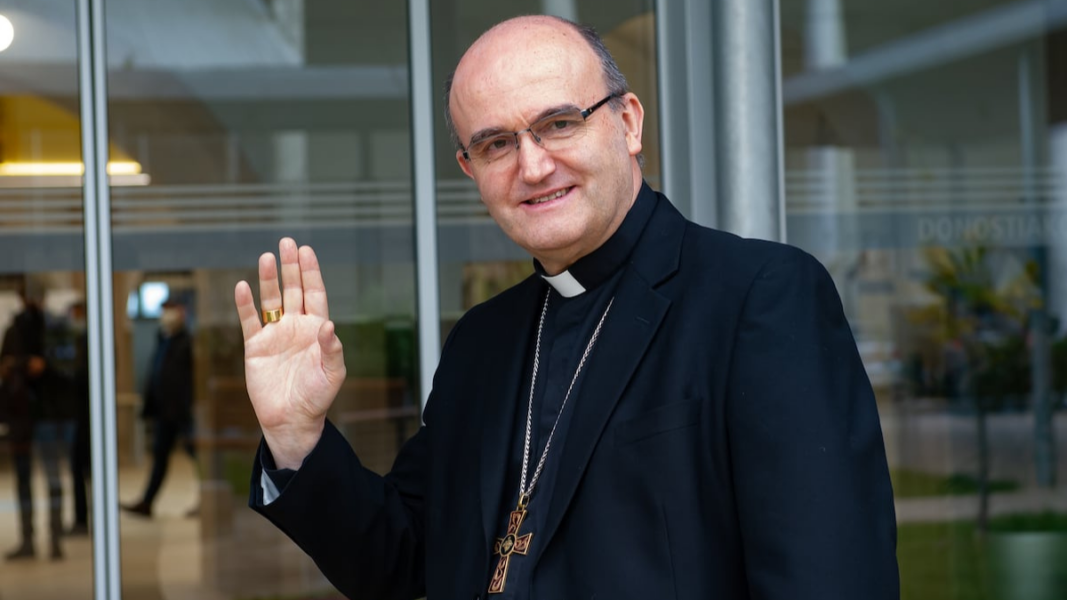
José Ignacio Munilla once again exhibits a constant that can no longer be dismissed as an isolated opinion or a mere verbal clumsiness: his profound incompetence in analyzing international politics, combined with an almost obstinate insistence on presenting geopolitical judgments as if they were direct applications of the Church’s social doctrine.
In his program Sexto Continente on January 9, the bishop devotes an extensive segment to the detention of Nicolás Maduro by the United States. The verdict is unequivocal: the action is «immoral» because it constitutes a violation of international law. From there, Munilla constructs a discourse that, far from illuminating reality, distorts it through abstract moralization, disconnected from the real world and once again serving a well-known ideological prejudice.
Recognizing the tyrant… to absolve him in practice
Munilla begins by admitting facts that no one disputes and that are morally relevant:
«There were sufficient moral reasons to resort to the use of force to overthrow a dictatorship. We were facing a dictatorial political regime that had falsified elections… Added to that is the repression and the exodus of more than eight and a half million Venezuelans».
Up to this point, the diagnosis is correct. Maduro is a dictator, he has stolen elections, he has impoverished his country, and he has provoked one of the continent’s largest migratory crises. Munilla even recognizes that there are sufficient moral reasons to overthrow him.
However, that recognition is immediately neutralized by a mental operation that repeats throughout the segment: any practical consequence of that diagnosis is considered suspicious, illegitimate, or directly immoral.
«That said, not just anyone is legitimized to do that… What is not legitimate is an intervention on a private basis».
The result is an unsustainable moral paradox: the tyrant deserves to fall, but no one can touch him; the dictatorship is unjust, but its real end always arrives “wrong”; the people are victims, but their liberation must wait for an ideal procedure that never occurs in history.
The fetishism of international law
The core of Munilla’s discourse is not the defense of the Venezuelan people, but the sacralization of international law as if it were a pure, ahistorical, and incorruptible moral instance. That is why he states without nuance:
«The violation of international law remains a violation. The actor is not morally justified».
Here the underlying problem appears: international law becomes a moral fetish, detached from material justice, from the protection of victims, and from the classical principle that authority exists for the common good.
Munilla does not ask himself—not even once—whether Maduro’s regime has de facto destroyed the Venezuelan legal order, nor whether that same international law has been incapable for years of protecting citizens against tyranny. The legal framework is absolutized, even though it serves to shield the oppressor.
The United States as an abstract villain
The discourse takes a revealing turn when the focus shifts from Maduro to the United States. Munilla then introduces a systematic suspicion about the motivations for the arrest:
«The way in which all this has happened is very murky… There is a double ideological standard here».
And even more so:
«This reveals a doctrine of power without clear limits: national security as a wildcard, power above the law».
The concrete dictator, with a name, face, and victims, dissolves. In his place appears an abstract villain, Western, imperial, and predictable. Chavismo becomes almost a backdrop, while the moral emphasis falls on denouncing a supposed messianic logic of the United States.
It is no coincidence. Munilla does not analyze the facts: he filters them through an automatic distrust of any Western action that does not fit into his moralizing scheme. The consequence is that the real tyrant is relativized, while the one acting against him is subjected to relentless moral scrutiny.
A false moral equidistance
Munilla prides himself on balance by stating:
«The left is right… The right is also right».
But this equidistance is only apparent. In practice, the moral weight of the discourse falls almost exclusively on whoever detains the dictator, not on whoever has destroyed an entire country. The language becomes severe with the Western actor and surprisingly aseptic with the criminal regime.
The finale arrives with a warning as grandiose as it is revealing:
«Be careful about signing blank checks to an autocratic messianism. Our only Messiah is Jesus Christ».
An effective phrase that, in this context, shifts the moral axis from the real suffering of millions of Venezuelans to an abstract ideological fear, perfectly compatible with Maduro—the real tyrant—continuing to be, de facto, the beneficiary.
Social doctrine is not geopolitical moralism
The Church’s social doctrine is not a manual for disauthorizing any effective action against real evil, nor a pretext for demanding impossible procedural purities in contexts of tyranny. Nor is it a cover for turning international law into an idol that ends up protecting the oppressor against his victims.
Munilla is not obligated to opine on everything. But when he does, and moreover does so in the name of the social doctrine, it would be advisable to demand something more than disordered moral intuitions, forced analogies, and ideological prejudices.
Because when moral discourse loses contact with reality, it does not elevate Christian conscience: it confuses it. And in this case, the confusion ends up benefiting—the tyrant once again—and not his victims.
Below is the ordered and continuous transcription of everything Mons. Munilla says in the January 9 program about Venezuela, the detention of Maduro, and the actions of the United States, so that the reader can directly contrast his words:
«The first question is, from the point of view of Catholic social doctrine, from that Christian discernment, what is the correct stance on what happened in Venezuela, on that intervention carried out by the US government, the detention of President Maduro and his wife, and their transfer to the United States?»
«There were sufficient moral reasons to resort to the use of force to overthrow a dictatorship. We were facing a dictatorial political regime that had falsified elections with existing records showing that more than 70% of the electorate had chosen another candidate. Added to that is the repression and the exodus of more than eight and a half million Venezuelans.»
«That said, not just anyone is legitimized to do that. An intervention against a tyrant must be done either by the people themselves or through an international intervention. What is not legitimate is an intervention on a private basis.»
«Here we are hearing two readings. The left emphasizes that this action is contrary to international law and that it is a dangerous precedent. They are right. The right is scandalized that the detention of a dictator is not celebrated and suspects complicity with him. They are also right.»
«The end does not justify the means, but that does not mean that when someone uses unjust means and a good results, we have to be saddened by that good. We condemn the means, but we welcome the effect with hope.»
«The violation of international law remains a violation. The actor is not morally justified, even though we rejoice in the hope that opens up for the Venezuelan people.»
«The way in which all this has happened is very murky. Resorting to a police action for drug trafficking when weeks earlier another leader convicted of the same thing was pardoned. There is a double ideological standard here.»
«This reveals a doctrine of power without clear limits: national security as a wildcard, power above the law, force above international legality.»
«We rejoice with the Venezuelans, but be careful about signing blank checks to an autocratic messianism. Our only Messiah is Jesus Christ.»