


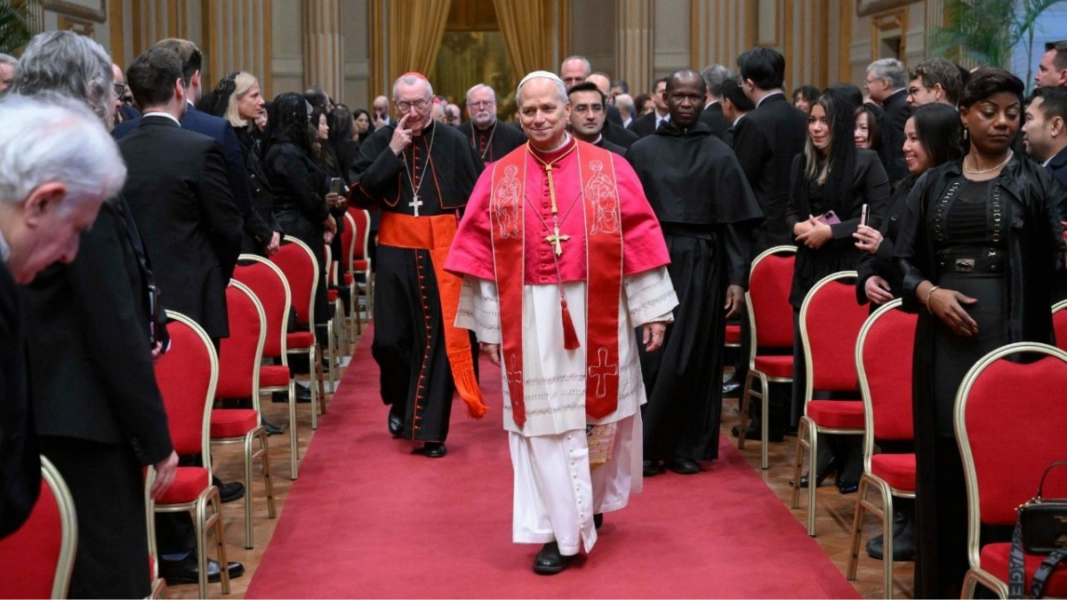
On the morning of this January 9, Pope Leo XIV received in audience the members of the Diplomatic Corps accredited to the Holy See, on the occasion of the traditional exchange of New Year greetings. The meeting took place in the Hall of Benediction, following the initial intervention by the Dean of the Diplomatic Corps, the Ambassador of Cyprus Georges Poulides.
In his extensive speech, the Pontiff offered a broad reflection on the current international situation, marked by the return of war, the weakening of multilateralism, and the erosion of international law. Leo XIV emphasized the centrality of peace, the defense of human dignity, religious freedom, and the protection of life and family, pointing out the irreplaceable role of diplomacy in building a more just and stable international order.
A moral and cultural crisis, not just geopolitical
During the audience held on January 9, 2026 in the Hall of Benediction, Leo XIV developed a broad reflection on the international situation, emphasizing that the current crisis is not only geopolitical, but profoundly moral, cultural, and spiritual. In that context, he affirmed that the protection of the right to life constitutes the essential foundation of any other human right, and that a society that does not protect human life in all its stages ends up undermining its own future.
The Pope explicitly reiterated the Church’s rejection of abortion, euthanasia, and surrogacy, practices that—he pointed out—deny the dignity of the person and reduce human life to a product subject to criteria of utility, efficiency, or desire. He also warned against the contradiction of States that allocate public resources to eliminate human lives while neglecting support for mothers, families, and unborn children.
In close relation to this pro-life defense, Leo XIV reaffirmed the central role of the family founded on the stable union between a man and a woman, emphasizing its irreplaceable function in the transmission of life, education, and social cohesion. The Pontiff linked the demographic winter affecting many Western societies to the cultural weakening of the family and to policies that despise motherhood and fatherhood.
The speech also addressed the situation of the sick, the elderly, and vulnerable people, denouncing false solutions that present euthanasia or assisted suicide as acts of compassion. In response, Leo XIV defended the development of palliative care and genuinely supportive policies that accompany suffering without eliminating the sufferer.
The weakening of multilateralism and the return of war
Beyond anthropological issues, the Pope devoted a substantial part of his intervention to the crisis of multilateralism, lamenting that diplomacy based on dialogue and consensus is being replaced by power alliances, ideological impositions, and the logic of force. He recalled the founding spirit of the United Nations after the Second World War and warned that its progressive moral emptying puts international stability at risk.
In this context, he expressed a firm condemnation of the return of war as a political instrument, emphasizing that peace is no longer sought as a good in itself, but as a balance imposed by weapons.
Leo XIV reaffirmed the need to respect international humanitarian law, insisting on the protection of civilian populations, the inviolability of hospitals and basic infrastructure, and the rejection of all forms of indiscriminate violence. He referred specifically to various ongoing conflicts, including Ukraine, the Holy Land, sub-Saharan Africa, Venezuela, Haiti, and several regions of Asia.
Religious freedom and conscientious objection
A highlighted axis of the speech was religious and conscientious freedom, defined as a fundamental human right and not as a concession from the State. The Pope denounced the increase in persecution against Christians and also warned about more subtle forms of religious discrimination in countries with a Christian tradition.
In relation to this, he warned about the growing pressure against conscientious objection, especially in the health and educational fields, pointing out that forcing someone to act against their own moral convictions constitutes a serious form of legal and cultural violence.
Migrations and the common good
Leo XIV also addressed the migration issue, recalling that every migrant is a person with inalienable dignity, but emphasizing that welcoming cannot be detached from the common good, from the responsibility of States, and from the need to combat the root causes of forced displacements, such as war, poverty, and political instability.
Finally, Leo XIV concluded by emphasizing that authentic peace requires humility, truth, and courage, and that the mission of diplomacy is not to manage conflicts, but to prevent them, promoting a culture of encounter that does not renounce truth or justice. Without the recognition of the inviolable value of every human life, he warned, politics loses its ethical foundation and peace becomes a mere truce imposed by force.
You can see the full speech here