


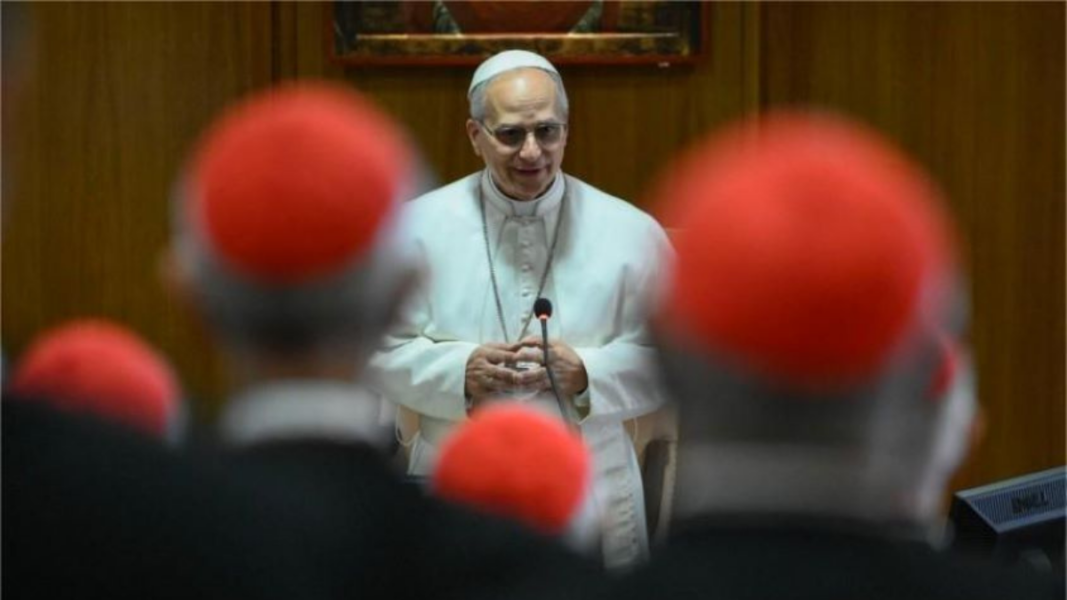
At the end of the first session of the Extraordinary Consistory, held on January 7, 2026, Pope Leo XIV addressed some improvised words to the College of Cardinals, marked by a tone of gratitude, spiritual exhortation, and a call to common discernment.
In his intervention, which was later published in the Holy See’s bulletin, the Pontiff emphasized the value of the shared journey over immediate results, insisted on the need for a living Church, open to the action of the Holy Spirit, and clearly recalled that the Church’s fundamental mission is not to look at itself, but to proclaim the Gospel with Christ at the center. The Pope explicitly linked the themes of synodality and evangelizing mission, in continuity with Evangelii Gaudium, and asked the cardinals to work together, without fear, trusting in the Lord.
We leave below the words of Leo XIV:
Once again, good afternoon, and thank you very much for all the work already done in this first session.
I would like to begin simply by repeating the words of one of the secretaries, the first one who spoke, who suggested that the journey has been as important as the conclusion of the work in the groups. I would like to start from there to say, first of all, thank you for being here. I think it is very important for all of you to participate in this experience as the College of Cardinals of the Church, which offers not only to us—it is not for us—, but to the Church and the world, a certain testimony of the will and desire, recognizing the value of meeting together, of making the sacrifice of a journey—for some of you very long—to come to be together and to seek together what the Holy Spirit wants for the Church today and tomorrow.
That is why I truly think it is important, even if it is a very brief time, but it is a very important time also for me, because I feel and experience the need to be able to count on you: it is you who have called this servant to this mission! Therefore, I would like to say that I think it is important that we work together, that we discern together, that we seek what the Spirit asks of us.
If you will allow me, I repeat some words from yesterday’s homily on the feast of the Epiphany. Many of you were present, but I say them again: “Let us ask ourselves: is there life in our Church?” I am convinced that yes, certainly. These months, even if I had not lived it before, I have had many beautiful experiences of the life of the Church. But the question remains: is there life in our Church? “Is there space for what is born? Do we love and proclaim a God who sets out again on the journey?” We cannot close ourselves off and say: “Everything is already done, finished, do as we have always done.” There is truly a journey, and with the work of these days we are walking together.
“In the story, Herod fears for his throne; he is agitated by what he feels is out of his control, he tries to take advantage of the Magi’s desire and seeks to twist their search for his own benefit.” Herod “is willing to lie, he is willing to do anything. Fear, in fact, blinds. The joy of the Gospel, on the other hand, liberates. It makes one prudent, yes, but also bold, attentive, and creative; it suggests paths different from those already traveled.”
This meeting, for me, is one of the many expressions in which we can truly live an experience of the newness of the Church. The Holy Spirit is alive and present among us too. How beautiful it is to meet together in the boat! That image that Cardinal Radcliffe offered us in his reflection this afternoon, as if to say: we are together. There may be something that scares us; there is doubt: where are we going, how will it end? But if we place our trust in the Lord, in his presence, we can do much.
Thank you for the decisions. The choice of all the groups by a large majority is quite clear, I think. And it seems very important to me also, based on the other comments made, that one theme cannot be separated from the other. Indeed, there is much that we will be able to see together. But we want to be a Church that does not look only at itself, that is missionary, that looks beyond, toward others. The reason for being of the Church is not for the cardinals or for the bishops or for the clergy. The reason for being is to proclaim the Gospel.
And that is why these two themes: the Synod and synodality, as an expression of the search for how to be a missionary Church in today’s world; and Evangelii Gaudium, proclaiming the kerygma, the Gospel with Christ at the center. This is our mission.
Therefore, I thank you. This will help us to organize ourselves for tomorrow’s work in the two sessions. The other themes are not lost. There are very concrete and specific issues that we still need to address. I hope that each of you feels truly free to communicate with me or with others, and we will continue this process of dialogue and discernment.
Nothing more. Thank you for this service. I don’t know if I have exceeded three minutes. The moderator has been very courteous! Good afternoon and see you tomorrow morning.