


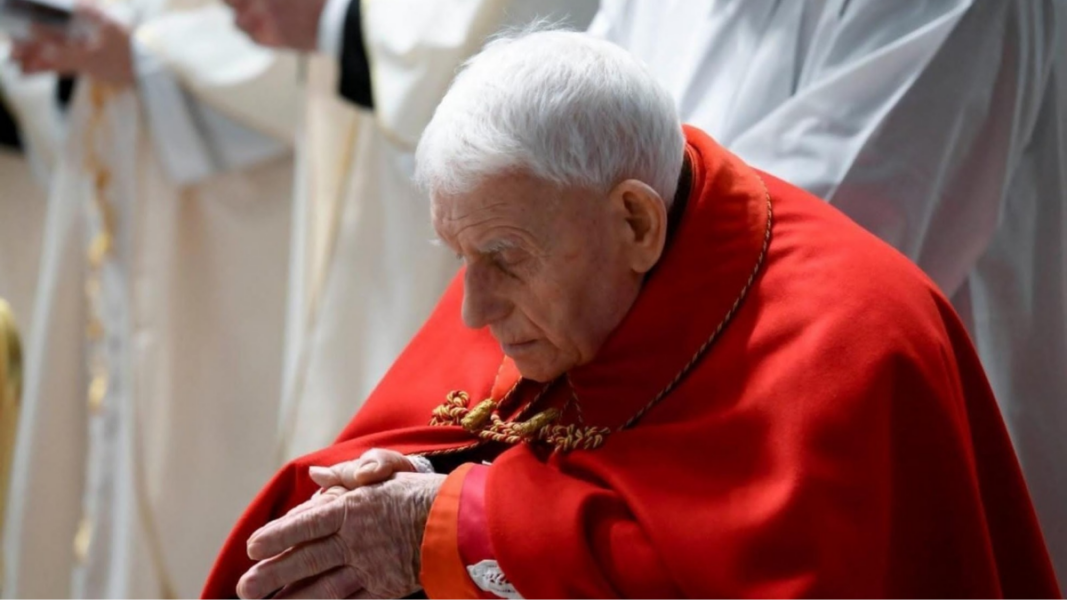
Cardinal Ernest Simoni decided not to concelebrate at the consistory Mass. Ninety-seven years sustain his body, ninety-seven years accredit his faith. A faith confessed even to prison in communist Albania, purified in the trial of two decades tortured, lived when believing was not a custom but a decision that implied risk and pain. That personal history, crossed by persecution and fidelity, has shaped a priestly conscience deeply rooted in Christ’s sacrifice and in the sacrificial character of the Mass.
Simoni owes nothing to anyone nor seeks to be interpreted. He knew and celebrated the Mass before 1969, when the altar was not a space shared for convenience, but a sacred place ascended with fear and trembling. In the heart of this nearly centenarian priest dwells a serene conviction: that each Mass is complete in itself, that its value is not increased by the number of concelebrants, because in each one the same redemptive sacrifice is made present. From that certainty his gesture is understood.
Throughout the entire Eucharistic Prayer (the second one and in Italian), he remained kneeling. It was not a gesture of differentiation but of interior coherence. There are priests for whom concelebration is a legitimate and occasional possibility, but not a habitual way of living the Mystery. In Simoni, it is clearly perceived that the accumulation of concelebrants does not add depth to that which is already infinite, and that the personal recollection of a cardinal can express with greater clarity the centrality of Christ’s sacrifice.
Probably, that same day, at a more discreet moment, he offered the Holy Mass according to the ancient rite that has accompanied his priestly life and his two decades of imprisonment. Not as an identity gesture, nor as a reaction, but as a natural continuity of a faith lived without ruptures. In Simoni’s way of positioning himself before the altar, there is a clear preference for sobriety, for silence, for a liturgy that speaks of centrality and avoids dispersion.
Simoni reminds us that the Church is not sustained by the abundance of visible gestures, but by the silent fidelity of those who have lived the faith to the depths. He reminds us, those of us who doubt, those of us who look at the present with unease, that this Church is made of martyrs and confessors, of men who do not need to explain themselves to teach. In his physical weakness, Simoni sustains us; in his kneeling, he orients us; in his discretion, he restores to us the just proportion of things.
In times of confusion and weariness, Simoni reminds us of something essential: that each Mass suffices, that Christ’s sacrifice is eternal, and that not everything diluted and multitudinous is necessarily the best.
Thank you, Cardinal. Perhaps this image alone validates an entire empty consistory.