


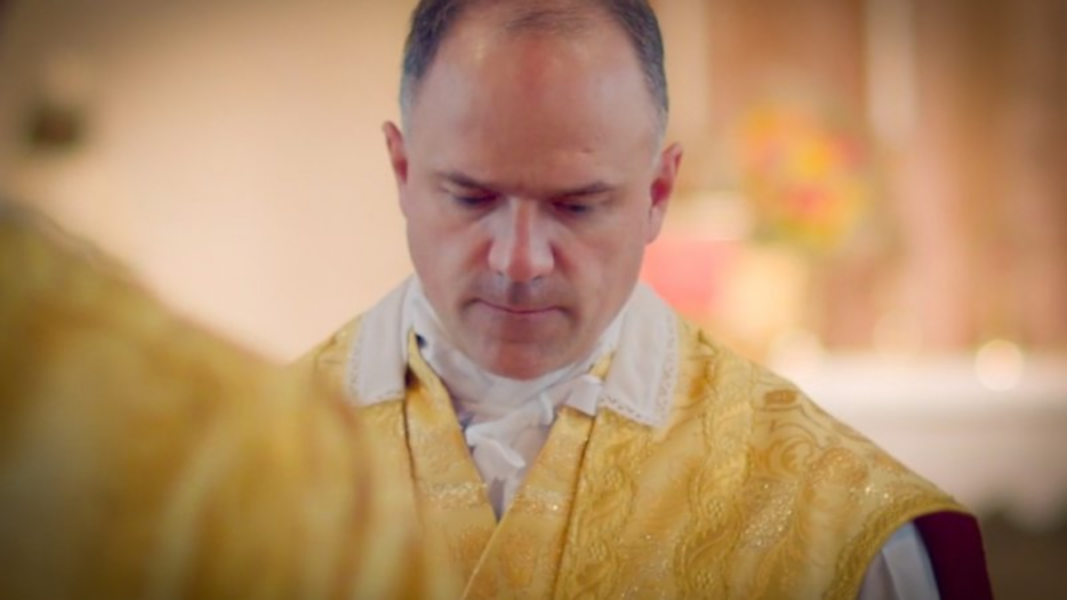
The Superior General of the Fraternidad Sacerdotal San Pío X (FSSPX), Father Davide Pagliarani, has publicly acknowledged the possibility of future episcopal consecrations, even without express approval from Rome, considering that the Church is going through a more serious emergency situation than that of 1988, when Monsignor Marcel Lefebvre consecrated four bishops without a papal mandate.
Read also: The FSSPX admits that it will need to ordain new bishops in the coming years
The statements were made last December 13 in Friedrichshafen (Germany), during an event where Pagliarani shared the stage with Monsignor Bernard Fellay, former Superior General of the Fraternity and one of the bishops consecrated by Lefebvre.
“The million-dollar question”
In his speech, the current Superior General directly addressed an issue that for decades has been treated with extreme discretion within the FSSPX. “The question of future episcopal consecrations is the million-dollar question,” he stated, clarifying however that he could not provide “dates or names.”
The question of bishops is central to the identity and survival of the Fraternity, which continues to operate outside the ordinary canonical structures of the Church, claiming a “supplied jurisdiction” based on a state of necessity to ensure the administration of the sacraments.
Pagliarani explicitly revisited that argument and applied it to the current situation: “Does a state of necessity exist in the Church today as it did in 1988? This state of necessity is today more clearly recognizable than it was then.”
The legacy of the Francis pontificate
The Superior General situated his diagnosis mainly in relation to the pontificate of Pope Francis. “After the pontificate of Pope Francis, we find ourselves in an emergency situation,” he maintained, adding that, although the Pope has died, his decisions remain “epochal, problematic, and far-reaching.”
According to Pagliarani, that pontificate “exemplifies from beginning to end the state of necessity within the Church.” In that context, he denounced serious shortcomings in ordinary parish life: “In many parishes, the means for the salvation of souls are no longer guaranteed. The preaching of the truth and the administration of the sacraments are often lacking.”
Not an internal matter, but “the good of the Church”
The priest insisted that an eventual consecration of bishops should not be understood as an internal matter of the Fraternity, but as an issue oriented “toward the good of the Church.” At the same time, he emphasized that a decision of such magnitude cannot be taken lightly. “It is not enough to prepare the ceremony of episcopal consecration; one must also prepare hearts,” he affirmed, stressing the need for prayer.
Contacts with Rome, but no decisions taken
Days earlier, on December 8, the English medium The Catholic Herald, reported an interview granted to the German medium Corrigenda by Father Franz Schmidberger, also a former Superior General of the FSSPX, who confirmed that the matter is being considered, although without concrete decisions. “It is being studied, but I cannot say when it will take place or how many bishops will be ordained,” he declared.
Schmidberger added that any step in that direction would necessarily require dialogue with the Holy See, recalling that “in a normal situation, bishops cannot be consecrated without the Pope’s permission.”
Continuity, not protest
From its origins, the Fraternity of Saint Pius X has defined itself as a work of preservation, rather than protest. Monsignor Lefebvre did not initially seek confrontation with Rome, but to protect priestly formation and sacramental life in a context of doctrinal confusion following the Second Vatican Council.
Historical documentation shows that the 1988 consecrations were perceived internally as a last resort, adopted under pressure and after failed negotiations with the Vatican. For decades, the question of episcopal succession has been treated with extreme reserve to avoid an escalation of the conflict.
Therefore, the fact that it is now being addressed publicly is significant, beyond the absence of announced concrete decisions. By invoking the concept of “state of necessity” once again, Pagliarani positions the present as a continuation of an unresolved crisis since 1988, especially accentuated—according to his analysis—by the lasting effects of the last pontificate.