


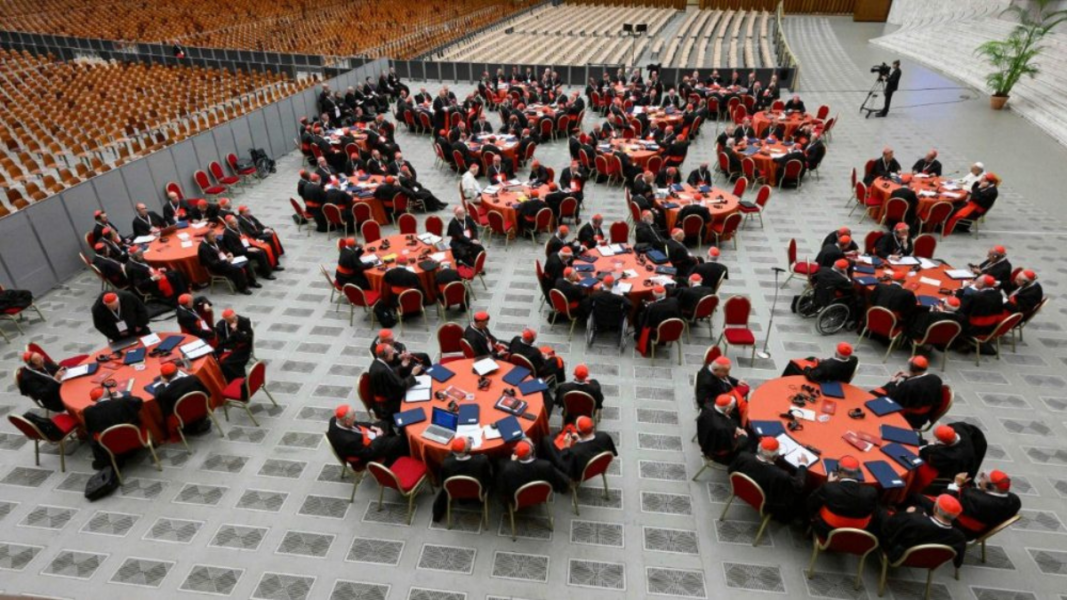
The first news from the first consistory of Leo XIV’s pontificate is not a gesture of rupture, nor even of correction. It is a confirmation. By a wide majority, the cardinals gathered in the extraordinary consistory have decided to dedicate their work to two themes: synodality and evangelization and mission in the light of Evangelii gaudium. Liturgy and reform of the Curia, for another occasion. If there’s time left. We’ll see.
The fact is not minor. It is not a technical nuance or an agenda issue. It is a declaration of priorities. In a moment of objective emergency—vocational collapse, sacramental disaffection, moral discredit of the hierarchy, doctrinal confusion—the College of Cardinals has once again chosen to look in the mirror and talk about itself.
We are told that time is pressing. That not everything can be discussed. And precisely for that reason, what touches the very nerve of the Church is left out: the liturgy, the source and summit of its life; and the apostolate understood not as a concept, but as the real transmission of the faith. Instead, it chooses to continue reflecting on the process, the method, the structure. On synodality. Again.
Meanwhile, cardinals like Robert Sarah—who represent an ecclesial sensitivity centered on God, on worship, on silence, and on the living tradition—have spent hours listening to figures like Tolentino de Mendonça, Tagle, or Radcliffe. The implicit message is clear: there is no time to talk about liturgy, but there is time to listen again to those who have been delivering the same discourse for a decade, with the same results.
And here it is worth pausing, because the problem is no longer debatable in the abstract. Synodality, as it is being applied, has failed. And it has not only failed: it is beginning to seem obscene.
It is presented to us as a process of listening, but it is not. It is an institutional monologue. The same structures that have led the Church in the West to an unprecedented crisis—episcopal conferences, commissions, secretariats, diocesan offices—ask themselves questions, answer themselves, and then present the result as “the voice of the People of God.”
That is not discernment. It is self-justification.
The People of God do not speak in forms. They do not speak in carefully moderated assemblies. They do not speak in synthesis documents drafted by technical teams. They speak in measurable facts, uncomfortable ones, impossible to gloss over: in empty or full seminaries; in vocations that arise or disappear; in marriages that persevere or dissolve; in actual Mass attendance; in effective sacramental practice; in pilgrimages that grow spontaneously on the margins of official pastoral plans.
That is the voice they do not want to hear, because it cannot be manipulated.
Organizing a “listening process” channeled through the same dioceses and episcopal conferences that have been failing pastorally for decades can only produce one thing: echo. Resonance of one’s own voice. Self-complacency. Pure narrative engineering. There is no listening: there is internal propaganda.
And the most serious thing is that it is no longer a matter of a one-off diagnostic error. It is a stubbornness. Year after year, synod after synod, document after document, the same pattern is repeated: endless analysis, therapeutic language, vague appeals to the Holy Spirit… and meanwhile, less lived faith, fewer sacraments, fewer vocations, less clarity.
The hierarchy contemplates itself like Narcissus, fascinated by its own reflection, while reality slips away completely. Texts, stages, itineraries, “journey experiences” multiply… but the method is not corrected, even though the results are disastrous.
And now, in Leo XIV’s first consistory, it insists once again that “the journey is as important as the goal.” It is a nice phrase. Also deeply revealing. When the journey becomes the end, the mission disappears. And without mission, the Church ceases to be Church to become a spiritual NGO that manages processes.
Evangelization, moreover, appears subordinated. Not as a clear proclamation of Christ crucified and risen, but filtered “in the light of Evangelii gaudium,” that is, framed in an already known, already exploited, already ideologized framework. Evangelization, yes… but without discomfort, without confrontation, without questioning dominant categories.
Meanwhile, the liturgy—where faith is embodied, where God is worshiped and not managed—is postponed. As if it were a secondary matter. As if it had nothing to do with the transmission of faith. As if liturgical degradation were not precisely one of the key factors in the current crisis.
This consistory has not opened a new stage. It has confirmed an inertia. And that inertia has a very high cost: continuing to lose time while faith is lost.
Synodality, as it is being posed, is not a path of renewal. It is a symptom. The symptom of a Church that no longer dares to teach, that has replaced authority with procedure, truth with consensus, and mission with conversation.
And the problem is not that there is no time. The problem is that it continues to avoid, deliberately, talking about the essential.