


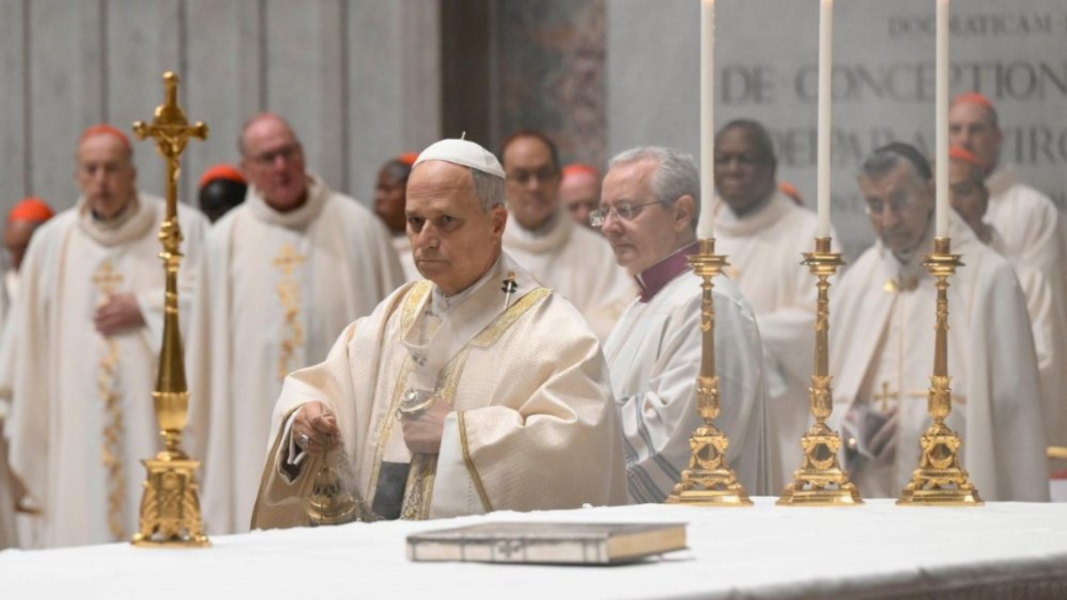
On the morning of this January 8, Pope Leo XIV presided over the Holy Mass in the Vatican Basilica with the cardinals gathered in Extraordinary Consistory, within the framework of the works convened for reflection and discernment on issues relevant to the life of the Church. During the Eucharistic celebration, the Pontiff delivered a homily in which he emphasized the spiritual meaning of the consistory as a time of listening, prayer, and communion.
In his reflection, Leo XIV insisted on the need for an ecclesial discernment free from personal or group agendas, recalling that the College of Cardinals is not called to function as a technical body, but as a community of faith at the service of the People of God. The Pope placed the Eucharist as the proper place from which to guide the works of the consistory, putting charity, communion, and shared responsibility with the Successor of Peter at the center.
We leave below the complete homily of Leo XIV:
«My dear ones, let us love one another, because love comes from God» (1 Jn 4,7). The liturgy proposes this exhortation to us as we celebrate the extraordinary consistory, a moment of grace in which we express our union in the service of the Church.
As we know, the word Consistory, Consistorium, “assembly,” can be read in the light of the root of the verb consistere, that is, “to stop.” In fact, all of us have “stopped” to be here; we have suspended our activities for a time and renounced even important commitments, to gather and discern together what the Lord asks of us for the good of his People. This in itself is a very significant, prophetic gesture, especially in the context of the frenetic society in which we live. In fact, it recalls the importance, in every journey of life, of stopping to pray, listen, reflect, and thus refocus our gaze better on the goal, directing all efforts and resources toward it, so as not to run the risk of running blindly or flailing in the air, as the Apostle Paul warns (cf. 1 Co 9,26). In fact, we are not here to promote “agendas”—personal or group ones—but to entrust our projects and inspirations to the scrutiny of a discernment that surpasses us «as the heavens are higher than the earth» (Is 55,9) and that can only come from the Lord.
That is why it is important that now, in the Eucharist, we place all our desires and thoughts on the altar, along with the gift of our life, offering them to the Father in union with the sacrifice of Christ, to recover them purified, illuminated, melted, and transformed, by grace, into a single bread. Only in this way, in fact, will we truly know how to listen to his voice, welcoming it in the gift that we are to one another, which is the reason we have gathered.
Our College, though rich in many abilities and notable gifts, is not called, first of all, to be a team of experts, but a community of faith, in which the gifts that each one brings, offered to the Lord and returned by Him, produce the maximum fruit, according to his Providence.
After all, the love of God, of which we are disciples and apostles, is “Trinitarian” love, “relational,” the source of that spirituality of communion from which the Bride of Christ lives and wants to be a home and school (cf. Apostolic Letter Novo millennio ineunte, 43). Saint John Paul II, desiring its growth at the beginning of the third millennium, defined it as «a gaze of the heart above all toward the mystery of the Trinity that dwells in us, and whose light must also be recognized in the face of the brothers who are at our side» (ibid.).
Our “stopping,” then, is, first of all, a great act of love—to God, to the Church, and to the men and women of the whole world—with which to let ourselves be shaped by the Spirit, first in prayer and silence, but also by looking into each other’s eyes, listening to one another, and giving voice, through sharing, to all those whom the Lord has entrusted to our care as pastors, in the most diverse parts of the world. An act that must be lived with a humble and generous heart, aware that it is by grace that we are here and that there is nothing we have that we have not received as a gift and talent that must not be wasted, but employed with prudence and courage (cf. Mt 25,14-30).
Saint Leo the Great taught that «It is something great and very valuable in the eyes of the Lord when the whole people of Christ dedicates itself jointly to the same duties, and all ranks and all orders […] collaborate with one spirit […]. Then—he said—the hungry are fed, the naked are clothed, the sick are visited, and no one seeks their own interests, but those of others» (Sermon 88,4). This is the spirit with which we want to work together: that of those who desire that, in the Mystical Body of Christ, every member cooperate orderly for the good of all (cf. Eph 4,11-13), performing their ministry with dignity and fullness under the guidance of the Spirit, happy to offer and see mature the fruits of their work, as well as to receive and see grow those of the activity of others (cf. S. Leo the Great, Sermon, 88,5).
For two thousand years, the Church has embodied this mystery in its multifaceted beauty (cf. Encyclical Letter Fratelli tutti, 280). This very assembly is a witness to it, in the variety of origins and ages and in the unity of grace and faith that gathers and fraternizes us.
Of course, we too, before the “great crowd” of a humanity hungry for good and peace, in a world where satiety and hunger, abundance and misery, the struggle for survival and desperate existential emptiness continue to divide and wound people, nations, and communities, before the words of the Master: «You give them something to eat yourselves» (Mk 6,37), we can feel like the disciples: inadequate and without means. However, Jesus repeats to us again: «How many loaves do you have? Go and see» (Mk 6,38), and this we can do together. In fact, we will not always manage to find immediate solutions to the problems we must face. However, always, in any place and circumstance, we will be able to help one another—and in particular help the Pope—to find the “five loaves and two fish” that Providence never fails to provide when his children ask for help; and to welcome them, hand them over, receive them, and distribute them, enriched with God’s blessing, the faith and love of all, so that no one lacks what is necessary (cf. Mk 6,42).
Dear brothers, what you offer to the Church with your service, at all levels, is something great and extremely personal and profound, unique to each one and valuable to all; and the responsibility you share with the Successor of Peter is grave and burdensome.
For this reason, I thank you from the bottom of my heart. I would like to conclude by entrusting our work and our mission to the Lord with the words of Saint Augustine: «You grant us many things when we pray; but whatever good we have received before we prayed, we received from you, and that we have known it afterward, we received from you also […]. But remember, Lord, that we are dust and that from dust you made man» (Confessions, 10, 31, 45). For this reason we say to you: «Give what you command and command what you will» (ibid.).